Showing posts with label Fred Ebb. Show all posts

Thursday, 8 June 2023

New York, New York - Review

St. James Theatre, New York


****


Music & lyrics by John Kander & Fred Ebb
Additional lyrics by Lin-Manuel Miranda
Written by David Thompson
Co-written by Sharon Washington
Directed & choreographed by Susan Stroman


The company of New York, New York


Recently opened on Broadway, New York, New York is a new musical, loosely drawn from the 1977 movie but re-engineered with the compilation of John Kander and Fred Ebb numbers now enhanced with additional lyrics from Lin-Manuel Miranda. 

The 1977 tale was of a bittersweet and tempestuous romance that evolved between saxophonist Jimmy (Robert De Niro) and singer Francine (Liza Minnelli). This time around David Thompson with Sharon Washington, both long time collaborators with Kander and the late Ebb, have re-imagined a narrative that captures the movie’s complex emotional travails but, reflecting the post-war placing of the plot, adds an additional thread focussing on the racism that black Americans were facing at that time (and for some decades after). In this iteration of the yarn it is Colton Ryan and Anna Uzele who play Jimmy and Francine with assured talent.

Thompson and Washington also transform the original tightly drawn narrative into more of a melting-pot with the introduction of  minor Hispanic and Jewish sun-plots. At times these underlying stories become a mawkish distraction, and one is left wishing that the show could have been more of a straightforward screen-to-stage translation of the movie. That some of those 1977 songs (not all of which were by Kander and Ebb) have also been dropped is another disappointment.

But many aspects of what are left still make for a show with outstanding moments of musical theatricality. Susan Stroman directs and choregraphs and there are few of her peers that can helm a show with such audacious vision and talent. Wine and Peaches is a number that is stunningly tap-danced by a company of construction workers high above the clouds atop the steel beams of a skyscraper that they are building. And equally Stroman’s vision in how she directs Uzele to deliver those Kander and Ebb gems of But The World Goes Round and the show’s eponymous title number is musical theatre gold.

Under Susan Stroman’s vision, New York, New York makes for a classy night at the theatre.


Booking to 14th January 2024

Wednesday, 25 May 2022

Henry Goodman talks about bringing Hercule Poirot to the stage

 
Henry Goodman has received near universal acclaim for his portrayal of Belgian detective Hercule Poirot in Agatha Christie's Murder on the Orient Express that opened in Chichester last week. Describing the Belgian sleuth as “a cop with a conscience, a detective with dignity”, earlier this month Goodman took a break from his hectic rehearsal schedule to speak with me about the production.

Henry Goodman returns to the Chichester stage this month, leading the cast on a newly-written version of Agatha Christie’s Murder on the Orient Express. One of the crime-writer’s classic yarns, the story has been committed to screen numerous times. Now, for the first time, in Ken Ludwig’s adaptation, the murder mystery is to be performed live on stage, with Goodman waxing up his moustache to step into the role of famed detective Hercule Poirot. 

“What is so exciting about the challenge of this story is Poirot. We all know I’m standing on the shoulders of giants – Kenneth Branagh, David Suchet, Peter Ustinov, John Malkovich, Albert Finney and Alfred Molina have all played him on screen – but lockdown gave me the time to read quite a lot of the novels and look at all the films. I didn’t do this to nick ideas, although there might be the odd thing that inspired me, but to soak myself up in Poirot and try to understand why he is so important to people. Why did Christie fall in love with him? I see Poirot as a figure of hope and this adaptation enhances that. I’m in my 70s, so it’s an older man who is saying: ‘This was the case that really was unique in my life. Come back and have a look at it with me.’

“Why is Poirot so refreshing, and why is he able to say things about the British that the British can’t say about themselves? It’s not just that he’s got an odd walk, or that he’s slightly eccentric in his speech, or that he is a foreigner out of place amongst all these people because in this story there are a lot of foreigners all trapped on a train who are from Russia, Sweden and Hungary. No, the interesting, exotic thing is it that this blend of cultures makes him act differently to how he does when he is with the English. Ludwig has been very clever about keeping alive the whodunnit and the questioning, but also in allowing me to observe different nationalities and different presumed attitudes. He’s not just a cop with a conscience, he is a man with a moral strength, and that’s why this case is so important to him as he invites the audience to go back and explore it with him.”


Previous Poirots have all been on film or TV where the camera can be close-up on every hair on his moustache. Here, we are in a 1300-seat auditorium, which Goodman last appeared at in 2010 when he played the role of Sir Humphrey Appleby in Yes, Prime Minister. “Live performance doesn’t necessarily mean melodrama, because it’s a wonderfully powerful and intimate space, but it’s theatre not film,” says Henry. “That means not ‘bigness’, but a different type of laser-focus on certain things that a camera can cheat on. The camera can suggest a little shot through a window or a lingering dolly shot or all sorts of things, but we have to make it happen in a different way.”

Speaking about the historical context of the story, Goodman continued: “I am very conscious that it’s set in the 1930s just after the Nazi rise of 1933. Although it’s a murder mystery, and Ken’s been very strong on the thriller element of working out what happens when and where, there are certain social attitudes built into Christie in her time. Some of these tend towards the colonial and imperialist. However, these people are trapped on a train in the ‘30s. I don’t want to give anything away, but towards the end of the play they are revealed to be acting in a particular light of current events. There are the attitudes of the thirties: of nobility, royalty, a Russian princess, an American actress. These are the characters in the novel, so they’re nothing new, but we have intensified the contrast between them, creating a strong insight into the attitudes of the time, which speak to us now because here we are with Russia invading Ukraine. In the ‘30s that’s exactly what was going on – an invasion of Europe.”

In 1997 Goodman brought Broadway’s Billy Flynn to London in Kander and Ebb’s Chicago. I ask if there are any parallels between playing a ruthless criminal defence lawyer and an investigating detective?

“I’ve played a lot of manipulative nasty people, but the reason these roles are so interesting to play, and why people enjoy reading criminal novels and dealing with dark stuff, is that there’s something charismatic about them. Flynn is manipulative, while Poirot discovers other people’s manipulation, and that is a joy to play. Poirot is passionate about his moral certitude in a world that is in danger.”

Goodman grew up in the East End and worked a pitch selling watches on Petticoat Lane. He landed his first role in 1960 in a film called Conspiracy of Hearts. He was 10. “The film was about little kids being rescued from a concentration camp by nuns. My picture was in Woman’s Weekly – the first image of myself on film was standing behind barbed wire as a little boy in a concentration camp. These things go very deep.


Runs until 4th June at Chichester, then tours to Theatre Royal, Bath

This interview was first published in the Jewish News

Photos of Henry Goodman by Johan Persson

Monday, 13 December 2021

Cabaret - Review

Playhouse Theatre, London


*****


Music by John Kander
Lyrics by Fred Ebb
Book by Joe Masteroff
Directed by Rebecca Frecknall


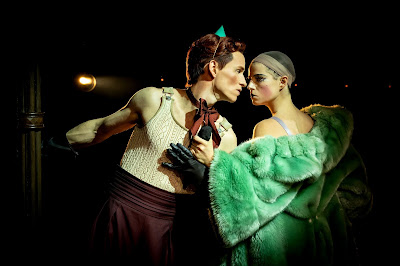
Eddie Redmayne and Jessie Buckley


In a remarkable transfiguration, London's Playhouse Theatre is ingeniously transformed by designer Tom Scutt to an in-the-round setting which after an equally imaginative pre-show mise en scene, goes a long way to transporting the audience to Berlin’s Kit Kat Club, the home of the show’s eponymous cabaret.

Rebecca Frecknall’s interpretation offers a bold take on the Kander & Ebb classic. The cabaret girls (“each and every one, a virgin”) are a chic metrosexual bunch, cleverly mixing 2021’s androgyny with Berlin’s famed inter-war decadence. The Kit Kat Club of course is a dive and rising from its deepest depths is the exquisitely ghastly Emcee, played in this iteration by Eddie Redmayne.

Cabaret’s Emcee is one of the most ingenious creations of late 20th century musical theatre. Almost like a Greek Chorus, or Lear’s Fool, he holds up a mirror to the Club’s audience (literally, in this staging, the theatre audience), parodying the hopes of the outside world (“Life is disappointing? Forget it”) while equally mocking the rise of Nazism and the persecution of the Jews. As Redmayne delivers If You Could See Her, the brutality of his satire chills to the bone. The actor is a tour de force throughout the piece such that when he is at times mute in the Finale, it only adds to the horrors that Germany as a nation will soon descend into.

Opposite the Kit Kat Club’s Emcee is of course the English cabaret artiste Sally Bowles. Jessie Buckley is sensational in her take on Bowles, bringing an understated haunting to the role. In her opening number Don’t Tell Mama, Buckley stuns with a polished insouciance that has the Kit Kat Club cheering for more. By the time the show is done however, and her Sally has both witnessed and experienced tragedy, Buckley’s take on the title number is breathtaking. Not for her the Broadway bravado of the song that one may perhaps associate with Liza Minnelli - rather, a delivery of Kander & Ebb’s signature tune that shows the singer to be broken and vulnerable. It is a stunning realisation of the song that shocks both in its despair and in quite how powerfully Buckley inverts the number’s traditional style into something far more poignant and haunting. I doubt that there will be a stronger performance to be found on London’s musical theatre scene for quite some time.

Redmayne and Buckley are surrounded by talent. Omari Douglas’ Clifford Bradshaw, a naïf to Berlin and the foil to the story’s piercing arc is assured and credible in his role. When late in the second act he is beaten up by Nazi thugs, there is a multi-faceted angle to the hate that he is subject to. Liza Sadovy as Fraulein Schneider, Berlin’s world-weary landlady, is gifted a number of musical opportunities, in which she shines, and her story too offers a sad wry glimpse into the country’s looming thunderstorm of fascism.

Fraulein Schneider’s two other tenants are the Jewish grocer Herr Schultz (Elliot Levey) and prostitute Fraulein Kost (Anna-Jane Casey).  Kander, Ebb and Joe Masteroff had a challenge in writing Schultz - as they sought to capture his pride in his German citizenship alongside his love for Schneider, while at all times keeping him wilfully blind to how the fate of German Jewry was to play out. It would have been easy to make Schultz a more soft and sentimental sop, but he is written (and here, played) perceptively, such that his future murder, that as a Jew he will likely face, plays out only in our minds, rather than on stage.

Casey is magnificent as Fraulein Kost, a small character who so skilfully depicts both Berlin’s depravity and its desperation. The gusto with which Kost joins in with Tomorrow is one of the most outstandingly simple depictions of the appeal of Hitler’s National Socialism to much of the German population.

Stewart Clarke’s Ernst Ludwig is the musical's face of Nazism, with Clarke cleverly capturing the ugliness of his role, at all times avoiding cliche and melodrama. As he leads the end of the first act with Tomorrow, it is a chastened and shocked audience that head out for their interval beers and ice-creams.

Jennifer Whyte’s musical direction of her 9-piece orchestra that boldly spans the auditorium is adroit, with Kander’s melodies being richly served. All her musicians are magnificent, but the guitar/banjo work from Sarah Freestone together with Matt French’s percussion are particularly distinctive and memorable.

With antisemitism again manifest on the streets of London, Cabaret has never been more relevant.


Booking until 1st October 2022
Photo credit: Marc Brenner

Monday, 23 December 2019

Curtains - Review

Wyndham’s Theatre, London


****


Music by John Kander
Lyrics by Fred Ebb
Book by Rupert Holmes
Directed by Paul Foster 


The company of Curtains


American songwriters Kander and Ebb are probably best-known for creating the smash-hit musicals Chicago and Cabaret. But now another of the duo’s creations Curtains,  currently in the middle of a UK tour, steps into the limelight in London’s West End replacing The Man In The White Suit at the Wyndham’s Theatre until early January. 

With a book by Rupert Holmes (based on an original book and concept by Peter Stone), Curtains is a musical comedy whodunnit which initially opened on Broadway two years after the death of Fred Ebb. When musical actress Jessica Cranshaw, star of Robin Hood and the weakest link in a Boston theatre company, is murdered during the curtain call on opening night, her fellow cast mates and crew are all put under the spotlight as suspects. Enter stage left Lieutenant Frank Cioffi (Jason Manford), who puts the theatre on lockdown while he interviews those under suspicion. A keen musical theatre fan himself, Cioffi soon gets wrapped up in Robin Hood and sets about trying to save the show whilst catching a killer. 

Boasting a unique concept, Curtains is a classic murder mystery which at the same time provides the audience with an amusing look behind of the scenes of a critically-panned musical. With a show-within-a-show concept, plenty of clever twists and turns and humour throughout, Curtains is an enjoyable production sure to be a hit with fans of musical theatre. The soundtrack is pleasing, with toe-tapping numbers like Show People alongside more amusing tunes such as The Woman’s Dead and What Kind of Man? (the latter of which takes aim at critics, and went down particularly well on press night). Unlike Kander and Ebb’s more renowned productions, the songs here sadly aren’t particularly memorable but they’re all performed well by the brilliant cast. The ensemble numbers however highlight both the show and the company’s talent, providing a visual treat for the audience thanks to Alistair David’s spectacular choreography and Paul Foster’s clever direction. The beauty of Curtains is that it doesn’t take itself too seriously, packed full of clichés, puns and delightful digs at critics. 

Jason Manford proves likeable and funny as the overly enthusiastic yet charming detective. Carley Stenson shines as Georgia Hendricks, one of the songwriters behind Robin Hood, while Andy Coxon does an equally great job as her ex Aaron, his rendition of ‘I Miss the Music’ one of the more touching moments of the show. Rebecca Lock is fantastic as the tough-edged producer Carmen and it is she and Samuel Holmes who very nearly steal the show. Holmes gets most of the best lines in his role as British director Christopher, delivering his many one-liners with a delightful dose of witty acerbic sarcasm.

Curtains makes for a warm and entertaining musical sure to leave you with a smile on your face and a spring in your step. With dazzling choreography, slick humour and top-notch performances it is well worth seeing this Christmas. 


Runs until 11th January 2020 before continuing its UK Tour
Reviewed by Kirsty Herrington
Photo credit: Richard Davenport

Thursday, 31 May 2018

The Rink - Review

Southwark Playhouse, London


*****


Music by John Kander
Lyrics by Fred Ebb
Book by Terrence McNally
Directed by Adam Lenson


Gemma Sutton and Caroline O'Connor

To read my fascinating interview with Caroline O'Connor, in which she talks about leaving Broadway to return to The Rink after 30 years, click here

The Rink, now on at the Southwark Playhouse for a month, is one of those shows that defines the beautiful potential of London’s off-West End theatre scene. A little known musical from giants Kander and Ebb, its first outing in the capital some thirty years ago was to be sadly short-lived. Here however, amidst Southwark’s humble thrust and away from the multi-million pound expectations of the mainstream commercial sector, there is an opportunity for this glitter-ball of a show to spin and sparkle.

With faint echoes of Sondheim’s Follies and just a hint of Rodgers and Hammerstein’s Carousel too, the action plays out in a dilapidated roller coaster rink somewhere on America’s eastern seaboard. Anna Antonelli is selling the place that has been a family heirloom for generations and as the removals team arrive to clear away the decades of detritus amassed over the years, so too does daughter Angel, estranged from her mother for the past 7 years. Kander and Ebb are masters of applying perceptive wit to life’s humdrum highs and lows that define the human condition, and over the course of just one day The Rink’s narrative explores, through a series of flashbacked vignettes, these two women’s stories.

Skating across the decades, Caroline O’Connor and Gemma Sutton are mother and daughter respectively. Both performers at the top of their game, the pair bring vocal magnificence combined with an acting ability in both word and song, that can convey the subtlest of messages, with the finely nuanced denouement of the final act proving a masterclass from both. O’Connor’s casting adds a further sparkle to the show. Thirty years ago she was one of London’s earliest Angels and this return across the Atlantic, from Broadway’s Anastasia to the modesty of London’s fringe, is an artistic commitment not often seen in today’s hardened money-driven world. O’Connor has a personal heritage that draws on Ireland, England and Australia - but witness her Anna Antonelli and one could swear she’s got Italian DNA too, such is her mastery of the passion and quick one-liners that define her character’s robust resilience.

Six men make up a supporting ensemble - dipping in and out of roles as needed. They are all magnificent and convincing. Stewart Clarke shines as Anna’s long lost husband Dino and there are equally gorgeous turns from a patriarchal Ross Dawes and Ben Redfern as Lenny, a kindly nebbish who’s held a candle for Anna since they were both kids.

Producers Jack Maple and Brian Zeilinger have imbued the highest standards in The Rink. Adam Lenson’s direction is carefully observed, in what is unquestionably his finest work to date while the choreography from Fabian Aloise is breathtakingly audacious. What Aloise achieves in a tiny space, with six guys on skates has to be seen to believed, with the audience’s grins dissolving into whoops of delight. Likewise Bec Chippendale’s set design - complete with panelled floor is another marvel. Rarely is decrepitude so perfectly portrayed with Matt Daw’s ingenious lighting, Tardis-like, transporting this boardwalk fun palace back and forth through the years.

Jason Winter, Michael Lin & Ross Dawes

Sat hidden above the action, Joe Bunker’s band make fine work of this all too rarely heard score. Indeed, from this critic’s personal perspective, it has been a long, long while since seeing a show for the very first time has led to its tunes still being compulsively hummed the next morning!

Yet again, Southwark Playhouse are delivering an outstanding musical for a fraction of the price of a West End ticket. If you love the genre, it's unmissable.


Runs until 23rd June 2018
Photo credit: Darren Bell

To read my fascinating interview with Caroline O'Connor, in which she talks about leaving Broadway to return to The Rink after 30 years, click here

Friday, 25 May 2018

Caroline O'Connor talks about returning to The Rink after 30 years


Gemma Sutton and Caroline O'Connor in rehearsal for The Rink

Commencing performances this week at the Southwark Playhouse, The Rink is a musical set in an American boardwalk-located roller skating rink that has long since seen better days. The show examines the relationship between the rink’s owner, Anna and her daughter Angel, two women who have grown apart over the years and written by Kander and Ebb, from Terrence McNally’s book, it is the rich complexity of human relationships that drives the narrative.
What makes this particular musical on London's fringe quite so mouthwatering however is its casting of Caroline O'Connor to play Anna. Thirty years ago, when the show first played in the West End, at London’s Cambridge Theatre,  a young O'Connor appeared as Angel.
O'Connor is making an incredibly bold and confident move in stepping back from an acclaimed Broadway run of Anastasia and heading instead to the humble surrounds of the Elephant and Castle. Over a beautifully sunny weekend during the show’s rehearsals, I caught up with O'Connor to talk not only about the show, but also her remarkable career.

JB:    Lets start with The Rink first time around. Tell me all about it....

Caroline:    Well, it was an amazing opportunity really. I'd been in the Me and My Girl original company and then Cabaret with the Gillian Lynne production and also A Chorus Line on national tour, playing Cassie, when the chance came along to cover Angel in the West End. Additionally, with a lot of leading ladies liking to take a show off of their schedule, (I was understudying Diane Langton) I was guaranteed one performance a week which seemed like a pretty good deal in those days.

Fred Ebb came over. John Kander was there so I had the two writers sitting in the auditorium on the day I did my first understudy call on stage, which was quite terrifying! But of course it was also thrilling for me, as a girl who grew up in Australia and just having arrived in England for a few years, to have the actual composers there in the room, along with Terrence McNally too.

Sadly the production did not last for very long and you could feel a great sense of loss amongst the theatre community. But now I feel like it's full circle. Perhaps, I was meant to come back and revisit this beautiful show and get to play the role of Anna. I'm the biggest fan in the world of Chita Rivera (who created the role of Anna on Broadway), she's such an inspiration to me. This show is huge.

JB:    Explain more, please, about the story and the themes of The Rink.

Caroline:    Well, it's a mother/daughter relationship. Angel is a young spirit, and she's gone away, like young people did at that period in the Woodstock kind of finding themselves and having more freedom. Anna however is this poor woman who’s  been left with this business to run, this rink, and her daughter's gone and she's kind of kept this thing going.

The rink belonged to her husband's family, for many years. And, suddenly, she's thinking, "You know what? I think I need some time for myself." And, as soon as she makes that decision, in walks the daughter again. And so kicks off an amazing story of: Will they connect or will they always have this fractious relationship?

It's not just us of course. There are six other men in the show who are brilliantly versatile and extremely talented. They play the show’s other roles, the wreckers, but they also play very important characters in the story, like husband, grandfather, love interest. Just terrific, beautiful voices, great talent.

Adam Lenson our director is rejigging it a little here and there and we have a brilliant choreographer too, Fabian Aloise, who did Working recently. I did West Side Story with him years ago, so we have a connection already. There is a young team around me, which is kind of exciting because of this energy that they bring, and they're all so excited and keen, and it's a lovely feeling in the room.

And Gemma Sutton who plays Angel in the show is just so very talented. I mean, from the moment we met, we just clicked and that's always a blessing when you're doing something where you have to work so closely. And, especially a relationship where it's not exactly a love fest!

JB:    The last time that I heard you sing in London was at The Kings Of Broadway concert at the Palace Theatre. You sang Time Heals Everything from Mack and Mabel that was just gorgeous. You of course played (an Olivier nominated) Mabel when the show opened in the West End in 1995.

Caroline:    Thank you. The most wonderful time I've probably ever had was doing that show. Of course I have loved pretty much everything I've ever done, but I loved Mack and Mabel because although it's a difficult show #I never found it as difficult as a lot of people who would always say, "Oh, the book's not that good."

I never found that a problem, because I felt like we told the truth about Mabel Normand’s life, and I thought she was worth celebrating. She was such an incredible person, not only as an actress, but she was the first female director, and there were so many elements and she just wore here heart on her sleeve.

I had a lot of help too. I met Mabel’s great- nephew and we discussed a lot about her, I saw photos, and he actually gave me a couple of gifts, of items that had belonged to her. So, I felt very fortunate that I had that real insight into her through that contact.

JB:    Tell me a little about your work in Kander & Ebb's Chicago – a show that you’ve played around the world: on Broadway and in Australia, as well as over here. 

Caroline:    I played Velma in Australia and on Broadway, I played Roxie at the Leicester Haymarket Theatre as well as in Lebanon. I've done the show quite a few times and actually I did Chicago twice in Australia, 11 years apart, would you believe! You have to get yourself incredibly fit for Velma, which I quite enjoy too when it's necessary. I was torn the last time, because I was very tempted to do Roxie again, but I’m lucky that I've been able to get to play both those roles. And, now, here with The Rink, this is kind of weird, because now I'm playing both of those roles too.

JB:    And what about your own story?

My parents were Irish so I got sent to Irish dancing classes. The school I went to taught ballet so I auditioned and got into the Royal Ballet School when I was 17. That brought me to London, so that's when I fell in love with London. When I went back to Australia at 19, I was like, "Do I keep going with the ballet or not?" I wasn't like, "Oh, I want to be a big star." That wasn't my mentality. It was always that I wanted to work in theatre. I wanted to learn and to work with great directors and choreographers and people. So, I'm glad that it happened that way, and I'm glad that my success came even if it was a little later, because I had such great training up until then. 

JB:    So, where is home for you now? 

Caroline:    I have homes in Surrey and Sydney and I am lucky enough to have worked all over the world and create a pretty amazing lifestyle and also a pretty amazing, understanding husband too. 

I met him when I was doing Cabaret here in London so, we've been together for 32 years and not everybody in the industry has that kind of support system. You know those sad, tragic stories you hear about people who're in theatre and they have a great career but they have nobody at home, or they have a bit of sadness, I feel really blessed that I've had this amazing, constant love and support in my life. Without sounding too corny, it's true. And, he also just loves what we do. He loves that we travel and that we're both very passionate about music and about theatre.

JB:    You walked away from Anastasia on Broadway to do The Rink. What lay behind that decision? 

Caroline:    People say to me, "why did you come back from New York to do a show at the Southwark Playhouse?” and my reply is because this is what I do. This is my work." I'm still in a black box. I'm still in a theatre. I'm still doing what I love to do, and I would've kicked myself if I hadn't done this. As hard as it is, I really would have kicked myself.

I could have stayed in Anastasia. I was invited to stay on in the show, and I was like, "No, I think I have to do this. I just feel in my heart I have to do it." And, now, some days I'm like, "oh, my God. This is huge. This is a huge" ... When I was playing Angel, I suppose I didn't appreciate how much Josephine Blake (London's original Anna) was doing in the role, and now I look at this mammoth script and mammoth emotional journey and the vocal demands of it. And, there's dancing, and there's a little skating, in brackets. A little. So, yeah, I just think, "Wow! But, my favourite thing is a challenge."


The Rink runs until 23rd June at the Southwark Playhouse
Photo credit: Darren Bell 

Tuesday, 1 May 2018

Chicago - Review

Phoenix Theatre, London


****


Music, lyrics and book by John Kander & Fred Ebb
Directed by Walter Bobbie


Cuba Gooding Jnr.

Returning to London after some years, Chicago proves why it is one of the longest ever running revivals to still be playing on Broadway. Kander & Ebb’s genius lies in focusing on complex, troubling aspects of humanity and viewing them through the prism of satirical musical theatre. But where their other works (say Cabaret or The Scottsboro Boys) have an underlying horror that rightly pricks our consciences, Chicago's guilty pleasure is that much of its satire proves to be deliciously enjoyable.

The action mainly plays out in Illinois’ Cook County jail where female felon Velma Kelly (who had murdered her husband and his lover as they were caught in-flagrante) finds herself joined by new inmate Roxie Hart (who had shot her lover as he walked out on her). In their quest for liberty rather than the gallows, both women hire celebrity lawyer Billy Flynn to fight their case. Flynn in turn, much like a modern-day Mark Anthony (or should that be Max Clifford?) seeks to play to the public’s emotions and outcries by garnering as much press coverage as he can for his sensational clients in the hope of achieving their acquittal.

Over the years, and on both sides of the Atlantic, Chicago's producers have acquired a reputation for parachuting celebrities into leading roles, with little regard to their song or dance expertise, but rather with an eye on their ability to bring a different star quality to the show, as well as to get bums on seats. So it is here, with Hollywood leading man (and Oscar winner) Cuba Gooding Jnr making his West End debut as Billy Flynn. While Gooding Jnr may not have the finest voice, he delivers impact, presence and above all credibility to the smooth-talking shyster he portrays. The wicked twinkle that he brings to Flynn more than justifies the producers’ gamble in hiring him.

Elsewhere however there is musical theatre excellence as Josefina Gabrielle brings a sultry wisdom, alongside a vocal and physical athleticism to Velma. A veteran of the London show from the last time around (where she played Roxie), hers is an assured, delightful interpretation. Also back in the London show, Sarah Soetaert reprises her Roxie Hart in a solid performance that doesn’t disappoint.

The eye-opening casting, aside from Cuba Gooding Jnr., is Ruthie Henshall who completes a personal hat-trick with the show by playing jailer Mamma Morton. Seasons past have seen Henshall not only play Velma, but also be London's first ever Roxie when Chicago opened at the Adelphi Theatre in 1997. Henshall may not have quite the burlesque/statuesque presence that When You’re Good to Mamma demands, but her vocals are unsurpassed. She and Gabrielle make the duet Class, class.

There’s fun stuff too from Paul Rider as the ineptly cuckolded Amos Hart, jazz-handedly delivering Mister Cellophane to one of the evening’s loudest cheers.

Choreographed by Ann Reinking in the style of Bob Fosse, this staging which is now into its third decade, speaks of a world that is highly sexually charged. The costumes are provocative with both men and women (aside from the two male leads)scantily clad, in outfits outlining provocative sexuality. Recent months of course have seen sexual politics being radically re-evaluated, and against that backdrop it is interesting to consider Chicago's own distinct stance on the matter. Kelly, Hart and Flynn understand the power of sex, while the Cell Block Tango number is a celebration of women who (for the most part) have exacted righteous retribution on the disappointing or treacherous men in their life. It's a complex argument for sure but at least within its on-stage iteration, Chicago's women are victors rather than victims.  

Chicago remains fine Fosseian musical theatre. Strong story, stylish dance, and Kander & Ebb’s brilliant songs. Class, indeed.


Booking until 6th October
Photo credit: Tristram Kenton

Wednesday, 18 April 2018

Josefina Gabrielle talks about Chicago

Sarah Soetaert and Josefina Gabrielle

As Chicago returns to London, I spoke with Josefina Gabrielle who as Velma is sharing the show’s leading credits, about the piece and her career.

Josefina:    Well, it's the longest running American musical. It's been running for 21 years on Broadway and it is wonderful to have it back in the West End. Chicago holds a very dear place in my heart, because I've had so many wonderful experiences with it. And I also have to admit an obsession with it too! Before I’d even saw the show, the original cast album had been a favourite of mine. I love to watch it and I love being in it.

It also has a real international appeal. Not only do theatre lovers come to see the show, but it brings other audiences too. It makes me feel very proud, and Cuba Gooding Jr., by the way, is a diamond. We love him, an absolute superstar. He's a true star - a lovely, warm, funny man and an excellent company leader too. And of course, to work with Ruthie Henshall is a privilege and a dream. I've followed her for years and admired her and we've meet socially on occasions too, but to finally get to work together, and to sing Class with such a classy lady, is a thrill.

JB:    You’re playing Velma but when Chicago was last in town you played Roxie. Tell me about that contrast.

Josefina:    It is terribly interesting, because I played Roxie for the first time, 18 years ago. I went in and out of Chicago on various occasions during its run. I think the last time I was involved as 10 years ago. So now I am Velma watching Roxie, having been Roxie watching Velma.

I suppose, maybe because of who I am now, 18 years later, my Velma certainly feels very grown up. Looking back at Roxie, I felt more sort of twinkly and girlie then. Now I feel more calculating, more of a planner, whereas Roxie didn't really think about consequences. She sort of turns on a six pence and just cleans up as she goes along, whereas Velma is more calculating. 

JB:    You’ve played a number of phenomenal roles in recent years. What have you brought from your experience to date, to add to your take on Velma?

Josefina:    Interestingly and thinking of Merrily We Roll Along from four years ago, I've tapped into Gussie quite a few times. 

JB:    The sexual politics of Chicago take on a different hue post-Weinstein. This production’s publicity shots follow the tradition of presenting Roxie, Velma and here, Mama Morton too, clad in underwear, while Billy Flynn (and Amos) remain fully clothed. How can that styling be explained, today?

Josefina:    I feel that the entire company, men and women, with the exception of Billy and Amos maybe, are owning their life with sexuality and physicality. Fosse is such a very strong, wonderful style of choreography, and we are wearing outfits and costumes that represent that style of the show and its dance.

If you think of any ballet company, any dance company, it's no different. It is a dance and singing and acting show, so you're covering everything, really. I don't feel anyone is being exploited or feeling weak, because of what they're wearing. 

JB:    Tell me your thoughts on performing Kander and Ebb's work. 

Josefina:    My experience with Kander and Ebb and also Rodgers and Hammerstein are that the subjects that they pick are so fascinating and very often ahead of their times. How they portray those subjects, the structure of the shows and the music is just so wonderful, such brilliant numbers, that is it pure, pure entertainment that really sort of picks you up and makes you soar, soar as in fly to the sky.

But when you really think about the message that you're putting across, it is wonderful food for thought of the whole sensationalising criminal behaviour in Chicago. Cabaret with the rise of the Nazis in Berlin. They touch on such fascinating subjects, moving you. And then, when you explore what you've celebrated, it opens your eyes. It's wonderful. 

JB:    I'm glad that you touched upon Rodgers and Hammerstein because the first time that I came across your work was at the National Theatre 20 years ago in Trevor Nunn’s remarkable Oklahoma! What do you mean by those composers being "ahead of their time"?

Josefina:    Well I've done three Rodgers and Hammersteins now. Oklahoma!, Carousel and The King and I and every time it's an education. It's the birth of a nation in Oklahoma! as that state was just coming into existence. The musical is about the land rush, starting from scratch and setting up communities. That's an entire education on the history of the birth of a state.

The King and I is all about cultural differences. Where you believe yourself to be superior, because you think you know better, but then another culture opens your eyes to your ignorance and you learn from each other. It's always been a wonderful education, and a sort of sense of coming home to, every time I've done a Rodgers and Hammerstein – the material is just so rich. 

JB:    And of course you are one of the few West End leading ladies to have played opposite Hugh Jackman!

Josefina:    Yes. I mean on stage, it's just me, isn't it?

JB:    And now, together with Ruthie Henshall and Sarah Soetaert, you can add Cuba Gooding Jnr to that tally too!


Chicago plays at the Phoenix Theatre and is booking until 6th October.


Photo credit: Tristram Kenton


Tuesday, 11 October 2016

Chicago The Musical - Review

Churchill Theatre, Bromley


*****

Lyrics by Fred Ebb
Music by John Kander
Book by Fred Ebb and Bob Fosse
Directed by Walter Bobbie


John Partridge and Hayley Tamaddon

Were it not for a young reporter - Maurine Dallas Watkins - being assigned to cover the trials of women accused of murder, for the Chicago Tribune, the world would have missed out on the long-running musical named after that same city. Some very real characters from the early 20th century provided the inspiration for iconic names such as Roxie Hart, Velma Kelly and Billy Flynn - all of whom are brilliantly brought to life by the cast of Chicago The Musical, currently touring the UK.

The tale of murder, deception and glamour is played out against the backdrop of Cook County Jail, where dazzling black costumes and stage lights replace orange jumpsuits and jail bars. The media's morbid fascination with some of its more attractive criminals enables Roxie and Velma to engineer a route to a new life of celebrity.

A social commentary on fame and justice - but more than that, Chicago is a fast-paced extravaganza, whirling through iconic numbers such as All That Jazz, Razzle Dazzle and Cell Block Tango with the cast and orchestra never missing a beat, step or line. 

The principals in this line-up are equally strong, each bringing stellar vocals and a convincing embodiment of their characters to the stage. Jessie Wallace as Mama Morton, John Partridge as Billy Flynn and Neil Ditt as Amos Hart blow the audience away with their solos but are also a joy to watch working with the rest of the cast. Hayley Tamaddon's Roxie and Sophie Carmen-Jones' Velma both play beautifully off against each other, shining while on stage every time. 

The chorus also puts on an impressive show, seamlessly transitioning from scene to scene while retaining a high level of energy throughout. Gary Chryst's recreation of Bob Fosse's choreography and Ann Reinking's original choreography transports the audience back to the roaring 1920s but never feels dated. 

The orchestra is the other star of the show. Under Léon Charles' direction, the score is slick and cheeky and the musicians - centre stage throughout - work beautifully with the actors. The clever staging also ensures that the stage never feels cramped or that it is a touring production. 

Particularly striking is the absence of a dull moment. The show starts with a literal bang and, never resting on its laurels, continues to ramp up the momentum throughout. As Velma and Mama Morton muse about the notion of class, the answer is evident - it's all being held by this production of Chicago.  


Runs until 15th October, then tours
Reviewed by Bhakti Gajjar
Photo credit Catherine Ashmore

Thursday, 4 February 2016

The World Goes Round - Review

St James' Theatre, London


****

Sally Samad, Oliver Tompsett, Debbie Kurup, Steffan Lloyd-Evans, Alexandra Da Silva


Kander & Ebb's repertoire is famously bleak with musicals that have focused on the rise of Nazism, torture and misery in a Latin American jail, racism in the Deep South and celebrity criminals and corruption in Chicago. Their shows are challenging, often making for very uncomfortable entertainment. So it makes for quite a paradox that The World Goes Round offers an evening of delightful musical theatre treats. Conceived some 25 years ago, it was Susan Stroman and David Thompson together with Scott Ellis who put together this eclectic selection that referenced all the composers' musicals to date (though of course omitting The Scottsboro Boys which had yet to be written.)

Now on for one week only at the St James' Studio, there's an understated aura of finesse that surrounds this revival. Debbie Kurup leads an accomplished vocal quintet and with a nod to her Velma Kelly, makes fine work of Chicago's All That Jazz. There’s a measured quality elsewhere from Kurup with a neatly stylish opening take on the revue's title number and a sensational duet in the second half alongside Alexandra Da Silva, the women giving a perfect interpretation of The Grass Is Always Greener from the not so well known Woman Of The Year. 

Da Silva's acting through song proves to be one of the evening's highlights, kicking off the second half with Ring Them Bells. Sally Samad completes the female trio - and proves her credentials in (another) duet with Da Silva, Class from Chicago perfectly capturing the number's wry irony.

Oliver Tompsett and Steffan Lloyd-Evans provide the evening's tenor tones, never bettered than with Tompsett's I Don't Remember You segueing sweetly into Lloyd-Evans' take on Sometimes A Day Goes By - though a nod too for Lloyd-Evans' Mr Cellophane that captures the song's wit and pathos. 

It makes for a novel twist to hear Cabaret actually sung in cabaret - and the five-voice arrangement, accompanied mainly by Rhys Lovell's bass, offers a refreshing interpretation of one of the Songbook's greats. Kris Rawlinson's four piece band are on point throughout, lending a polished turn to the show's arrangements.

In a set that's crammed with the familiar as well as the obscure, The World Goes Round makes for a gig of unadulterated charm.


Runs until 7th February 2016

Saturday, 21 February 2015

Scottsboro - My Journey to Alabama

The sign above the platform at Scottsboro Railroad Station

This weekend sees Kander and Ebb's The Scottsboro Boys come to the sold-out end of its acclaimed West End run, a troubling yet brilliant show that first stunned London back in December 2013 at the Young Vic. I knew nothing of this chapter of American history before seeing Susan Stroman's production, but I was to leave the Young Vic stunned by the musical's technical and stylish genius and deeply moved by its tragic tale.

My journey to Scottsboro actually began in autumn last year. The show was about to transfer to the West End's Garrick Theatre and I had been invited to interview flown-over Broadway star James T. Lane, together with whirlwind New York impresario Catherine Schreiber who (along with Paula Marie Black and the Young Vic) was producing. As our conversation ended and the microphone was switched off, a chance remark led me to mention to Catherine that I had an impending business trip to visit clients across the USA. As I outlined my intinerary, Schreiber commented that one of the towns on my route was barely an hour's drive from Scottsboro and how I must visit the museum that marks the Scottsboro Boys' story. She made the necessary introductions and very soon I was in touch with the museum's founder and director, Shelia Washington.  

So it was that one overcast October morning last year I found myself deep in America's Deep South, driving along Alabama's stretch of the Lee Highway and heading for Scottsboro. My car's GPS (sat-nav) suggested that I detour from the fast route and follow the last ten miles into town along an old country lane that hugged the tracks of the Southern Railroad line. The show’s New York cast recording (a London recording is to be released soon) was playing in the car and as trees, track and churches sped by, the emotional power of heading towards that humble Southern town, now stained with one of the last century's most terrible miscarriages of justice, became quite overpowering. I could not have guessed that I was shortly to experience one of the most humbling and inspirational days of my life. 

Writing in The Guardian two years ago, Ed Pilkington succinctly describes the events that led to the arrest of the Scottsboro Boys.

Paradoxically, the Scottsboro Nine had nothing to do with Scottsboro. On the night of 25 March 1931 the boys – the youngest 12, the oldest 19 – were hoboing on a freight train heading west to Memphis, Tennessee, when some of them got into a fight with a group of white youths. The white boys jumped off the train as it passed through the Scottsboro area and complained to the local sheriff that they had been attacked and with that one dubious claim Southern justice cranked into motion. 
The view from Scottsboro platform. The Boys' train came from this direction

By the time the train reached the next stop a posse of armed local white men had formed and the group went from carriage to carriage, arresting all the blacks they could find. As they were searching the train, they also came across two white women, Victoria Price and Ruby Bates.
The view from Scottsboro platform. The Boys' train headed towards this direction

It's hard from the distance of 80 years to appreciate fully what it meant for white women to be found even in the vicinity of black men in 1931. Any physical contact, however remote, was taboo.
That taboo probably explains why one of the women, Price, invented the story that she and Bates had been gang raped – it was a ruse to avoid any risk of being jailed overnight herself. For the black young men accused of raping the two white woman, the risk was of a different magnitude. In the 1930s Deep South it meant only one thing: death. As the Arkansas poet John Gould Fletcher put it, if a white woman swears that a black man even tried to rape her, "we see to it that the Negro is executed".
When the nine terrified boys were taken to the nearest town, Scottsboro and put in the local jail, there was only one question that needed settling: would they be executed judicially or at the end of a rope slung from the nearest tree. There were 13 lynchings in the US in 1931 and the nine came very close to dramatically inflating that figure – the sheriff had to call in the National Guard to hold back a large and angry mob.

Although Scottsboro is the seat of surrounding Jackson County, its town square is surprisingly quiet. There is a tiny shopping plaza that includes a US Marines recruiting centre, whilst around the corner is the proudly emblazoned Scottsboro Gun & Pawn store. By American standards it’s a very small city, lacking even a town centre McDonalds. On realising that I had ventured out without a notepad, the writer's essential tool, I looked around the square to purchase a replacement. There was neither a stationers nor a supermarket to hand but I did spot a homely looking gifts and trinkets store. Wandering in, the charming owner and a true Alabama Lady for sure, helped me out by selling me a blank notepad from her stock of admin supplies. I was profoundly grateful and we struck up a brief conversation for a visiting Englishman turns out to be a rare event in Scottsboro. It was when this delightful shopkeeper asked me why I was in town and I explained that I was there to meet Shelia Washington at the museum, that the hitherto famously warm Southern hospitality turned icy.

Lee Highway, Jackson County ..... there's a pattern emerging in these names. Those men were the Confederate heroes of the American Civil War, who took the South’s battles to the North and ultimately lost. And while time and (some) legislation has moved on, many troubling old attitudes still straddle the Mason Dixon Line. Where most local authorities provide some funding to museums or places of culture within their jurisdiction, Washington was to tell me that the Scottsboro city fathers offer her museum no cash whatsoever. Not one dollar. Her revelation chilled me, for whilst the Jim Crow days may be gone, Scottsboro still remains a town struggling with its identity.


The Scottsboro Boys Museum
The museum is sat next to the eponymous railroad line and as I parked my car, what seemed like a never-ending freight train was rolling by. Travelling slow, it blew its beautiful mournful two-tone horn, an iconic sound that so defines an American train. Aside from the fact that trains fascinate me, I was transfixed. I stood, watched and listened before knocking on the museum door.

Created in a now de-consecrated church and where the former chapel is still filled with pews, it was in this tiny hall in April 2013 that Alabama's Governor Bentley signed the State’s Senate Bill and House Resolution that formally pardoned and exonerated the Scottsboro Boys. If Schreiber is a powerhouse of theatre-producing, then Washington is a beacon to those who campaign for racial equality. She drove the campaign that led to the Scottsboro Boys' exoneration and amongst the good people of the South, she is a hero. 

Aside from an unexpected flurry of media interest, where two local newspapers and a TV news station had turned out to cover my visit, (for media link see below) I was touched that not only had Washington opened the museum specially for me (it usually opens twice a month), but that most of its Board of Trustees had turned out to meet with me too. I met with Caroline Lynch, the daughter of the now long deceased Dr Marvin Lynch and one of the two doctors who examined the women on the night of the alleged rapes, finding no evidence of sexual assault. The doctor truthfully reported his findings at the time, but they were ignored by the Scottsboro prosecutors as an inconvenient truth. It was not until some years later, that the medic felt safe enough to re-assert his clinical evidence.


Caroline Lynch

It is important to remember that amidst the evil turmoil that surrounded the Scottsboro Boys' wrongful arrest, there were acts of principled bravery from a number of white people. Most heroic perhaps was Scottsboro's Sheriff Matt Wann who supervised the shepherding of the boys, away from the baying mob, to the comparative safety of the town's jail on the night of the arrests. I met with Scottsboro citizen Clyde Broadway, who told of his uncle being tasked by Sheriff Wann to "go buy a skein of rope" to help corral the boys and keep them huddled together away from the crowds. One year later, Wann was to be shot dead on duty.


Clyde Broadway

But what of Shelia Washington and what drives this remarkable woman? Pilkington writes: 
Young Shelia Washington had never heard a single word of the story of the "Scottsboro Boys", as they were then called, despite having been born and brought up in the small town where such visceral history had been made. When her father found her reading the memoir he snatched the volume from her hands and ordered her never to open it again. "He said he didn't want me to know the harmful things that were contained inside," she says.
Shelia Washington

It is Washington's understated strength and conviction that is so profoundly humbling. She told me of her brother who had been brutally murdered in jail whilst serving his sentence. His killers had never been formally identified, let alone brought to justice and Washington is convinced that the murder was racially motivated. She believes she knows the identity of his killers too, but resignedly accepts that there is little she can do to achieve justice for her dead brother. It has been the harnessing of her rage at the injustice meted out to her brother that sparked her to champion the cause of the Scottsboro Boys. Even as I write this, Washington’s next mission is to locate and to mark the burial places of each of the nine men. Her commitment is unshakeable.

Against a backdrop of endemic racism, The Scottsboro Boys’ trials were to prove a focal point for the nation at that time, though as 87 year-old composer John Kander was to tell me recently:
I remembered that when I was just learning to read I would see on the newspaper, pretty much daily in those early reading days, something about The Scottsboro Boys. I didn't know what that was or who they were, but they were always mentioned, they were always called that title. As I began to be able to read and understand more, it seemed to me that they were always spoken of as a group. Then they disappeared altogether.
Whilst the story might have disappeared from the national headlines, it had already cemented a foundation for the emergent American civil rights movement. Rosa Parks, one of the key civil rights figures in the 1950s was a steadfast campaigner for the Scottsboro Boys and she in turn was to inspire the support of Martin Luther King. 

Recent events in the USA and elsewhere in the world tell us that the essential cause of the Scottsboro Boys is a fight that still goes on, with America in particular still having deep issues to address. Speaking in the Scottsboro Boys Museum on the day of Governor Bentley’s pardon, Alabama’s Representative Laura Hall said: 


Hopefully, our great State of Alabama can be Alabama the Beautiful, where justice is dispensed equally and fairly without regard to race, sex, social class or religious belief.

Hall’s is a noble hope, sincerely to be commended, but there is much to be done to realise it. It is to the credit of Scottsboro’s Shelia Washington however, that such momentous progress has already been achieved.


Media Links:

Click here to visit the website of The Scottsboro Boys Museum