Friday, 7 October 2016

This Little Life Of Mine - Review

Park Theatre, London


**


Written and directed by Michael Yale 
With music by Charlie Round-Turner


James Robinson and Kate Batter

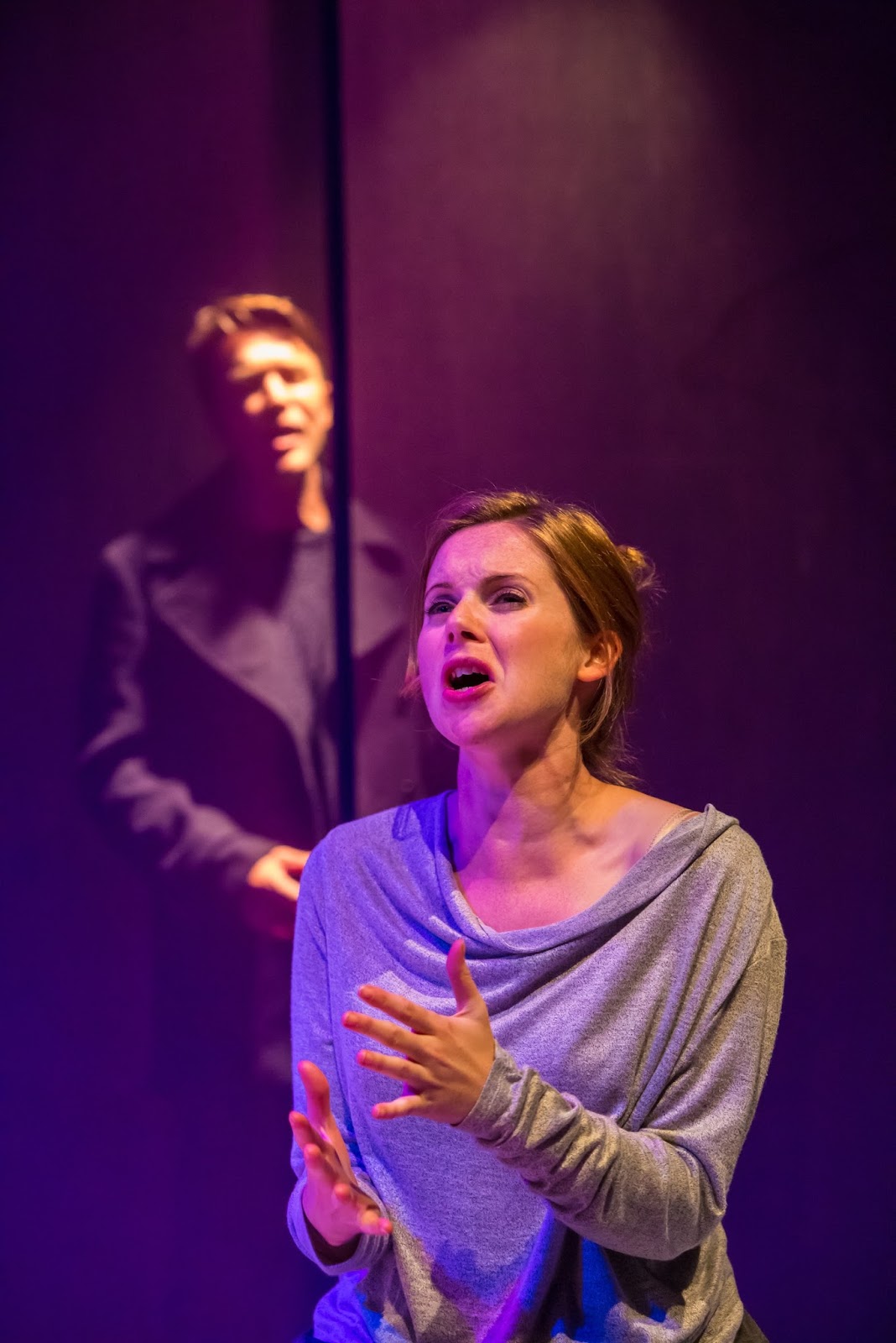
The strapline to This Little Life of Mine invites us to "be at the birth of a brand new British musical". This is all well and good, but unfortunately aside from being "brand new " and, to be fair, an astonishingly good performance from Kate Batter as leading lady Izzy, there is little else to redeem this show.

Michael Yale (who also directs) has compiled a glimpse into the lives of a young couple, Izzy and Jonesy (James Robinson) as they set up home in today's high rent, cappuccino infused capital, subjecting them to a handful of recognisable but cliched vignettes along the way.

Its all very humdrum and unremarkable and that's just not good enough. For a musical to transport its audience to the highs and lows of the human condition (and surely that is what good musical theatre is all about) there must be sharp, witty lyrics, memorable tunes and standout performances. Sadly, with only a few exceptions, Yale and his composer Charlie Round-Turner subject their cast to little more than a barrage of stereotypical set pieces, which in the second half descend into dire predictability.

Batter puts in a fine turn, with a striking presence and voice that sometimes hints at her desperation for a child. The shallowness of the script however suggests that a woman's creative input in this show has been much missed. Yale fails to convince us in his documenting the depths of desperately female angst. There is at times an awkward schoolboy clumsiness to his writing, highlighted in the naïveté with which he has his characters handle the profound sadness of a miscarriage.

Other writers tackle such complexities with aplomb. Across the Atlantic, Sara Bareilles offers an acute understanding of the modern woman in Waitress, whilst Jason Robert Brown's The Last 5 Years is a masterclass in understanding how a deeply loving relationship between two young people can both grow and yet soon be extinguished. 

Elsewhere Greg Barnett and Caroline Deverill make the best of the script in fleshing out their multitude of supporting characters.


Runs until 29th October
Photo credit: Charlie Round-Turner

Thursday, 6 October 2016

Murder Ballad - Review

Arts Theatre, London


****


Conceived by and with book and lyrics by Julia Jordan
Music and lyrics by Juliana Nash
Directed by Sam Yates

Read my interview with Kerry Ellis and Norman Bowman here
Kerry Ellis, Ramin Karimloo, Norman Bowman


In yet another example of exciting new writing to appear in London, Murder Ballad opens at the Arts Theatre following its original a brief run off-Broadway. This first collaboration between Julia Jordan and Juliana Nash sees the show’s female writers choose the classical plot structure of a high octane love triangle and a woman torn between two men, with Jordan and Nash proving that that sometimes; the oldest storylines can still be the best.

Notwithstanding its title, the work avoids a feast of all too common self-indulgent balladry, plumping instead for a heavily rock based score full of exciting guitar riffs, punctuated by a pulsating percussive undertone with Sean Green's band doing a fine job throughout the sung-through show.

Set in modern day New York, Sara's passionate relationship with the gorgeously masculine and muscular Tom ends suddenly. Rebounding into the loving, caring arms of Michael who's educated, compassionate and everything that Tom isn't, their love develops into marriage and parenthood. A chance encounter years later between Sara and Tom sees a mutually lustful desire fatally re-ignited.

What sets this show apart from most other emerging productions is its casting. Of the four lead roles, two are filled by actors more used to headlining casts in multi-million pound West End or Broadway productions, rather than the more intimate environs of the modestly budgeted Arts.

Kerry Ellis is Sara, playing a role that she herself has described as being a woman who’s "a rock star in a mother's body". Very much an everywoman (and so much more so than cinema's saccharine Bridget Jones currently swamping the multiplexes) Ellis nails Sara's complex emotions, juggling her primal lustful yearnings for Tom's passion against the betrayal of the family that she’s built. Magnificent in both voice and presence and under the scrutiny of the venue's compact space, Ellis delivers a knockout performance.

The source of her understandably weak-kneed desire is Ramin Karimloo's Tom. Spending much of the gig shirtless, the ripped Karimloo demonstrates that the inked body art he sports on his left arm is as impressive as his renowned musical theatre ability. In a gender-reversed definition of pure theatrical Viagra, he brings a ravishing guttural energy to his performance. If Ellis is an everywoman on stage, then Karimloo is for (nearly) every woman in the audience.

It's a tough gig to be cast against Ramin's ramming, rampant potency, but Norman Bowman's Michael rises to the occasion magnificently. His love for Sara is sincerely played out and Bowman who with as much Shakespeare as musical theatre to his recent credit, must surely be ranked as one of our finer performers. His character, a kindly homemaker is not the easiest to portray with an engaging sympathy, but as ever, Bowman pulls it off with charm and flair. 

Completing the quartet of leads, Victoria Hamilton-Barritt takes on the chameleon-esque role of Narrator, guiding the narrative as it plays out across Manhattan. As ever beautifully voiced, Hamilton-Barritt offers her own seductive charm to the evening as the doomed denouement looms.

Sam Yates directs intelligently with a clever use of simple revolves and ingenious projections to transport us through time and place.

Shows this sassy don’t come along that often. Poignant, punchy and perfectly performed, Murder Ballad drips with desire.  


Runs until 3rd December
Photo credit: Marc Brenner

Kerry Ellis and Norman Bowman talk about Murder Ballad


As Murder Ballad opens at the Arts Theatre, I with spoke two of its quartet of performers, Kerry Ellis and Norman Bowman to learn a little more about the show.
Update - You can read my review of Murder Ballad here

JB: Kerry, tell me about the show.

KE: It's a very intimate show, it's a four-hander with, obviously, Ramin, Norman, Victoria and myself. It's at the Arts Theatre, with the lovely Sam Yates directing us.

Murder Ballad has only been performed once before and that was off-Broadway, so it's a very new thing. It's got a bit of rock music in, a bit of country, a bit of musical theatre. It is completely sung through, it deals with real people's situations and, obviously, there's a murder, but I'm not going to tell you who did it!
NB: Kerry pretty much summed it up quite well. It's funny because I've been describing it exactly the same way, as kind of a rock, country piece based on, I think, a very traditional principle of a love triangle. I'm very excited, it's a stellar cast and I just think it's wonderful. 

JB: Tell me about your respective characters, to the extent that you are able to. Norman, I'll start with you. 

NB: I play Michael and I keep wanting to say he's the sensible one of the story in some respects.

If people have any knowledge of those kinds of relationships that a woman will sometimes go for the dark, edgy character, the bad boy, for a thrill, and sometimes the sensible guy for marriage. It's a bit like that game, "sleep with, marry, or murder” I think Michael is the one that you would end up marrying. I guess he wants to be a bit edgier in places, maybe that's why he falls for Kerry's character like he does, because everybody likes a bad girl too.
JB: And Kerry, what about your character Sara?
KE: I guess in a way she’s quite typical. She has a relationship in her younger years and then that kind of breaks down and she moves on and meets Michael and they have their relationship. She talks through having a child and all of that, and then things go wrong, dealing with all of that too.

She's a little bit dangerous, I guess. She had dreams when she was younger to be a rock star and that didn't work out, so I think when she becomes a mother and gets into that routine lifestyle, she craves a bit of that youth and excitement, to be a rock star again. 

I think she's a bit of a rock star in a mother's body! Something I can relate to a little bit!

JB: Who is the show going to appeal to?

NB: Anybody interested in relatively new musical theatre. This is such an unknown quantity to a lot of people. I think that the advertising campaign is great. I think it's been very clever, very catchy. 
KE: I think what's interesting, for me especially, is just that it's so raw and intimate that it's quite exposing. For me, I'm kind of used to doing big, glitzy musical theatre. Costumes, lights, sound, all that kind of showy stuff. This is very raw. It's four regular people telling their story and it's very close. 
NB: It's bringing more of the fringe values into town. 

JB: Norman, what do you mean by "fringe" values?

NB: Fringe values, for me, first of all, they always tend to be a bit more bite sized. They're about shows that are not there for the duration, to run for years and years. They have a known shelf life and I think, as a result of that, something else is given to those productions. 

I know, of course, at the end of the day, it's a business and people still need to make their money back, but a fringe show is not always about the money. It's about putting something on; from beginning to end that is something for the audience. I think it represents great value for money, to be honest.
I know that if you go and see something like Wicked and you pay top dollar for it, you're helping to fund a big production that’s got enormous running costs. When you bring all of the running costs down and you go into something as intimate as the Arts, it can say more about the content that you're going to see, rather than lavish production values.

JB: The show's already extended before it opened, which is good news. Was that something you were expecting to happen?

NB: I wasn't surprised, knowing that Kerry and Ramin were attached to it. I don't mean that as a disservice to either myself or Vic, because we both have worked solidly for a long period of time, but if you're looking to bring audiences in then you need people with that extraordinary profile. 
 
JB: Kerry?

KE: I'm blushing now. Thank you, Norman, that was very kind of you.

NB: It's very true.

KE: Likewise, I think what attracted me to it was the fact that it's an incredible cast. We all come from slightly different areas and that's what's exciting, for me especially.

JB:   Kerry and Norman, thank you both and break a leg with the show!

Murder Ballad plays at London's Arts Theatre until 3rd December 2016
Saturday, 24 September 2016

The Hired Man In Concert - Review

Cadogan Hall, London


****


Music and lyrics by Howard Goodall
Book and narration by Melvyn Bragg
Directed by Samuel Hopkins


It is all too rare that an established musical is performed as a stand-alone concert. Taking the rich beauty of Howard Goodall's score and having it sung by some of the industry's biggest names, it was no wonder that The Hired Man in Concert, for one night only, was a hot ticket. Not just that the leads were joined by an onstage ensemble and accompanied by a stunning 14 piece orchestra, conducted beautifully by Andrew Linnie, narration was also delivered at various points, by none other than the book's author, Melvyn Bragg. 

Set in England around the turn of the 20th century, The Hired Man focuses on the day to day life of those who lived on and worked the Cumbrian farms out on the fells and who were inevitably to go off and fight in the Great War. From the outset Goodall's score richly defines atmosphere and emotion, going hand in hand with events as they unfold. For audience members the piece is a roller coaster of emotions and the celebratory highs and tragic lows were not lost within this concert version. 

Amongst the cast there wasn't a weak link to be found, particularly amongst the vocal power houses of the leading voices. However while all seven leads delivered excellence, it was a shame that all referred frequently to script and score in front of them, detracting from the power of both spoken and sung performances. Hiccups aside, the cast delivered sterling performances.

Jenna Russell's Emily Tallentire bubbled with detail and nuance in all the moments of her character's uncertainty, while John Owen-Jones made Goodall's music sound easy, adding just the right amount of passion and struggle. Both performers are so well known for so much, but tonight it was just a treat to hear them get their vocal teeth stuck into Goodall's mellifluous melodies.

And for the aficionados in the crowd, there was the neatest of touches. On stage and in a marvellous performance singing the role of Seth Tallentire (John’s brother) was Stewart Clarke. It had been Clarke’s parents Paul Clarkson and Julia Hills who’d played John and Emily in 1984 when the show premiered in the West End. 

Director Samuel Hopkins ensured that the minimal staging complimented rather than confused proceedings. Simple costuming gave a sense of each of the characters' backgrounds, while stunning projections filled the immense white back drop of the Cadogan Hall's rear wall. Those images, alongside Bragg's narration, were welcome sign posts guiding the audience through the show's key settings and contextual changes. 

Notwithstanding a few teething issues (be easily forgiven in a one night only gig) the show still captivated its audience, the concert format bringing a magnifying glass to Goodall's stunning score. This is without doubt one of the most beautiful pieces of British Musical Theatre and after this concert treatment, one cannot help but feel that The Hired Man needs another outing in London's West End.


Reviewed by: Andrew Milton

Friday, 23 September 2016

No Man's Land - Review

Wyndhams Theatre, London


*****

Written by Harold Pinter
Directed by Sean Mathias


Ian McKellen and Patrick Stewart

Every once in a while the theatrical planets align to create a pairing of such fine actors that it may well be unmatched for a generation. So it is with Harold Pinter's absurdist gem No Man's Land, a work that’s always best played by starry knights. Ralph Richardson and John Gielgud first created Pinter’s curious curmudgeons during the National Theatre's residency at the Old Vic in 1975. Today the honours fall to Ian McKellen and Patrick Stewart who again re-unite to lead an evening of theatre that remains as perplexing as it is entertaining.

In their twilight years Hirst (Stewart) and Spooner (McKellen) chance upon each other in a pub on Hampstead Heath before retiring to Hirst's nearby mansion. We learn that both men have literary achievements of varying pedigree, but while the wealthy and patrician Hirst still exudes an air of the virile masculinity that that made him an accomplished ladies’ man in years past, Spooner, the shabbier by far, is a down on his luck gay poet who spends his time earning a few bob collecting glasses in another local pub and spying on clandestine homosexual liaisons on the Heath. As the alcohol flows, the bleakness of their respective no man's lands of old age gradually emerges.

It wouldn’t be Pinter without a sinister undertone, injected here by two younger men, Foster and Briggs (Damien Molony and Owen Teale respectively) who also reside with Hirst. Quite what or who they are isn’t defined, though the suggestion that they are poised to prey upon the old man's wealth is never far away.

Amidst this cocktail of comedy and conspiracy, Pinter's prose is a delight. Hirst hates the "solitary shittery" of his decline, whilst Spooner is threateningly taunted as a "minge juice bottler". The bravura of the text is as timely as Stephen Brimson Lewis' exquisite costuming, with the 1970s so perfectly defined that the play could almost be a fusion of Derek and Clive mixed with The Sweeney.

Acclaimed on Broadway (though one wonders how American audiences have ever managed a text so steeped in London's geography and vernacular) Sean Mathias extracts power as much as pathos and frailty from his leading men. There's a hint of Shakespeare in the play's nosings too. Consider in act two how a vulnerable Lear or Gloucester could be being channelled - with the younger men's brutality (think here of Regan’s Cornwall) merely being hinted at. 

For lovers of theatre, drama does not get better than this, especially with both McKellen and Stewart having evolved into latter day screen giants. Freed from the close-up confines of film and TV work the pair are unmissable, with an electrifying chemistry in their interaction

No Man's Land may ultimately remain as unfathomable as Pinter intended, but no matter. Much like a generous measure of one of Hirst's malts (and a 40 year one at that), this production offers performance and dialog and oh, those glorious pauses that merit being swirled around in a heavy glass, savoured and carefully contemplated.


Runs until 17th December
Photo credit: Johan Persson

Thursday, 22 September 2016

The Pianist of Willesden Lane - Review

St James Theatre, London


****

Adapted and directed by Hershey Felder
Based on the book The Children of Willesden Lane by  Mona Golabek and Lee Cohen


In a non-stop performance of virtuoso theatre, The Pianist of Willesden Lane sees Mona Golabek, an accomplished American concert pianist, pay the most remarkable of tributes to her late mother Lisa Jura.

An accomplished pianist herself and who in fact taught her daughter Mona to play, the Jewish Jura was born in Vienna in the 1920s and as the tentacles of Nazism spread into Austria, by a quirk of fortune was to be spared the unfolding Holocaust. Following the Kristallnacht in 1938 her family, heartbreakingly, placed her on a Kindertransport train to London, where she ultimately found herself billeted at a hostel in Willesden Lane. Here friendships were formed, her Jewish heritage was preserved and her love for the piano was encouraged.

Jura told her life history to Golabek who then published her mother's story as a book. Subsequently and working with director Hershey Felder, Jura’s journey has been translated into this 90 minute solo show that combines a heartfelt narrative interspersed with exquisitely performed extracts of some of the greatest classical piano compositions - and there is even a sprinkling of American songbook gems too. It makes for an evening of moving powerful drama as we follow Jura's heroic personal endeavours and learn of her family’s fate as European Jewry burned. 

Simply staged, Golabek sits at a Steinway itself framed by a handful of gilt picture frames upon which images of loved ones or historical scenes are projected. It's slick yet painstaking, with the unfolding of a story that is as inspirational as it is educational - telling ultimately of how British kindness offered sanctuary to the forever grateful refugee child.

Lisa Jura's story is one of beauty, goodness and perseverance that was born out of a time of evil, slaughter and destruction, but what makes The Pianist of Willesden Lane truly remarkable is the woman who has made it possible. Golabek tells her mother's remarkable story, one of so many that must never be forgotten, in a performance of elegance, dignity and breathtaking musical excellence.


Runs until 22nd October
Photo credit: Tristram Kenton

Friday, 16 September 2016

The Alchemist - Review

Barbican Theatre, London


****

Written by Ben Jonson
Directed by Polly Findlay


Mark Lockyer

First performed in 1610, Ben Jonson's powerful and timeless satire of city life is presented here at its best, thanks to a flamboyant and utterly enjoyable RSC production.

The Alchemist has always been a vibrant tale about human miseries and weaknesses, with its promenade of highly iconic and recognisable characters. Polly Findlay's beautiful direction however adds something more to the story: an up-to-date twist and a sparkling syncopated rhythm.  The new prologue and script revisions by Stephen Jeffreys are fundamental in achieving that. The original version's sometimes wordy text, cut by one fifth here, is lighter and clearer. What is left is a magnificent play that, at its very core, proves capable of engaging a contemporary audience too.

The cut and thrust dialogue between the on and off sides of the stage starts from the very beginning with the sparkling use of the musical prologue: a complex twine of classical and cinematographic melodies cleverly arranged by composer Corin Buckeridge and sound designer Gregory Clarke.

The plot is well-known: during the plague of 1610 a mischievous trio formed by Face, Subtle and Dol Common take advantage of the temporary absence of the master of the house – the wealthy Lovewit – and use it as the headquarters of their dubious trade.

Subtle, playing the part of the Alchemist, arranges a series of swindles to the detriment of various greedy and foolish human beings: taking advantage of their vanities and very worldly desires he manages to help relieve them of their money. But in mad times it is all too easy for the trickster to become the tricked

The sharp, witty script is delivered impeccably by the three leads and this production's real strength lies in the energetic chemistry between them: like three separate elements they are the human embodiment of the perfect alchemic process. Mark Lockyer’s superb Subtle is all power and rush, like a rascally version of a grumpy Prospero, a masculine presence that reigns over the stage; Ken Nwosu’s Face is utterly convincing in its humanity, he is the “Servitore di due padroni” – the unfaithful servant who in the end proves his faith, while Siobhan McSweeny’s depiction of Dol Common is truly surprising – there is so much unsaid in her character, but nonetheless she is able to turn each silent look into an entire speech.

A saucy farce, slightly reminiscent of Blackadder, The RSC's Alchemist is pure gold and shouldn't be missed. Go and discover it for yourself!


Runs until 1st October
Reviewed by Simona Negretto
Photo credit: Helen Maybanks