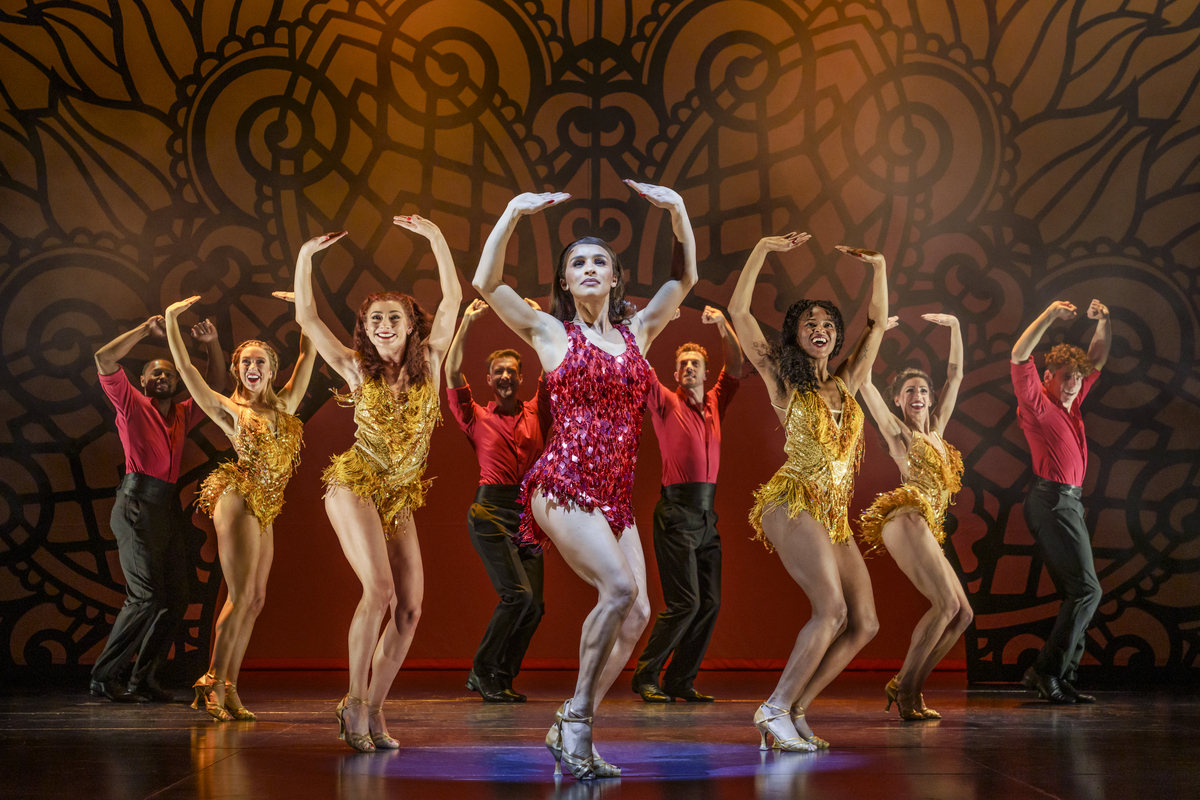
Thursday, 8 June 2023

Parade - Review

Bernard B. Jacobs Theatre, New York


****


Music and lyrics by Jason Robert Brown
Book by Alfred Uhry
Directed by Michael Arden


Micaela Diamond and Ben Platt


It is nearly 25 years since Parade premiered on Broadway, where it was to win two Tonys (out of nine nominations) but yet close after barely three months of performances. Fast forward to 2023 where this first Broadway revival of the show has already garnered 6 Tony nominations and plays to a much changed world than when it first opened in 1998.

Parade was always a bold and brave concept for a musical. It was legendary director Hal Prince who co-conceived the show, turning to Brown when Stephen Sondheim was unavailable. Drawn from the early 20th century history of Georgia USA, Alfred Uhry's book tells of the Jewish Atlantan Leo Frank, wrongly accused and subsequently found guilty, of the murder of Mary Phagan, a young Christian child. Originally from New York, so an outsider as well as a Jew, Frank found himself the focus of extreme antisemitism that was to have a tragic outcome. The genius of Brown’s writing lies not just in his music that draws from a raft of Southern styles and influences, but in his lyrics that not only chart the horrific evolution of the murderous right-wing extremism of the time, but also catches moments of underlying wry American humour, as well as the profound and loving pathos of the relationship between Frank and his wife Lucille.

Having reviewed numerous productions of Parade over recent years, this marks the first mainstream commercial take on the work that www.jonathanbaz.com has covered, and notwithstanding the musical excellence heard in those previous iterations, to hear Brown’s score, played here magnificently by Tom Murray’s 18-piece band, is an absolute treat.

Ben Platt is a magnificent Leo, who defines the man’s transition from an orthodox chauvinist into a loving and appreciative husband in a beautifully nuanced interpretation. Platt’s vocals are also tremendous, never better defined that in that wondrous vocal leap that sees him transformed from the fantastical and vile (albeit imagined) predator in Come Up To My Office to a pleading, vulnerable innocent facing a monstrous world in It’s Hard To Speak My Heart. Platt also nails the wit of How Can I Call This Home?, a number that defines his incredulity, as a “Yankee with a college education”, he tries to get to grips with the redneck South. 

Opposite Platt, Micaela Diamond takes on the equally challenging role of Lucille. There is excellence in much of Diamond’s work, particularly in her duets This Is Not Over Yet and All the Wasted Time, but her solo work, especially in the first act’s You Don’t Know This Man fails to hit the spot.

Other notable vocal contributions come from Alex Joseph Grayson as convicted criminal Jim Conley who smashes his every song out of the park and also from Kelli Barrett as Mrs Phagan, the mother of the murdered child. Barrett captures not only a poignant grief at her terrible loss, but also a palpable Jew-hatred in her remarkable delivery of My Child Will Forgive Me.

Seeing this show for the first time in the USA rather than in the UK, it is pleasing to see Brown’s New York wisecracks that lampoon Southern stereotypes, landing to audience laughter rather than falling flat to a house full of Brits, who struggle to grasp the writer's brilliant irony

The show’s design is simple, with most of the cast on-stage throughout and principle action playing out on a raised central dais in front of projected scenic images. There is however a curious projection that occurs in the pre-show mise-en-scene as the audience are taking their seats. An actual newspaper report of the Leo Frank story, from back in the day, is shown on the screen that graphically tells of Frank’s ultimate fate. This is a curious and patronising decision by the show’s creative team, for while the themes and history of Parade are undoubtedly educational and important, to undermine the musical’s narrative and not only that but in front of New York audiences that are mostly made up of Yankees with a college education, is not fair on the show. It is also, for those in the audience unaware of how the Leo Frank saga plays out and are hopefully looking for the musical to tell them a story, one heck of a spoiler.

If you love Brown’s score you are unlikely to hear it played finer than this.


Runs until 6th August


See below for my programme notes, written to accompany the production of Parade that opened the Hope Mill Theatre in 2016


My Thoughts on Jason Robert Brown's Parade 
Written by Jonathan Baz and published in 2016


Jason Robert Brown’s Tony-winner kicks off during the 1913 Confederate Memorial Day Parade in Atlanta, Georgia. The Civil War had been fought (and lost) some 50 years earlier and it is the aftermath of that defeat that powers the context of this show. 

The Southern States had fought the North in a desperate, bloody struggle to hold on to their right to enslave African Americans. Slavery was (and is) de-humanising and barbaric and yet, to a majority of folk in the Confederacy, it was not only acceptable, it was desirable. Southern racism was ingrained and the Confederate flag remains a chilling emblem of the white supremacists.

As that 1913 parade passed by, Mary Phagan a white 13 year old girl from Marietta, just outside Atlanta, was brutally raped and murdered in the city’s pencil factory where she worked. Amid a hue and cry for justice, it didn't take Atlanta’s Police Department long to be conveniently pointed in the wrong direction, accusing Leo Frank, the factory superintendent. Frank may have been white, but he was a Yankee from the North and worse, a Jew. 

Parade explores how Frank was subsequently framed and how he and his wife Lucille, fought back. Child abuse and murder may not be regular subjects for a musical theatre treatment, yet from this dark core, composer Jason Robert Brown has fashioned one of the finest musicals to have emerged in the last 20 years.

Parade succeeds on so many levels. It has a finely crafted score and libretto, it's a history lesson and a towering love story. Brown won a Tony for the score; listen out for the traditional melodies of the South, carefully woven into his work. There’s Gospel, Spiritual, Blues and Swing in there, with the composer saving perhaps one of musical theatre’s finest coups for his Act One Finale. As Parade’s narrative reaches a horrendous turning point, Brown has his citizens of Atlanta launch into an exhilarating cakewalk. Where Kander and Ebb brought Cabaret’s first half to a troubling close with ‘Tomorrow Belongs To Me’, Brown’s cakewalk juxtaposes jubilation with injustice. Rarely has an array of swirling Southern petticoats and frocks been quite so stomach churning.

As a history lesson, Parade is up there with the best. The opening number ‘The Old Red Hills Of Home’ hits the audience with an unforgiving staccato percussion that soon includes a funereal chime alongside discordant strings, before evolving into a chilling yet (whisper it not) discomfortingly stirring anthem. The song is remarkable in that between its opening and closing bars, Brown tells the entire story of the South’s Civil War. A young and handsome Confederate soldier sings the opening lines, who by the song’s end is a gnarled and crippled veteran. Wounded and bitter, the old soldier dreams of the ‘lives that we led when the South land was free’. 

Brown also kicks off the second half with a punch. While Parade is famously about anti-Semitism, ‘A Rumblin’ And A Rollin’ is sung by two of the Governor of Georgia’s African American Domestic Staff, both well aware that while the Frank furore is gripping the nation, their lot hasn't significantly changed, even after the abolition of slavery. Riley, the Governor’s Chauffeur has a line ‘the local hotels wouldn't be so packed, if a little black girl had gotten attacked’ that should prick at America’s collective conscience even today, while his killer lyric a few bars on, ‘there’s a black man swingin’ in every tree, but they don't never pay attention!’ has a devastating simplicity.

Parade also beats to the drum of a passionate love story. Early on we find Leo and Lucille questioning their very different Jewish lifestyles. He’s from Brooklyn, a ‘Yankee with a college education’, while she is a privileged belle about whom Frank observes ‘for the life of me I cannot understand how God created you people Jewish AND Southern!’. There is a cultural gulf between the pair which, upon Leo’s arrest, only widens. How Alfred Uhry’s book and Brown’s lyrics portray the couple’s deepening love, is a literary master stroke. 

While the show was to receive numerous nominations in both Broadway’s 1999 awards season and later in 2008 on its London opening, the Opening at New York's Lincoln Centre disappointed, running for barely 100 performances. Variety magazine called it the ‘ultimate feel-bad musical’ and the crowds stayed away.

It was however, to be at London’s modest Donmar Warehouse, directed by Rob Ashford who had been the show's original Dance Captain on Broadway, that the show was to soar. So much so that Brown took the Donmar production back for a successful run in Los Angeles, with Lara Pulver, the Donmar’s Lucille, still in the lead. Thom Southerland’s fringe production a few years later at London’s Southwark Playhouse received similar plaudits. 

So why was Parade loved in London, yet shunned in New York? Wise theatre heads have suggested that perhaps Americans have little appetite for a musical that focuses upon such an ugly feature of their country’s history.

100 years on, what has been the legacy of the Frank case? For good, it served to spawn the Anti-Defamation League, America’s anti-fascist organisation. However the episode also re-ignited the burning crosses of the Klu Klux Klan. I recently visited Marietta to see for myself where Leo Frank’s story ended. Sadly, even if un-surprisingly, the site isn't marked amidst what is now a busy road intersection and if you didn't know what you were looking for, you'd never know you've been there.

And think back to last year, with the horrific massacre of 9 Black Americans, shot as they prayed in a South Carolina church, by a man who was pictured proudly waving the Confederate flag. Incredibly up until last year, a handful of States still flew that flag from government buildings, with Mississippi still including the Confederate emblem as a component of its state flag to this day. 

The Leo Frank trial and its aftermath ripped a nation apart, re-opening fault lines that to this day have barely healed.

Saturday, 27 May 2023

Rose - Review

Ambassadors Theatre, London


***


Written by Martin Sherman
Directed by Scott Le Crass


Maureen Lipman

Maureen Lipman delivers a flawless performance in Martin Sherman’s fictional Rose, a play drawn from the experiences of his grandparents. Over two acts and two and a half hours, Lipman performs a monologue that charts the path of diaspora Jewry through the 20th century.

Set in 2000, the narrative sees Rose looking back upon her life. Born in a shtetl in the Ukraine in 1920, she was to experience Cossack pogroms and then the inhuman horror of the Holocaust that was to see her witness the shooting of her nine-year-old daughter by the SS in the Warsaw Ghetto. Escaping Europe and making her way on to the Exodus, bound for Palestine, Sherman is rightly unforgiving in his description of the harshness of the British rule over mandated Palestine and the accompanying hostilities shown by UK forces towards Jewish refugees.

The second act sees Rose build a life with the second of her three husbands, with Sherman offering up a description of the post-war American Jewish experience that will likely resonate with much of the play’s transatlantic audience. So far, so good, with the playwright having crafted a magnum opus in addressing the history that his writing has encompassed.

The wheels fall off in the monologue’s closing phase, as Rose equates Israel’s modern day actions in the West Bank with the Nazis' extermination of the Jews. This is a poorly argued conflation that offers a shallow and dangerous interpretation of a complex situation. It no doubt suits Sherman’s political agenda to promote this analysis, but as a historical comment his conclusion debases the preceding 90 minutes of brilliance.

Maureen Lipman’s performance of Rose is magnificent. Sherman’s writing however is ultimately found to fail to match her excellence.


Runs until 18th June

Thursday, 25 May 2023

Aspects of Love - Review

Lyric Theatre, London


***


Music by Andrew Lloyd Webber
Lyrics by Don Black & Charles Hart
Based on the novel by David Garnett
Directed by Jonathan Kent


Michael Ball and Laura Pitt-Pulford

Returning to the London stage and complete with re-vamped orchestrations, Andrew Lloyd Webber and Don Black / Charles Hart’s Aspects of Love takes up a modest residency at the Lyric Theatre .

Michael Ball who starred in the original production as the young Alex, here tops the bill as the avuncular George, in this curious tale of love that according to Messrs. Black and Hart, changes everything.

Ball is magnificent and so too are his company of Laura Pitt-Pulford as Rose, Jamie Bogyo (Alex), soprano Danielle De Niese as Giuletta and Anna Unwin as Jenny (with on press night Millie Gubby as her character's pre-teen iteration). It all makes for a fabulously performed ménage à cinq that on closer inspection turns out to be a most unappetising minestrone of morals.

Technically, the show is a marvel. Not just in the actors’ glorious work, but in Lloyd Webber’s melodies married with John Macfarlane’s ingenious designs and projections, that make for an evening of exquisite stagecraft.

Ultimately though, the musical is little more than a sung-through panoply of privileged, priapic, polyamory. Go see it for the gorgeous songs.


Runs until 19th August
Photo credit: Johan Persson

Tuesday, 23 May 2023

Awful People - Review

Latest Music Bar, Brighton


****


Written by Julie Burchill and Daniel Raven
Directed by Carole Todd


Joseph White, Temisis Conway, Seth Morgan and Deborah Kearne in rehearsal


Awful People is the latest play from Julie Burchill - this time co-authored with husband Daniel Raven - that proves to be a morality tale for our time.

India (Deborah Kearne) and Aonghas, pronounced Seamus, (Seth Morgan) are a bitterly estranged couple in early middle age who are nonetheless still pooling their creative talents together in the vain hope of penning a rap version of The Wind in the Willows. Their infertility, recently addressed by IVF, has seen them become late-onset parents to offstage toddler twins. 

While Aonghas lives in a nearby flat, India shares her comfortably appointed home with Galyna (Temisis Conway) a Ukrainian refugee who she has billeted in the room next door to the kitchen and tasked not just with the household’s domestic chores, but also with providing care to the toddlers.

Both Aonghas and Guardian reading India are fleshed out as grotesques and while their callous Class A drug-addled existence may at times verge on the caricature, there are piercing moments of clarity that define Burchill’s ability to skewer these chattering (il)liberal metropolitans with their own hypocrisies. When late in the play Galyna reveals that she is a qualified doctor and India exclaims “You never told us”, the Ukrainian’s reply is brilliantly devastating: “You never asked”.

Completing the quartet of players is Joseph White as Gideon, a Deliveroo motorcyclist. Born in Britain but of Nigerian descent, Gideon has been brought up with a strong Christian ethic and an equally firm moral code. From a poor background, and having lost a brother to drug-running violence, (possibly having delivered drugs to Aonghas in the past), Gideon’s take on the world is wise and measured and his scorn for Aonghas, to whom he is delivering a smashed avocado sandwich, is palpable. 

Aonghas and India view immigrant communities as being there to serve them on low wages. Gideon and Galyna however, having experienced the harshness of life’s knocks, bring a more sanguine take on society and view with contempt the virtue signalling of their patrician patrons. Gideon describes divorce as a “disease of the affluent” and comments, with chilling perception, of the likelihood of the twins growing up into arrogant replicants of their parents.

As Aonghas behaves with a casual misogyny, so does India express an Emma Thompson-like contempt for the UK “Another day, another reason to hate this miserable island” with both of them spitting sneerful Remoaning contempt at the ruin and inconvenience brought to them by Brexit. It is the youthful Gideon and Galyna who rise to become the adults of this piece.

At around 75 minutes, the play is short and (bitter) sweet. All 4 performers turn in assured work, deftly directed by Carole Todd and wrapped up at the end with an unexpected but gorgeously sung solo from Conway. 

Only on for a tiny run in Brighton’s Fringe Festival and coming in with visibly low running costs, Awful People deserves a wider audience as there are millions across the country to whom Burchill and Raven’s words will resonate with truth. The work is crying out for a British theatre (either London or regional) to stage this provocative piece.


Runs until 25th May

Wednesday, 17 May 2023

The Bodyguard - The Musical - Review

Churchill Theatre, Bromley


****


Based on the Warner Bros film
Screenplay by Lawrence Kasdan
Book by Alexander Dinelaris
Directed by Thea Sharrock


Melody Thornton and the company of The Bodyguard

Having conquered London’s West End 10 years ago, Alexander Dinelaris’s production of The Bodyguard returns to the UK with a nationwide tour, arriving at Bromley’s Churchill Theatre and playing to a packed house on this, its fifth location on the road. 

With a wonderfully hokum narrative hung around Whitney Houston’s most famous hits, it follows the story of fictional singer Rachel Marron who has recently hired a bodyguard following threats from a stalker. You can expect drama, romance, emotion and of course, Houston’s 80s and 90s classics we all know and love.

Six years on from playing the lead role on tour in China, Melody Thornton reprises her role as Rachel Marron, alongside Ayden Callaghan as bodyguard Frank Farmer. An incredibly demanding sing, Thornton delivers exceptional vocals throughout, particularly in the climactic One Moment in Time and finale I Will Always Love You, giving Whitney's recordings a run for their money! Callaghan’s performance was stoical, with hints of humour along the way, playing the role of dependable yet emotionless bodyguard very well.

Particular mention must go to Emily-Mae Walker playing the role of Marron’s sister, Nikki. Her vocals were breathtaking and effortless - a pleasure to listen to. Hers and Thornton’s duet of Run To You towards the end of act one captured the audience with its stunning harmonies. Walker and Thornton were joined by Iesa Miller, playing Rachel’s son, Fletcher, in a heart-warming trio rendition of Jesus Loves Me. Miller delivered an impressive performance for such a young age, with believable acting and fantastic vocals and dancing.

The first half's plot is sometimes slow, but act two picks up the pace, full of suspense with a few jump-scares resulting in screams and subsequent laughs from the audience. The whole performance is impressive, with pyrotechnics, brilliant ensemble choreography, a dazzling wardrobe and a couple of stand-out vocal powerhouses - it has something for everyone with the encore of I Wanna Dance With Somebody getting all of the audience on their feet to dance away with the cast.

Playing at the Churchill until Saturday 20th May and then touring until the end of the year, audiences will love this show that will certainly leave them wanting to dance with somebody!


Runs until 20th May and then tours
Reviewed by Sophie Kale

Wednesday, 10 May 2023

4000 Miles - Review

Minerva Theatre, Chichester


**


Written by Amy Herzog
Directed by Richard Eyre


Eileen Atkins

Eileen Atkins’ take on her character, the 95 year old New Yorker Vera Joseph, is the standout feature of what makes, for the most part, a clumsy pot-pourri of themes and issues.

Visited by her grandson Leo (Sebastian Croft), a twenty-something who has seen his coast to coast cycling adventure with a friend end in the friend's tragic death in a road accident, the play explores the relationship between Vera and Leo, with fleeting references to the young man's love (and potential love) interests along the way.

Atkins is a consummately skilled performer, but Richard Eyre fails to extract a convincing New York tone from her words. Her accent is generic American where a harsh Manhattan dialect would have given her more acid observations greater heft. Joseph is a champagne communist like many of her generation, however Amy Herzog rarely journeys beyond cliché in her play’s crass political representations.

Where the script comes alive is in Atkins’ take on her character’s advanced years. Her memory lapses, erratic irascibility and, at times, profound melancholy at the loneliness of her widowhood are poignant and well observed. Sadly, not much else is, and yet again a Chichester audience is found to be laughing insensitively at moments that are far from funny.

It’s not often that a 90 minute play feels like a tedious three hours.


Runs until 10th June
Photo credit: Manuel Harlan

Wednesday, 3 May 2023

The Motive and the Cue - Review

National Theatre, London


*****


Written by Jack Thorne
Directed by Sam Mendes


Mark Gatiss and Johnny Flynn

Jack Thorne’s new play is one of those rare events, fusing the strongest of stories with an exquisite script, delivered by a riveting troupe of actors. The Motive and the Cue takes an ingenious delve into the rehearsals that underscored Richard Burton’s 1964 Hamlet on Broadway, a production that was directed by Sir John Gielgud.

Burton was at the peak of his hell-raising career, while Sir John, arguably the finest Shakespearean performer of his generation was already past his zenith. Johnny Flynn and Mark Gatiss play Burton and Gielgud respectively and their take on both of these giants is nothing short of remarkable. Vocally and physically the actors capture the instantly recognisable characteristics of both men: Gatiss bringing a balding mellifluous wisdom to the theatrical knight, while Flynn wields a louche, perfectly pitched swagger that, with just a hint of Welsh tonality, nails Burton’s distinctive presence.

Johnny Flynn

Thorne’s genius is in crafting the theatrical history of what was to become Broadway’s longest-running Hamlet ever, into a standalone dramatic gem. Tuppence Middleton plays Elizabeth Taylor - 1964 saw the Burton / Taylor marriage at its most passionate, remember that their legendary Cleopatra movie had only opened the year before  - and her take on the actress, describing Burton as “the finest actor she ever went to bed with”, is inspired. Middleton's Taylor understands the Welshman’s complex roots, his impoverished childhood, nurturing and nourishing his talent. In her final scene, clad literally in fur coat and no knickers, Middleton defines the smouldering, beautiful complexity of one of the twentieth century’s most compelling actresses.

With an acute perception Thorne brings to the fore both Burton's and Gielgud's troubled pasts. Gielgud contemplating the waning of his career at the end of act one, in which having coaxed the recalcitrant Burton in Hamlet’s “Speak the speech I pray you” speech to the Players, then, solo, and as a monologue, recites the speech himself, creating a moment that evolves into one of the most heart-rending and tender scenes penned in recent years. Gatiss defines Gielgud’s melancholy with a profound and measured depth, his gauche second-act encounter with a rent boy proving equally tender.


Mark Gatiss

Flynn too offers a glimpse into the alcohol-fuelled complexities that contributed to Burton’s gargantuan stage presence. Thorne’s script and Sam Mendes’ assured direction offer up a fascinating glimpse of both men’s vulnerabilities.

There’s excellence throughout the cast, with Janie Dee as Eileen Herlie (the production’s Gertrude) and Allan Corduner as Hume Cronyn (Polonius) both in sparkling form. Rarely has Hamlet’s closet scene been played with such credible hilarity. Es Devlin works her usual magic in the play’s scenic design, with scenes ingeniously changing behind the opening and closing aperture of the Lyttleton’s curtain. Credit too to Charmian Hoare, the production's dialect coach, for capturing such aural perfection from the leading performers.

The Motive and the Cue is new writing at its finest, built upon the most fascinating of stories. It is an unmissable night of theatre.


Runs until 15th July
Photo credit: Mark Douet