Showing posts with label Christopher Marlowe. Show all posts

Thursday, 23 February 2023

Tracy-Ann Oberman in Conversation


Tracy-Ann Oberman in rehearsal


Opening next week at Watford Palace theatre is The Merchant of Venice 1936, a production that is the brainchild of actress Tracy-Ann Oberman who, for a number of years, has nurtured the idea of taking one of Shakespeare’s most controversial plays and pivoting it into the 20th century.

I caught up with Tracy-Ann in the middle of rehearsals and we spoke about its conception and development. Describing The Merchant of Venice as a very difficult play, she does not think that the text is taught properly in schools today, observing that a lot of people argue for it to be removed from the syllabus. Oberman however wants to make the play accessible, offering a fuller understanding of antisemitism, as well as reclaiming aspects of the Jewish history of London’s East End, an area of the city long associated with poorer immigrant communities. Her own roots go back to the East End and she remains inspired by her great grandmother and the matriarchs of her family who all stood against Oswald Mosley and his British Union of Fascists at the Battle of Cable St in 1936.

She comments that Shakespeare wrote the The Merchant of Venice at a time of huge antisemitism, when the Jews had already been banished and the few that were left in England were frequently seen as devils. The emergence of mediaeval antisemitism was strongly fuelled by Jews often being the money collectors for the king.

Around this time the myths about Jews and blood libels were to emerge, myths that have never really left the English sub-conscience, Oberman wryly comments. And so the Jew, as a sort of evil villain she continues, was absolutely where Shakespeare wanted to place him, much like Marlowe had done with his creation of Barabas for The Jew of Malta. 

With all due humility, Oberman does credit Shakespeare as a very good writer. She acknowledges that in Shylock he has created aspects of humanity which are frequently absent from other portrayals of Jews in literature, notably The Jew of Malta where Barabas, in her opinion, is simply a cartoon villain. She comments that in The Merchant of Venice the “’hath not a Jew eyes” speech is brilliant, describing it as an absolute call to humanity to say that we are all the same, that we are all human.
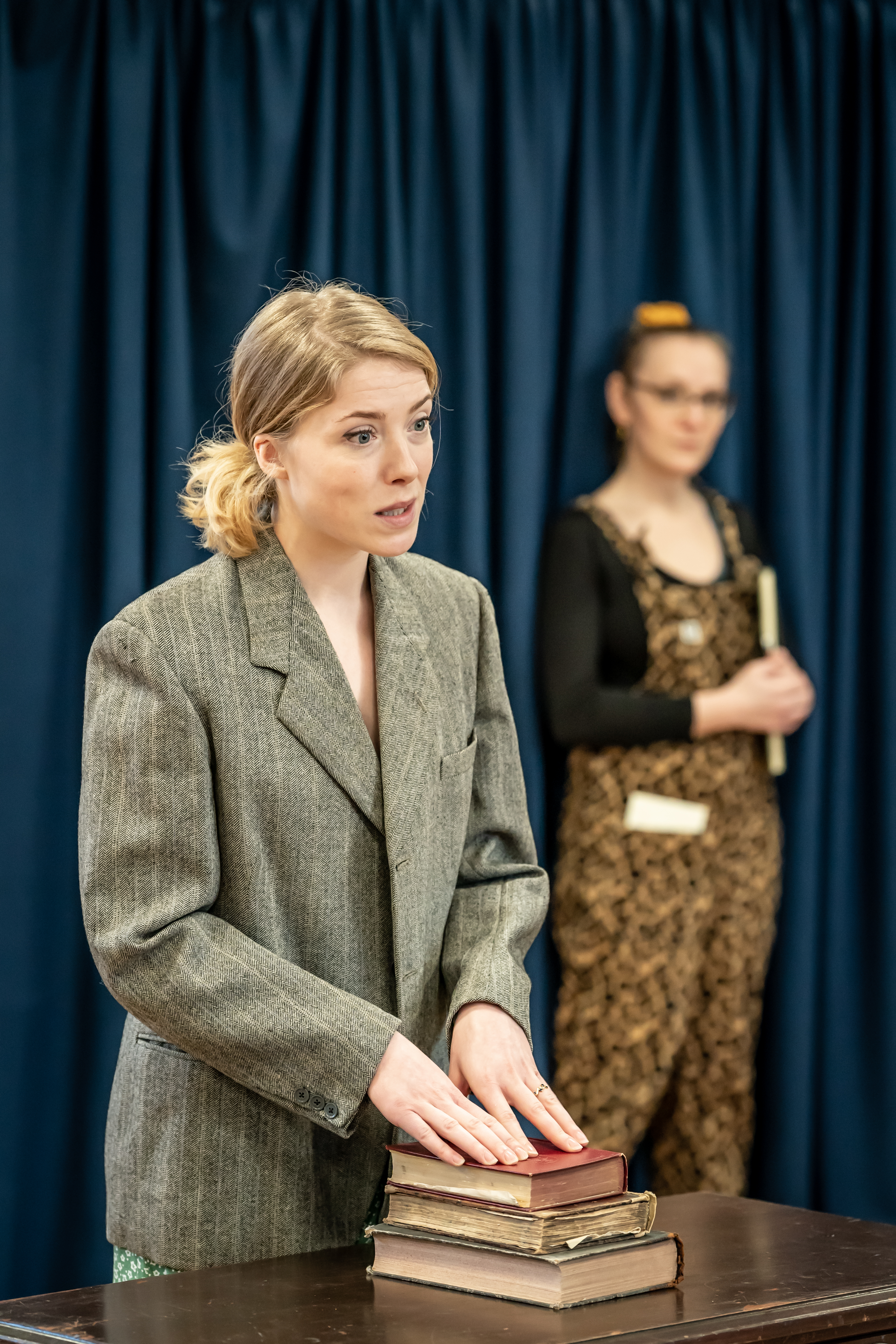
Hannah Morrish as Portia

Oberman has long been fascinated by Britain’s history in the 1930s, a time that saw flirtations from the country’s aristocracy with the parties of fascism both at home and in continental Europe. It is no small coincidence that Mosley’s march of fascists that led to the Battle of Cable Street, occurred during the brief reign of Edward VIII, himself strongly suspected of harbouring fascist ideals. Oberman sees the play as shining a spotlight into some of this country’s darker crevices. 

She is also proud of having reinvented Shylock as a female role and in so doing, reclaiming a different aspect of the narrative. Referencing how within the text, that Shylock is referred to as a dog and Antonio, the merchant to whom Shylock has loaned money secured on a pound of flesh, kicks at her and spits at her, Oberman sees a clear link between misogyny and antisemitism. She is well qualified to make such an observation. Away from the stage Tracy-Ann Oberman is one of the UK’s leading campaigners in today’s fight against antisemitism, a role that has seen her subject to some of the vilest abuse imaginable. Oberman has seen all too clearly in her inbox and her social media streams the seamless link betwixt the hatred of Jews and a hatred of women.

On the subject of women I quiz Oberman on Shylock’s relationship with daughter Jessica. Penned by Shakespeare with a father/daughter perspective in mind, how is the mother/daughter dynamic evolving? The mother of a teenage daughter herself, Oberman observes that Jessica has the capacity to range from being her mother’s best friend to her worst enemy and she is relishing that parental aspect of the role. 

Exploring as to how this interpretation of the play may be received by people who don’t share Oberman's Jewish heritage, she comments that she’s already observed people who’ve seen the play in rehearsals, friends of hers from working class backgrounds or diverse immigrant backgrounds, who are are recognising aspects of her Shylock in their own heritage and also with Shylock as a matriarch, identifying strongly with the strong woman that Oberman portrays. 

The conversation would not be complete without an understanding of the supportive role that Watford Palace Theatre have played in bringing the play to fruition. Oberman speaks with an affection towards the venue that is almost tangible. Growing up in the London suburb of Stanmore, close to Watford, she would visit the theatre often as a child and it was there that her passion for acting was encouraged and nurtured. In later years and meeting up with Brigid Larmour, the Artistic Director of Watford Palace, it was Lamour who asked the actress what she was doing, to which Oberman replied that she was working on “this idea of a female Shylock”. From there the two of them took the idea forwards, receiving developmental support from the RSC, with Oberman reflecting warmly that Larmour has proved to be an incredible ally both creatively and politically.

In the first scene of The Merchant of Venice Antonio famously says the world is “A stage where every man must play a part”. On the Watford Palace stage Tracy-Ann Oberman will be upending Antonio’s words in what promises to be an exciting evening of Shakespeare.


The Merchant of Venice 1936 runs from 27th February to 11th March and then tours


The cast of The Merchant of Venice 1936

Rehearsal photos by: Marc Brenner

Tuesday, 26 April 2016

Doctor Faustus - Review

Duke of York’s Theatre, London


***


Written by Christopher Marlowe and Colin Teevan
Directed by Jamie Lloyd


Jenna Russell and Kit Harington

Christopher Marlowe’s story of Dr Faustus is well-known. The scholar no longer able to find interest in the traditional fields of knowledge (law, religion and medicine) who delves deep into the dark arts and to make a pact with the Devil, selling his soul in exchange for 24 years of godlike powers. 24 years of fame and success followed by eternal damnation. 

Black and existential in its original form, here Marlowe's play is given a more cynically contemporary twist as Colin Teevan introduces new texts that connect today’s transient and trashy pop culture with the moral vacuum Faust makes for himself. 

The result is  fascinating, disturbing and at the same time farcically ironic, like a delirious post-hangover nightmare. The barely-dressed actors inhabit Soutra Gilmour’s stage as already-damned souls, occasionally with an unbearable tension much like the slow-motion protagonists of a Bill Viola video, at other times simply with aggressive violence.

Kit Harington plays a young Faustus, in possession of both human frailty and ingenuity. His pact with Lucifer however is firmly set in the 21st century, with our anti-hero seeking TV celebrity rather than the traditional order of regular superpowers. No longer a scholar, he becomes a magician like David Copperfield or Dynamo, desperate for popularity. Faustus’ longing for a show in Vegas reveals the height of his ambition: we're not in 1592 anymore and people’s deepest desires have changed. 

Harington, albeit looking more comfortable delivering the modern sections by Teevan than the originals, convinces as the easily-duped Faustus. The real strengths of this production however lie with Jenna Russell’s Mephistopheles and Forbes Masson as Lucifer. Russell’s performance is magnificent, part demonic seductress and part talent agent. Her ability to convey the suffocating love/hate relationship with Faustus – Who is really the master, who the servant? – is outstanding. In her nightgown, with her short hair, Russell remains the powerful central focus of her scenes and don't linger too long in the bar either - her on-stage singing towards the end of the interval is an infernally ingenious treat.

Masson shines as a sardonic and auto-ironic Lucifer, dangerously mellifluous more than straightforwardly intimidating and a nod too to Tom Edden for his representation of the seven deadly sins. Helped by Jon Clark’s lighting, his is a spectacular transformation through the sins. 

It certainly makes for a stimulating night at the theatre. Lloyd and Gilmour have a well-established partnership that leads to stunning visuals, usually supported by outstanding performances. Russell is fabulous, Harington’s Faustus is likely to be best enjoyed by his fans.  


Runs until June 25th.
Reviewed by Simona Negretto
Photo credit: Marc Brenner

Saturday, 13 February 2016

Dr Faustus - Review

Swan Theatre, Stratford upon Avon


****


Written by Christopher Marlowe
Directed by Maria Aberg


Oliver Ryan
Much of what makes The RSC great is embodied in Maria Aberg’s Doctor Faustus, now playing in Stratford’s Swan Theatre. A classic Elizabethan text that is given an invigorating and challenging interpretation and presented in a display of top-notch stagecraft. For students of modern theatre, Aberg’s show should be compulsory viewing.

Dr Faustus’ pact with the Devil is legendary. Having amassed all human knowledge and keen to broaden his horizons yet further, Dr Faustus summons up Lucifer’s demon Mephistophilis. After some hard persuading a deal is struck, Faustus’ veins are cut open and a contract signed in his blood. He is to be given 24 years of superhuman immortal powers on earth, after which his soul will belong to the Devil in eternal damnation. As Faustus is presented with the 7 Deadly Sins and assorted amoral choices, Marlowe’s allegory is clear – that the temptation to evil lies within us all.

In a novel touch, two actors share the leading roles. They enter the stage identically clad and simultaneously strike a match each. He whose match burns out last leaves the stage, to return as Mephistophilis. On press night Oliver Ryan was to play the title role with the lean scot, Sandy Grierson shortly to return shirtless, in an immaculately tailored white suit and in a neat touch, with charred blackened bare feet.

This is a brutal, bloody and above all desperately physical production with Ryan’s Faustus on stage virtually throughout the 1hr 45 one act play. Faustus paints a crude pentagram across the Swan’s black stage to summon the Devil, the bucket of whitewash slopping in his desperation. As the evening unfolds, so does the Doctor become more and more stained by the painted mess that he has created.

Mephistophilis summons up a nightmarish cohort of scholars to confront Faustus on his journey– black clad and hatted and almost suggesting an ensemble of bottle-dancing Jews – and it is in their movement that much of this show’s magic lies. Ayse Tashkiran choreographs his actors with an infernal ingenuity (that at other times hints at the zombies from Michael Jackson’s Thriller video), meanwhile up in the gods (natch) Jonathan Williams six-piece band deliver the classy yet disquieting dischord of Orlando Gough’s musical backdrop with a chilling resonance. The costuming and design (credit Naomi Dawson) is at once simple and grotesque, exemplified best perhaps by Natey Jones’ transvestite manifestation of the deadly sin Lechery. He’s all legs and frock, complete with outrageously kinky heels, though it is Ruth Everett’s Wrath, sporting a wig that’s half black and half white and which offers a troubling suggestion of anger stemming from a psychiatric disorder, which offers up another of this production’s perceptive yet brilliant conceits.


Sandy Grierson and the scholars

Ryan gives his soul to the role as he finds his all-knowing self so knowingly played by Grierson’s perpetually suave and sardonic emissary. It all makes for compelling, unsettling theatre.

Perhaps the most troubling image of all is that of Jade Croot’s Helen Of Troy. This child-woman, with a face that launched a thousand ships, provided by the Devil to satisfy Faustus’ lust, launches her gamine youthfulness at the Doctor. Their passion rises in a whirling embrace, until, spent, her prone body is lifeless in Faustus’ arms as he fast recognises his impending doom. Like much of the play, the moment is both beautiful and terrifying.


Runs in repertoire until 4th August
Photo credit: Helen Maybanks

Tuesday, 31 March 2015

The Jew Of Malta - Review

Swan Theatre, Stratford upon Avon


****

Written by Christopher Marlowe
Directed by Justin Audibert


Jasper Britton

Christopher Marlowe’s The Jew of Malta play takes a tale of cunning and avarice, love and hypocrisy and strips it down to the basest of humanities at its core. Barabas  the Jew is a man for whom it is possible to feel both compassion and disgust.  He hadn’t chosen his calling, having first been a physician, then an engineer and finally a usurer.  Yet it is in that money-lending role that he is singled out by Ferneze, Malta’s Christian governor, to fill the island’s war chest or face conversion to Christianity. And as the Muslim Turks threaten Malta, so do we find Marlowe sketching out a contemporary, if troubling resonance, as the three Abrahamic faiths challenge each other

Justin Audibert’s intelligent production sees Jasper Britton give a warmth and joie de vivre to Barabas that one might not have expected from a man destined to ultimately wreak hideous revenge. Britton’s wiles and connivances serve only to endear him to the audience, whom he plays beautifully, with a string of raised eyebrows and intimately glanced asides. An unexpected counterpoint to the Jew is Ithamore, his Moorish slave. Lanre Malaolu bounces and clowns across the stage as we witness the slave perversely worming his way deeper into the affections of his master.

The threatening Turkish armada is led by Calymath, ably played by Marcus Griffith in true swashbuckling form. As the intrigues of the plot, riddled with treachery and deceit lead to an inevitably tragic conclusion, we witness the duplicity of inter-faith conflict alongside an even more painful intra-familial despair as Barabas and daughter Abigail, (sensitively and spiritedly played by Catrin Stewart) both come to despise the other, with fatal consequences.

Steven Pacey’s Ferneze displays a recognisable statesman-like duplicity, as he schemes both with and against Barabas to defend his nation, whilst we catch but a glimpse of Marlowe endorsing his own personal inclinations when Simon Hedger’s Merchant says ‘I count religion but a childish toy’.

In a production that thrills, Jonathan Girling’s music enhances proceedings. His introduction however of a 19th century klezmer sound, whose history derives from the European Ashkenazi Jewish community whereas Malta’s Jews hailed from a distinctly Mediterranean Sephardi heritage, does seem a little incongruous.

But elsewhere the detail invested in The Jew Of Malta is meticulous, manifest in the clarity, diction and playing of the company for whom neither a syllable nor glance is wasted. Bringing their world class style to this Elizabethan classic, with Lily Arnold’s plainest of sets proving a foil to magnificent costumes, The RSC again deliver magnificent theatre.


In repertory until 29th August 2015