Showing posts with label Hannah Morrish. Show all posts

Friday, 3 March 2023

The Merchant of Venice 1936 - Review

Watford Palace Theatre, Watford


****


Written by William Shakespeare
Directed by Brigid Larmour


Tracy-Ann Oberman and cast members


For the second time in six months, the dramatic whirlwind that is Tracy-Ann Oberman has seen a play open that has not only been her brainchild, but has boldly and bravely put antisemitism firmly centre-stage. Her first foray into this field was at the Royal Court in September in what turned out to be a flawed piece of modern writing. This time however, by setting The Merchant of Venice to a backdrop of British fascism in the 1930s, Oberman has hitched the wagons of her creative firepower behind probably the greatest ever writer of English literature and the result is impressive.

The Merchant of Venice 1936 is an exciting interpretation of one of Shakespeare’s most troubling comedies and set against the era of Oswald Mosley and the British Union of Fascists, one sees how easily the Jew-hatred of the Venetians can be translated across the continent to the British Isles. Pause longer, to consider the real impact of Jew-hatred in Europe that blazed in furnaces at that time and the reflection becomes even more chilling.

In a gender swapped Shylock, Oberman transforms the Jewish moneylender into a thickly accented matriarch. An immigrant from eastern Europe, her Shylock is drawn from her great-grandmother who hailed from Belarus and with an opening scene that includes lighting the sabbath candles and blessing a glass of kosher wine (dozens of which are shared with the audience in an opening mise-en-scene) Oberman makes a bold statement that this production of The Merchant of Venice will be firmly rooted in Shylock’s Jewish heritage and the hatred that she and her community endured then and to this day.

Oberman makes fine work, not just of Shylock’s complex motives, but also of some of the most cracking monologues in the canon. Hearing a woman complain of being spat upon, kicked and mocked takes the play’s already present antisemitism and fuels it with a deeply disturbing misogyny. That the homosexual love between Antonio and Bassanio is so strongly signalled in Brigid Larmour’s direction, only adds a troubling depth to the woman-hatred that this Shylock suffers.

The supporting cast are all sound, with standout work from Raymond Coulthard as the fascist Antonio and Hannah Morrish as an icily Mitford-esque Portia. Indeed, when Jessica (Graine Dromgoole) finds herself having eloped to Portia’s Belmont, the diffidence with which she is treated by her hostess together with her coterie, offers a subtle further take on the immigrant Jew as an outsider, never to be truly adopted into their country of residence however hard they may try to assimilate.

Erran Baron Cohen has composed an intelligent musical  soundtrack to the play – part schmaltzy Jewish melodies that reflect the scenes in Shylock’s home contrasted with ingeniously Cole Porter-esque tunes that reflect the profound antisemitism of the champagne-quaffing patricians. Liz Cooke's design work on set and costume offers up an effective transition between London’s East End poverty and Belmont’s beauty, while her fascists are elegantly clad in black, as Oberman’s Shylock sports a stunning fur trimmed coat.

If there’s a flaw it’s that perhaps the finale’s segue into the 1936 Battle Of Cable Street is an overly abrupt jolt that follows hard on the gentility of Belmont. Equally there’s a disappointing use of the Union Flag draped around the shoulders of a fascist thug. While the flag may well have been adopted by some uglier aspects of society, it has also been a symbol to immigrants as they stepped off the boat, especially those fleeing persecution, of a land that represented hope and opportunity. 

Tracy-Ann Oberman’s production is fine, informative theatre. The Merchant of Venice 1936 offers up not just classic verse, but also a history lesson on this country in the early 20th century. Well worth seeing.


Runs to 11th March and then tours

 Photo credit: Marc Brenner

Thursday, 23 February 2023

Tracy-Ann Oberman in Conversation


Tracy-Ann Oberman in rehearsal


Opening next week at Watford Palace theatre is The Merchant of Venice 1936, a production that is the brainchild of actress Tracy-Ann Oberman who, for a number of years, has nurtured the idea of taking one of Shakespeare’s most controversial plays and pivoting it into the 20th century.

I caught up with Tracy-Ann in the middle of rehearsals and we spoke about its conception and development. Describing The Merchant of Venice as a very difficult play, she does not think that the text is taught properly in schools today, observing that a lot of people argue for it to be removed from the syllabus. Oberman however wants to make the play accessible, offering a fuller understanding of antisemitism, as well as reclaiming aspects of the Jewish history of London’s East End, an area of the city long associated with poorer immigrant communities. Her own roots go back to the East End and she remains inspired by her great grandmother and the matriarchs of her family who all stood against Oswald Mosley and his British Union of Fascists at the Battle of Cable St in 1936.

She comments that Shakespeare wrote the The Merchant of Venice at a time of huge antisemitism, when the Jews had already been banished and the few that were left in England were frequently seen as devils. The emergence of mediaeval antisemitism was strongly fuelled by Jews often being the money collectors for the king.

Around this time the myths about Jews and blood libels were to emerge, myths that have never really left the English sub-conscience, Oberman wryly comments. And so the Jew, as a sort of evil villain she continues, was absolutely where Shakespeare wanted to place him, much like Marlowe had done with his creation of Barabas for The Jew of Malta. 

With all due humility, Oberman does credit Shakespeare as a very good writer. She acknowledges that in Shylock he has created aspects of humanity which are frequently absent from other portrayals of Jews in literature, notably The Jew of Malta where Barabas, in her opinion, is simply a cartoon villain. She comments that in The Merchant of Venice the “’hath not a Jew eyes” speech is brilliant, describing it as an absolute call to humanity to say that we are all the same, that we are all human.

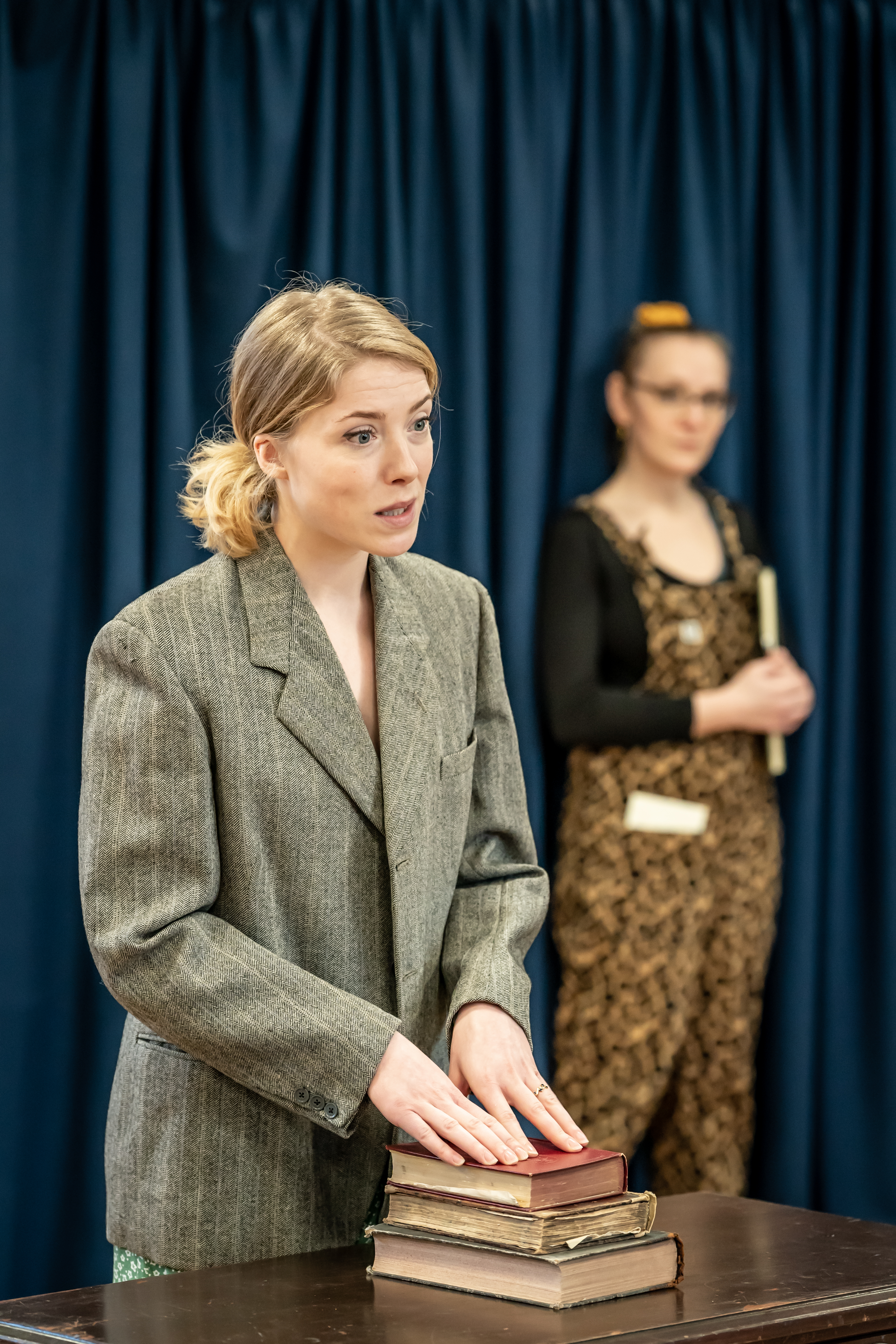
Hannah Morrish as Portia

Oberman has long been fascinated by Britain’s history in the 1930s, a time that saw flirtations from the country’s aristocracy with the parties of fascism both at home and in continental Europe. It is no small coincidence that Mosley’s march of fascists that led to the Battle of Cable Street, occurred during the brief reign of Edward VIII, himself strongly suspected of harbouring fascist ideals. Oberman sees the play as shining a spotlight into some of this country’s darker crevices. 

She is also proud of having reinvented Shylock as a female role and in so doing, reclaiming a different aspect of the narrative. Referencing how within the text, that Shylock is referred to as a dog and Antonio, the merchant to whom Shylock has loaned money secured on a pound of flesh, kicks at her and spits at her, Oberman sees a clear link between misogyny and antisemitism. She is well qualified to make such an observation. Away from the stage Tracy-Ann Oberman is one of the UK’s leading campaigners in today’s fight against antisemitism, a role that has seen her subject to some of the vilest abuse imaginable. Oberman has seen all too clearly in her inbox and her social media streams the seamless link betwixt the hatred of Jews and a hatred of women.

On the subject of women I quiz Oberman on Shylock’s relationship with daughter Jessica. Penned by Shakespeare with a father/daughter perspective in mind, how is the mother/daughter dynamic evolving? The mother of a teenage daughter herself, Oberman observes that Jessica has the capacity to range from being her mother’s best friend to her worst enemy and she is relishing that parental aspect of the role. 

Exploring as to how this interpretation of the play may be received by people who don’t share Oberman's Jewish heritage, she comments that she’s already observed people who’ve seen the play in rehearsals, friends of hers from working class backgrounds or diverse immigrant backgrounds, who are are recognising aspects of her Shylock in their own heritage and also with Shylock as a matriarch, identifying strongly with the strong woman that Oberman portrays. 

The conversation would not be complete without an understanding of the supportive role that Watford Palace Theatre have played in bringing the play to fruition. Oberman speaks with an affection towards the venue that is almost tangible. Growing up in the London suburb of Stanmore, close to Watford, she would visit the theatre often as a child and it was there that her passion for acting was encouraged and nurtured. In later years and meeting up with Brigid Larmour, the Artistic Director of Watford Palace, it was Lamour who asked the actress what she was doing, to which Oberman replied that she was working on “this idea of a female Shylock”. From there the two of them took the idea forwards, receiving developmental support from the RSC, with Oberman reflecting warmly that Larmour has proved to be an incredible ally both creatively and politically.

In the first scene of The Merchant of Venice Antonio famously says the world is “A stage where every man must play a part”. On the Watford Palace stage Tracy-Ann Oberman will be upending Antonio’s words in what promises to be an exciting evening of Shakespeare.


The Merchant of Venice 1936 runs from 27th February to 11th March and then tours


The cast of The Merchant of Venice 1936

Rehearsal photos by: Marc Brenner

Sunday, 17 December 2017

Titus Andronicus - Review

Barbican Theatre, London


****


Written by William Shakespeare
Directed by Blanche McIntyre


David Troughton

The RSC once again proves that Quentin Tarantino aint got nothin’ on good ol’ Bill Shakespeare with this gloriously gruesome production of Titus Andronicus, first seen at Stratford earlier this year and now playing at the Barbican until 17th January. For those Scrooges among us, Titus Andronicus is truly the antithesis to the seasonal festivities as gleeful gore replaces glitter and garlands.

The titular Titus is the badass general in the triumphant Roman army. Returning from a long battle against the Goths and with their Queen Tamora and her delightful (!) sons in tow, Titus kicks off the action by sacrificing the Queen’s oldest son to avenge the deaths of his own sons during the war. What follows is a cycle of revenge and pettiness that spirals out of control with the hands of Aaron the Moor (a wicked performance from Stefan Adegbola) firmly on the wheel.

Headed up with an engaging performance from RSC stalwart David Troughton as the frail but somehow still intimidating Titus Andronicus, the play is quite the ride with humour kept firmly at the forefront even as Titus finds himself losing a limb, very slowly. This clever offset of what is Shakespeare’s most bloody and brutal play keeps things as light as they can be, difficult for a three hour production.

A spurned-love opening moment sees Tamora (Nia Gwynne) elevated to Empress of Rome opposite the newly installed Saturninus (Martin Hutson portraying wonderful ignorance) shortly after her son’s sacrifice. Not unreasonably, she bears nothing but terrible intentions and the illustrious Gwynne relishes every minute. Brothers Goth are certainly grim, inspired by their mother’s thirst for vengeance and violence, and almost childish in their pursuit and destruction of Titus’ only daughter Lavinia. Portrayed by Luke MacGregor and Sean Hart as brothers too in love with each other (at the moment platonically) to ever have a meaningful relationship outside their twosome, the actors have fun with the absolute wretchedness of their characters and bounce off each other, sometimes quite literally, with ease.

Marcus (Patrick Drury) heads up what is left of the Andronicus clan with Titus, together with Lucius (the stunning Tom McCall) and Lavinia (Hannah Morrish) who, putting it lightly, suffers a pretty terrible time. This clever quartet are certainly there to be rooted for as the idiots that surround them come crumbling down.

There were a couple of prop mishaps (the bloodiest Shakespeare was a little bloodless at times) that kept the play from being as flawless as other RSC productions. Though backed by the simple fortress set - designed by Robert Innes Hopkins - with many trap doors in which deaths, baths and burials can occur and combined with Blanche McIntyre’s grand and generous direction, the company depicts the tragedy of Titus Andronicus with a chorus of orchestrated bloody chaos that is breathtaking to behold.


Runs until 19th January 2018
Reviewed by Heather Deacon
Photo by Helen Maybanks (c) RSC

Thursday, 6 July 2017

Titus Andronicus - Review

Royal Shakespeare Theatre, Stratford upon Avon


***


Written by William Shakespeare
Directed by Blanche McIntyre


David Troughton

Blanche McIntyre strives to give an aura of political correctness to her take on the bloodiest of Shakespeare’s plays - but she misses the point. Titus Andronicus is always going to be more about its final act’s Imperial Bake-Off than it will ever be about the failings of society. 

A lengthy mise-en-scene featuring masked social justice warriors protesting about “Austerity” drags the Roman setting to 21st century Britain. As an amuse-bouche it’s certainly well choreographed, (suggesting at times the Crapshooters’ Ballet from Guys and Dolls) but McIntyre protests too much, methinks. However hard a director’s moral compass may point her to dress up Titus Andronicus with a worthy polemic, one must remember that it remains little more than a 16th Century Carry On caper. Misogyny, mutilation, rape and murder drive the narrative, with a degree of violence that by today’s standards would be both offensive and gratuitous.

That’s not to say Titus Andronicus  shouldn't be performed. It merits its place in the canon, but for all McIntyre’s worthy endeavours she’s still delivered a play that treats women abominably and other than, perhaps, Aaron’s scheming lies being labelled as “Fake News”, has little real comment to offer upon today’s events, however broken our world may be perceived to be.

David Troughton is a strong and forceful Titus. His love for Rome is unquestioning as he carries the role of weathered warrior magnificently.  We share his grief and he wins our sympathy as he pursues his own path in this most vengefully vicious circle. Likewise Martin Hutson’s Saturninus is appropriately oleaginous - there’s shades of any politician you may care to think of in his performance, but understand that any such resemblance is fleeting and barely more than superficial. 

Nia Gwynne’s Tamora is a curious casting. Gwynne captures the complex essence of Tamora’s maternal vengeance, and in the final act her portrayal of Revenge is truly ethereal - but she lacks the sex-fuelled stature of a Tamora who’s as capable of seducing Saturninus as she is to wantonly surrendering to Aaron.

Stefan Adegbola and Nia Gwynne

McIntyre is on record as having been kept “awake at night” (and rightly so) that the play’s violence against women is portrayed responsibly, but only in some very small part she has succeeded. Tamora’s wincing (was this an aspect of sisterly concern for Lavinia?) as her sons violently ravished the helpless young woman seemed contrived, as if to suit McIntyre’s agenda rather than define Tamora’s credibility. And again, in the play’s endgame, one might have hoped that McIntyre, as a modern woman, may have offered some tiny moral slant on Titus’ slaying of his daughter as worthy of some critique for the despicable “honour killing” that it truly is, rather than let it flash by in the melee of mealtime madness.

Where McIntyre has offered some new insight is in her use of the supernatural. The spirits of Titus’ dead sons Quintus and Marcius appear often, not least in the scene where Titus overpowers and captures Chiron and Demetrius, assisted by the two dead brothers’ bloodied but muscular ghosts. In a scene that is often hard to explain technically (just how does the old Titus come to overpower two fit and strapping young lads?) McIntyre makes it work. The ghost of Alarbus also appears in a final moment that offers a jolt reminiscent of the closing shock of Stephen King’s Carrie, hinting at the never ending cycle of Rome’s revenging curse.

Hannah Morrish’s Lavinia is a charming if emotionally muted interpretation. Bereft of tongue and hands, the role will always be challenging and whilst Morrish garners our sympathy, were she to dig just a little deeper she’d make us weep. Luke MacGregor and Sean Hart (respectively Chiron and Demetrius) are recognisably modern day thugs. Both actors possess a lithe muscularity that supports their personae and they equally impress, suspended by their ankles, as Titus wreaks his vengeance upon their throats. There’s a hint of TV’s Nick Hewer (or maybe Theresa May’s husband Philip) to Patrick Drury’s Marcus where again, a little more depth might really show an avuncular love for the violated Lavinia.

Arguably the star turn of the night is Stefan Adegbola’s Aaron. His vocal work is perfection and with sparkling eyes and an amazing physicality, Adegbola truly suggests the diabolical, at the same time displaying a love for his bastard child that is as passionate as his contempt for those he ruthlessly despatches.

The lighting, music and design are fun and if there’s a minor niggle, its that the hardworking RSC techies still need to sort out the effectiveness some of the hidden blood bags (especially Bassianus’), where a clumsy special effect can easily shatter the hard won suspension of our disbelief 

The political treatment may be naive, but the merciless misogyny of Titus Andronicus is probably and sadly timeless in too many of today’s multi-cultured communities - it’s only a shame the programme notes don't highlight that particular observation.

Nonetheless, lavishly budgeted productions of Titus Andronicus don’t come along that often and so for that reason if no other, the show is worth a pie-packed trip to Stratford. Or why not book now to see it at the Barbican over Christmas, for a very alternative festive feast!


Runs until 2nd September

Broadcast live to cinemas on 9th August

Plays at the Barbican Theatre, London from 7th December 2017 until 19th January 2018

Photo credit: Helen Maybanks