Showing posts with label Finborough. Show all posts

Wednesday, 5 November 2025

Mr Jones - Review

Finborough Theatre, London


*****


Written by Liam Holmes
Directed by Michael Neri


Mabli Gwynne and Liam Holmes

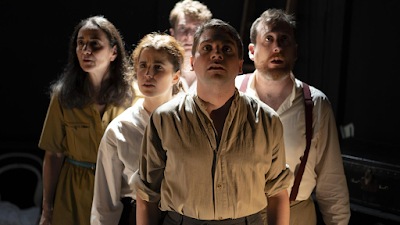
Stephen Jones (played by Liam Holmes) is a young lad from Aberfan in south Wales. A gifted rugby player, he’s the ‘King of the Village’ have just propelled the team into the cup-final. Angharad Price (Mabli Gwynne) is his teenage sweetheart and a young nurse. Stephen lives with his widowered father and his little brother David who’s a pupil at the village primary school.

But this is 1966 when on Friday 21st October a waterlogged, mountainous tip of spoil slid down the hillside and devastated Aberfan. 116 children at the primary school perished in the disaster, together with 28 adults - and the tight, tiny village community was shattered.

In an astonishing piece of theatre, Holmes has penned the most remarkably intimate portrayal of Welsh village life alongside the unimaginable grief of the Aberfan disaster. His play is a simply staged two-hander that spends its first 30 minutes building the characters. The craft in Holmes’s writing is exquisite, with hints of Dylan Thomas in his affectionately mocking descriptions of the village characters. But that half-hour is time well spent, for it allows the audience to have deeply invested in the villagers. When the tip collapses and 150,000 tons of slurry descend on Aberfan - all we hear is a growing, growling, horrendous rumble - the look of disbelieving horror on the two actors’ faces is almost unbearable to observe.

Holmes the writer shifts his times and locations around the later weeks of 1966 as Angharad and Stephen try to come to terms with the impact of the disaster. Holmes the actor, together with Gwynne are a masterful pair. He in dealing with the loss of the younger brother who idolised him, and her in having to have coped with the trauma of receiving the bodies of the dead children at the hospital. 

It is rare to see new writing of such stellar quality. The two characters navigating their grief makes for harrowing and heart-breaking drama. Simple narratives, combined with outstanding acting. Theatre does not get better than this.


Runs until 22nd November
Photo credit:  Ali Wright

Thursday, 13 February 2025

The Passenger - Review

Finborough Theatre, London


**


Written by Nadya Menuhin
Based on the novel by Ulrich Alexander Boschwitz


Robert Neumark Jones

Drawn from his personal experience, The Passenger was a novel by Ulrich Alexander Boschwitz describing the flight of Jewish Otto Silbermann from the horrors of Kristallnacht in 1938 Germany. Nadya Menuhin makes her playwriting debut with the piece, but while Menuhin’s intentions in translating the book to stage are honourable, the result is a one-act self indulgence that lacks dramatic sophistication and cries out for the input of a skilled dramaturg.

Robert Neumark Jones is Otto in a performance of remarkable energy that sees him onstage for the play’s entire 100 minutes. The story follows Otto’s journey in a cross-country railway travelogue that sees him, futilely, attempting to flee Berlin. Simply staged with no scenery, Joseph Alford’s carefully crafted soundscape is as impressive as Jones’ performance. A supporting quartet of actors deliver a multitude of roles ranging from Otto’s Aryan wife Elfriede (Kelly Price), through to to both the friendly folk and also the Nazis that he encounters on the rails.

In amongst the dialogue there are snippets of a history lesson - but Tim Supple’s staging is too simplistic and at times disappointingly pretentious. In what feels like a sometimes tedious evening, there’s a hint of a great play lurking within The Passenger. This isn’t it.


Runs until 15th March
Photo credit: Steve Gregson

Saturday, 3 December 2022

12:37 - Review

 Finborough Theatre, London


***


Written and directed by Julia Pascal


The cast of 12:37

Julia Pascal’s 12:37 is a multi-layered exploration of nationalism in the mid 20th century, that follows Paul and Cecil Green, two Irish-Jewish brothers, from 1935 Dublin through to the creation of the State of Israel in 1948, via a 1936 encounter with London’s fascism.

Pascal’s research is detailed, spotlighting a hatred of the Jews on both sides of the Irish Sea that prompts the brothers, via separate circuitous routes to find themselves in Palestine under the British Mandate.  Paul (Alex Cartuson) is lean and fit, a boxer in his youth, who works his way into the nascent army fighting for the establishment of the Jewish state and ultimately into being part of the terrorist gang who, at 12:37 on 22nd July 1946, bombed Jerusalem’s King David Hotel, a key base for the British Forces. That devastating action that was to prove influential in the UK’s withdrawal from Palestine and the subsequent creation of Israel. Cecil (Eoin O’Dubhghaill), less of a fighter than his brother and a kinder soul with a beautiful voice, finds his own journey to the Holy Land via ENSA, the British military’s entertainments division.

Perhaps the most intriguing character in Pascal’s play is the young Rina Goldberg (Lisa O’Connor) who we first encounter in London as a firebrand communist raising funds for Moscow’s Yiddish Theatre, and who by 1946 has survived the Holocaust, experiencing horrendous sexual violence having been moved around between concentration camps by the Nazis. The love triangle that Pascal creates between Rina and the brothers may lack credibility, but O’Connor’s interpretation of Rina’s horrific journey is a masterclass of powerful understatement.

The quintet of actors is completed by Ruth Lass and Danann McAleer and across the two hours of the drama all five put in outstanding and compelling performances, with Pascal’s direction making ingenious use of the production’s evidently modest budget and the Finborough’s compact space. An observation on the casting (albeit a company of excellent performers, doing their job superbly) is that the producers appear to have put more effort into ensuring the ethnic authenticity of actors playing most of the Irish characters, than they have as regards those playing the Jewish characters.

Dr Pascal is at her best in her slow, harrowing reveal of Rina’s story and equally talented in the bold technical construction of her play. Politically however she loses objectivity, her writing suggesting that she is uncomfortable with the concept of national identity per se. That this production’s printed programme/playtext itself ignores the time and location of the play’s final scene, set in 1948 in the newly-formed Israeli state, speaks volumes.


Runs until 21st December

Friday, 25 August 2017

Late Company – Review

Trafalgar Studios, London


****


Written by Jordan Tannahill
Directed by Michael Yale


Lucy Robinson, Lisa Stevenson and David Leopold

The stage is set for a dinner party in Late Company, a play that is making a rare and well deserved transfer across town from the fringe's Finborough to the West End's Trafalgar Studios. The opening dialogue is packed with wit and humour and yet, as the audience quickly discovers, this is not a happy occasion; rather it’s quite the opposite. This is a dinner that much like Titus Andronicus' endgame, is a meal that not one person around the table wishes to attend.

Joel Shaun-Hastings – the only child of Debora and Michael – has recently taken his own life and one of his bullying peers is Curtis Dermot. A child tormented by guilt that is, for a large part, compounded by an external narrative and gossip, Dermot is invited to this dinner of penance with his parents. The evening could almost be simultaneously billed as a cure both for the Shaun-Hastings’ grief as well as for the Curtis’ individual and familial demons – a very tall order.

Over guacamole, pasta and wine, the tale unravels. New facts come to light throughout the evening, each adding a new layer of complexity to the story and ultimately serving to cloud assignment of blame.

And the blame is spread in many different directions. Both sets of parents face scrutiny about their parenting styles. Attitudes to sexuality within the room and in society are examined, while mental health, bullying, perception and social media usage are also examined. It’s clear that there are many factors at play here, explored in a tight 75 minutes by a sterling cast.

Todd Boyce and Alex Lowe play the fathers and Lucy Robinson and Lisa Stevenson the mothers. Robinson is excellent in her ability to capture the dual tension of Debora’s grief. Her bereaved mother not only has a need to grieve but also to find closure. Stevenson provides a complex emotional ballast to her counterpart, in a majestic performance.

Arguably, the most striking character on the stage is David Leopold’s Curtis. The weight of his guilt appears to flit between being negligible and crushing – and it is this that sits at the crux of the problem in Debora’s eyes. Tough questions are raised about the nature of remorse and how it should be demonstrated, or indeed even recognised, in the most appropriate manner.

Most gripping is the fact that Curtis is a child, or at least he was. When offered a drink, he asks for a glass of milk and taps away on his phone as expected of a regular teenager. Yet although the milk is soon forgotten, replaced by a cigarette outside, it remains in plain sight; a constant reminder that he is straddling that perilous transition from childhood to adulthood. As the evening progresses, his growth is alternately impressive and heart-breaking.

75% of suicides are male, as information from Campaign Against Living Miserably in the programme informs us. And as the play aptly illustrates, it is a deeply complex issue that can be unpacked to some extent on stage, but leaves a plethora of further questions unanswered.

Under Michael Yale’s capable direction, Late Company is a high-calibre, punchy production with excellence running through every strand. After launching from an intriguing premise, it runs rapidly through a series of highly pertinent themes, sparking thoughts that continue well after the figurative curtain falls.


Runs until 16 September
Reviewed by Bhakti Gajjar

Wednesday, 3 May 2017

Late Company - Review

Finborough Theatre, London


****


Written by Jordan Tannahill
Directed by Michael Yale


Lucy Robinson, Lisa Stevenson, David Leopold

Late Company is a modern tale of domestic devastation. A compelling Canadian drama that sees Debora and Michael Shaun-Hastings (she's an artist , he an MP) struggling to cope with the suicide of their tormented teenage son Joel, their only child, some months previously. 

Set around the dinner table of the bereaved parents, their guests for the evening are Bill and Tamara Dermot together with their son Curtis, a peer of Joel’s at school and the ringleader of the bullies who had taunted him to his death.

The one act work lasts for an intense 70 minutes that pass with excruciating speed. The bereaved grief of the Shaun-Hastings is palpable in so many different ways - Where Todd Boyce's Michael has plausibly attempted to get on with his life, to the extent of concealing aspects of Joel's difficulties from his wife, Lucy Robinson's Debora is still raw with pain. 

Much like King Lear's final moments, Robinson breathes a recognisable howl into the unimaginable pain of such a tragic bereavement - retelling in a letter that she has written to Curtis, the incomprehensible pain of discovering her son dead in a bathtub. There is not a shred of melodrama in Robinson's work, simply a performance of carefully crafted grief and emotion that has to rank amongst the finest in London.

There's stunning work too from David Leopold's Curtis, who in a character that is not afforded much dialog to work with, delivers a startling depiction of sullen teenage inarticulacy. Leopold takes Curtis on a journey that starts with awkward shame and ends in profound and sincere regret for his actions. His is perhaps the evening's most complex of characters to portray and he delivers perfectly. 

Lisa Stevenson and Alex Lowe as the Dermot parents similarly turn in assured interpretations of complex characters. Offering an understandable thread of sympathy for the Shaun-Hasting's loss yet still with their own primal defence of Curtis, there's a troubling resonance to their responses around the dinner table. Clumsy yet conventional in their view of the world, we may not all have encountered folk who bear the pain of the Shaun-Hastings, but we can all recognise the Dermots.

Michael Yale directs his company with an incisive sensitivity, with Zahra Mansouri's set proving as economic as it is effective - the tiny cockpit of the Finborough lending itself perfectly to the stifling intimacy of this particular dinner.

Late Company examines grief, shame, parenthood and marriage alongside a backdrop of the all pervading, corrosive power of the internet and social media, particularly upon the young. The play also proposes an argument suggesting that bad deeds are not necessarily committed by bad people,

Not an easy night at the theatre, but Late Company makes for compelling, essential drama. 


Runs until 20th May
Photo credit: Charlie Round-Turner

Monday, 20 March 2017

I’m Gonna Pray For You So Hard - Review

Finborough Theatre, London


***


Written by Halley Feiffer
Directed by Jake Smith


Adrian Lukis and Jill Winternitz

At first glance, I’m Gonna Pray For You So Hard appears to be a somewhat self-indulgent glance into the life of David, an egotistical celebrated playwright complaining about a ‘hard done by’ life, whilst surrounded by a lavish and modern apartment, with a long standing marriage and a loving daughter. However, it quickly transpires that years of poor choices in his childhood and career have instilled in David a highly damaged and addictive persona that, in a single night, whilst waiting to read his daughters off Broadway play review, destroys his comfortable, conceited lifestyle and brings his world crashing own around him.

Adrian Lukis is David, in a role spans a great deal of emotional intensity, varying from playful, fatherly pride and affection, to spiteful and egotistical aggression within the space of seconds. Lukis portrays each state with great intelligence and depth. His is the standout performance of the two hander and his clear understanding and depiction of David’s destructive personality and ingrained sense of self-loathing is heart wrenching and ultimately, praiseworthy. In spite of this, the juxtaposition of David’s apparent obsession with leaving himself a more positive legacy than that left by his own father and his near violent mistreatment of Ella (whether intentional or not) creates some confusion within the character. A fault not in the acting but in the writing and direction of the play.

It is clear that Ella (Jill Winternitz) has an almost obsessive admiration for her father and hangs on his every word, even going so far as to mirror not only his drinking and drug habits but his use of language as well. Winternitz’s performance feels underwhelming against the performance given by Lukis. What she lacks in subtlety however is made up for in passion creating a performance that seems almost surreal in such an intimate space giving credence to the adage “less is more”.

Despite its flaws Halley Feiffer’s play is a harrowing yet interesting story that genuinely makes one care for the characters. Jake Smith creates a piece that both moves and distresses the audience, touching upon a number of sensitive topics.


Runs until March 25th 
Reviewed by Charlotte Darcy
Photo credit: Scott Rylander

Friday, 28 August 2015

My Eyes Went Dark – Review

Finborough Theatre, London


*****

Written and directed by Matthew Wilkinson


Thusitha Jayasundera and Cal MacAninch


"...If a country can't protect the rights of its people, what can a man do? A man must stand up... A man must defend himself."
Matthew Wilkinson's My Eyes Went Dark is an extraordinary piece of work. It tells the story of man, Nikolai Koslov, (played by Cal MacAninch) who loses his wife and two young children in a plane crash that occurred when two planes collided mid-air.

Grief stricken and utterly disconnected from the world without his family ("My life. As any family is the life of the individuals within it"), he seeks justice. This search begins immediately; as he is digesting the reality that his family is gone at the beginning of the play, he questions what happened, asking for an update on the flight recorders and attempting to coerce an explanation, of any sort, from the official he is speaking to.

This is a particularly striking characteristic of Koslov who, as a successful architect and family man, is probably used to drawing clear lines between events, ideas and thoughts, drawing out rational conclusions accordingly. He seems to be a rational being and a normal functioning one at that. This is best typified in professional settings, such as when he is giving an interview or operating in a work environment. 

This two-hander also features an outstanding performance from Thusitha Jayasundera, who plays ten different characters to incredible effect. 

Beautifully suited to the intimacy of the Finborough, the staging is simple; it features only two chairs. The sound design (Max Pappenheim) and lighting (Elliot Griggs) are flawless. Props are invisible but acted with such conviction that their physical absence is barely registered. 

The performance lasts approximately ninety minutes and comprises an intense sequence of scenes, cutting back and forth over the span of five years, over three different countries. Throughout its course, a range of themes including commentaries on justice systems, corporate responsibility and politics are investigated and provide much for consideration. 

What is incredibly powerful about My Eyes Went Dark is its ability to explore the complex and permanent effects of plane crashes. It is a tragedy that most of us are familiar with, blessedly, only through news reports that the media thrive on. The play however offers a stark reminder that the effects never leave those who have experienced loss and for whom so many questions are left unanswered.  

Wilkinson, MacAnich and Jayasundera capture this tragedy perfectly and hauntingly.


Runs until 19th September
Guest Reviewer: Bhakti Gajjar

Saturday, 4 July 2015

As Is - Review

Trafalgar Studios, London

****

Written by William M. Hoffman
Directed by Andrew Keates


David Poynor and Steven Webb

As one sits in the Trafalgar Studios waiting for Andrew Keates’ production of As Is to begin, there is an awareness of a gentle backdrop of conversation that eventually distils into individuals speaking of when they learned of their AIDS diagnosis. Gradually it builds, with statistics about the numbers of people dying or infected beginning to get louder. Perhaps the most uncomfortable soundbites are the (1981) news stories declaiming in loud American voices the menace of the Gay Plague along with vox pop interviews of members of the public saying how “they only have themselves to blame”.

It is two years since Keates brought William M Hoffman’s play to London’s Finborough Theatre and it has grown in impact. The set of the play is sparse but effective as a hospital space / New York loft complete with prerequisite red drainage pipes suspended from the ceiling. Strange multi-coloured light boxes hang on the walls. But perhaps most interesting is the use of the blackboard paint on the three other walls with names written in chalk. The audience is invited to write the names of AIDS victims known to them with the chalk provided.

Essentially As Is is a love story. Rich and Saul are a couple. They have lived and loved together for a long time. Saul is deeply happy and contented. He sees the relationship as having structure and stability. He describes it as being “Something to fall back on when life throws you a curved ball”. But Rich is stagnating. A writer “who can’t”, but who finds a muse in Chet (Giles Cooper) who is all muscle and California Dreaming. Rich (played excellently by Steven Webb) is leaving Saul to live with Chet. The only item from their life together he wants is the Barcelona chair. Then Rich discovers he has AIDS.

Suddenly the whole cast are on stage declaiming how Rich’s diagnosis has affected them. His caterer mother’s company loses contracts, his sister’s new hotshot boyfriend won’t meet the family for fear and embarrassment, whilst his brother has a wife who forbids him to have any contact with Rich for fear of the health of their children. All around is ignorance, panic and a crescendo of voices to deliver the line “What are my chances?”.

Rich is taken back by Saul (David Poynor) whose tenderness and real love of Rich is incredibly moving. Saul is prepared to stand by his man even though he may be gambling his own life. Rich gradually comes to realise the power of true love.

The issue of sex crops up now and then as you would expect. Some of the content is quite explicit but not gratuitous, with both Bevan Celestine and Russell Morton simmering with sexuality in leather and a hilarious scene where Rich and Saul discuss sex and how much they miss it.

Part public health information and part entertainment, As Is never preaches, rather it delivers. This is a laugh-out-loud and cry-out-loud production which explores what it is like to be outside of society, not only as an HIV+ individual, but also as a human being facing his or her own mortality. Amidst hilarious one-liners, we are reminded that none of us know what lies ahead of us. We must not just enjoy life, we must also protect ourselves and our health.

In publicly declaring his own HIV+ diagnosis Keates has made a personal stand that it as inspirational today as Hoffman’s prose was decades ago. The emotional and physical importance of As Is demands that it be seen.


Runs until 1st August 2015
Guest reviewer: Lucy Middleton

Thursday, 8 January 2015

The Grand Tour - Review

Finborough Theatre, London

****

Music and lyrics by Jerry Herman
Book by Michael Stewart and Mark Bramble
Directed by Thom Southerland


Nic Kyle and Alastair Brookshaw

Thom Southerland's production of Jerry Herman’s The Grand Tour may tell a bittersweet fable, but the show defines all that is good in fringe theatre today. Whilst Broadway success may have eluded its 1979 premier, a staging in the 50 seater Finborough offers the rare privilege of seeing this eclectic work make its maiden voyage across the Atlantic.

The pedigree of Herman, Bramble and Stewart was already established when they collaborated on this tale of tragic whimsy, set against a backdrop of France's encroaching Nazi occupation. Jacobowsky, a Jew who has already fled his native Poland and subsequently Austria and Czechoslovakia must flee Paris. So too must Colonel Stjerbinsky of the exiled Polish Army. Like the Nazis, Stjerbinksy hates Jews but the Germans are after both men and so out of necessity an unlikely allegiance is formed. Throw in a beautiful French woman Marianne, to whom not only is the Colonel betrothed but who can also recognise the human decency of Jacobowsky and the tale evolves into the most tragi-comic of Road movies, as the Holocaust’s tragedy looms.

Alastair Brookshaw’s Jacobowsky is a stunning performance that leads the show. Avoiding caricature, Brookshaw (an actor whose choral career has seen him more accustomed to Westminster’s Abbey rather than Syngaogue and who now, following his outstanding Leo Frank in Tarento’s 2011 Parade confirms his Jewish credentials) nails Jacobowsky’s desperate vulnerability in a performance that combines hilarious chutzpah with profound pathos. Onstage almost throughout, Brookshaw’s opening number I’ll Be Here Tomorrow, sung as he walks, stumbling, across the outstretched arms of the company, evokes the frailty and the tragedy of the time perfectly.

Nic Kyle is the Colonel. His is a tough act, playing the bad-guy/straight-guy to Jacobowsky’s antics, yet the kiwi Kyle skilfully manages his character’s transition as he learns to love his Jewish travelling companion. Completing the trio is Zoe Doano’s Marianne. Doano’s singing matched by her perfect poise and presence that convinces without once becoming sugary, evidences her West End experience.

As well as producing, Danielle Tarento casts the show and her eye for talent is, as ever, spot on. Blair Robertson’s murderous SS Captain defines a villainy that is cliché free, whilst Vincent Pirillo’s Jewish father whose grief as the Nazis destroy his daughter’s wedding (in a scene that is one of several gloriously choreographed routines from Cressida Carre) is a beautifully sung turn that also avoids melodrama.

The Finborough’s stage is tiny yet Phil Lindley’s ingenious scenery, comprising panels that open to reveal differing backdrops sets the locations wonderfully. The act one closing number, One Extraordinary Thing, set in a circus big top complete with high wire routine is a particular delight. Max Pappenheim’s well crafted sound design adds authenticity, whilst Joanna Cichonska’s filleting of the orchestral score to an arrangement for just two pianos maintains the charm of Herman’s melodies whilst never drowning the un-mic’d actors. Southerland has got the balance of song and setting just right – every lyric is crystal clear.

Reflecting the fate of France’s Jews, The Grand Tour offers no happy ending. The narrative may be fiction, but the backdrop is the most painful truth and in this expertly assembled troupe, Danielle Tarento offers up yet another slice of theatrical genius.


Runs until 21st February 2015

Thursday, 7 August 2014

Thérèse Racquin - Review

Park Theatre, London

****

By Ã‰mile Zola
Adaptation, book and lyrics by Nona Shepphard
Music by Craig Adams
Directed by Nona Shepphard

Greg Barnett and Julie Atherton

Thérèse Racquin, the new musical that wowed the Finborough earlier this year, makes a short journey across West London to be staged at the larger, though still intimate, Park 200 auditorium. French classics clearly prove a rich seam for composers. Where 30 years ago Boublil and Schönberg tackled Hugo's Les Miserables, so now do composer Craig Adams and writer Nona Shepphard take on Ã‰mile Zola's classic study on desire, guilt and most importantly the corrosive effect of these two emotions upon the human condition.

The story may be more than a hundred years old but it's a strong morality fable that responds well to Shepphard's "radical" adaptation and Adam's jarring melodies. This is no easy show to watch. The themes of lust, betrayal and hauntings, as well as some distinct nods to Zola's theatrical naturalism and all strung around a murderously macabre ménage á trois, demand an adult audience.

The performers are a treat. Who better than Jeremy Legat to play the cuckolded Camille, Therese's husband, with such sensitivity and marked understatement? Usurping his place in the marital bed, Greg Barnett plays the louche Laurent, Camille's childhood friend. Of swarthy peasant stock, muscular and vital, he is the alpha-male that Thérèse burns and yearns for. Proving a decaying and ultimately suspicious force within the home, Camille's mother Mme. Racquin is a cracking performance from the ever accomplished and occasionally menacing Tara Hugo.

The success of this show however, ultimately rests upon the slender and adulterous (though only in character, of course) shoulders of Julie Atherton as Thérèse. On stage for virtually the entire show, Atherton is silent for the first fourty-five minutes, before releasing her pent up desire for Laurent in the passionate I Breathe You In, sung as the two lovers consummate their lust. It is not so long since Atherton played Emily Tallentire in Leicester Curve's The Hired Man - she evidently plays the cheating wife well. In the final act, her contribution to the duet If I Had Known are spine tingling.

Some of the songs are inspirational. Thursday Night, sung by the company as they enjoy the weekly game of dominoes that old Mme Raquin hosts, suggested just a twinkle of Guys and Dolls' The Oldest Established, whilst Sweet Perfume Of Violets is possibly one of the most beautifully horrific songs in the canon, with Adams penning a truly haunting melody.

One criticism: Sat stage right of the Park's shallow thrust one can miss occasional visual moments. The Park is a very different space to the Finborough and it's not too late for Shepphard to tweak her blocking.

An imaginative use of a female trio as chorus adds to the harmonic delight of the production, whilst James Simpson directs a fine sound from the (mainly) string quintet. With Thérèse Raquin Shepphard and Adams have created invigorating and exciting new musical theatre. The show represents a cutting edge of the genre at its very best and brilliantly performed.


Runs until August 24th 2014

Thursday, 16 January 2014

Lost Boy

Charing Cross Theatre, London

***

Book, music and lyrics by Phil Willmott.
Arrangements and additional music by Mark Collins
Directed by Phil Willmott

Steven Butler

J M Barrie’s Peter Pan is currently proving the inspiration for many a new piece of theatre the most recent of which, Phil Willmott’s musical Lost Boy, has just transferred to the Charing Cross Theatre. Focusing on George Llewelyn-Davies (a stirring performance from Steven Butler), one of the real-life inspirations behind Pan and set during the First World War, Llewelyn-Davis dreams of being the boy that never grew up, poignantly considering the nightmare that his generation has to face, sent out to fight whilst on the cusp of adulthood. The audience is made aware of being taken on an “awfully big adventure” and as we begin this year that commemorates the centenary of the war’s outbreak, there is an enormous sense of foreboding as we are introduced to the story’s young boys. 

It's a brilliant concept and to begin with the 'grown up' versions of Barrie's beautifully crafted characters are entertaining, cleverly suggesting their Neverland charm. It quickly becomes apparent though that you can have too much of a good thing. Wilmott’s plotlines become too complex, finding little room for the development of the multitude of stories. 

That being said, the many subplots do provide the cast of 12 with an opportunity to showcase their talents. Joseph Taylor gives an enchanting Michael Darling, Joanna Woodward an impressively gutsy Tinkerbell and Richard James King sings, arguably the best song in the piece, 'Jungian Dream Analysis' displaying brilliant comic timing to re-inspire us at the opening of the second act. 

The music – executed brilliantly by Isaac McCullough’s on stage trio of keyboard, clarinet and cello – tries to marry together contemporary styles and sounds with Edwardian Music Hall. The two don’t integrate well but, again provide a platform for the talents in the cast and in the final moments of the show the sound of the youthful ensemble is powerfully moving.

Having just moved across London from the Finborough Theatre it’s apparent that the show has had an opportunity to grow. It’s a charming idea, with incredible potential and is a moving tribute to the lost boys of the Great War.


Runs until 15th February 2014

Sunday, 18 August 2013

As Is

Finborough Theatre, London

***

Written by William M. Hoffman
Directed by Andrew Keates


Tom Colley and David Poynor

William M. Hoffman wrote and set As Is in New York City in the early 1980s. AIDS was relatively newly emerged and as Hoffman witnessed some of those around him succumbing to the illness, so he documented his interpretation of the time in this play. The story introduces us to Rich, a writer, recently diagnosed with the disease. His ex-boyfriend and as we are to learn, true love Saul, manifests a profound friendship and love for his former partner and the play tracks Rich’s decline through a combination of flashback sequences and contemporaneous exchanges with friends and family.

Acclaimed when it opened off Broadway 28 years ago, As Is moved on to Broadway within weeks, but time has not been kind to the piece. Notwithstanding outstanding acting and direction, whilst the play is a fine and sound history lesson, as a credible dramatic vehicle its structure is at times clichéd. Its depiction of aspects of the gay club scene pre-epidemic, seem cursory and sensational and when Rich speaks of sex on a tombstone in Marrrakech, it begs the question, “So what?”

As Is becomes a whirl of Rich’s experiences as the disease takes hold, including the horrendous prejudices to which he is exposed, but these moments flit by as if the author is trying to cram as many reference points into 90 minutes as is possible. Whilst the play nobly informs and educates it skims a very wide surface, rarely achieving much sympathetic or empathetic depth with its characters. Tom Colley’s Rich is undoubtedly a powerful and draining performance, but in the final act, hospitalised and dying, the actor physically bears too much of a resemblance to his own real rude health rather than an ashen diseased man, to convince us of his plight. A consequence of Rich's incongruously healthy appearance is that the gallows humour with which Hoffman has deliberately peppered his play, appears to resemble more of an ill-conceived comedy routine, rather than the desperation of someone facing death. And when Rich goes on to contemplate suicide, Hoffman sets out an argument that had been far better addressed when Brian Clark tackled the thorny question of the right to die in Whose Life Is It Anyway?

Andrew Keates’ interpretation is as slick and perceptive as the writing’s formulaic structure will allow. David Poynor is a credibly compassionate Saul, and Jordan Bernarde as Rich’s brother, torn between a wife terrified of her brother-in-law’s illness and his own love for his dying sibling, offers a rare moment of poignancy. Whilst the play may be dated, with HIV/AIDS remaining a current major global health concern, Keate’s beautifully performed production holds a valid significance today.


Runs until 31st August

Tuesday, 24 July 2012

An Incident At The Border - Review

Finborough Theatre

**

Written by Kieran Lynn
Directed by Bruce Guthrie


An Incident At The Border is a play whose whole is unfortunately less than the sum of its parts. Kieran Lynn’s piece sets out to comment on power, bureaucracy, the impotence of the individual vs the state and the dynamics between man and woman. A tall order for any piece of theatre and far too broad a canvas for an 80 minute one-act play.

The play opens with lovers Olivia and Arthur enjoying an afternoon in the park. The location is not specified, however recent significant political upheaval is alluded to. After defining the affection between these two, Lynn has a Ruritanical border guard, Reiver, literally pop up from behind a bush with a roll of duct tape, to demark a new national border that incongruously bisects a park bench and which of course separates the two lovers.


Marc Pickering as Reiver, delivers the most engaging performance from the cast of three. A barely trained armed guard, equipped with Taser and walkie-talkie, he plays a convincing inadequate, who enjoys the status that a uniform and a weapon bestow upon him, a status that he appears incapable of commanding in his own right. His performance chillingly shows how power can corrupt, how he believes his uniform and rank will make up for his sexual inadequacies and how, when his Taser is taken from him, he cowers with pathetic fear, scared of his superiors as well as of being stunned by the device.

Florence Hall and Tom Bennett are the lovers drawn into this impossible situation. Hall’s Olivia is an impetuous performance that at times shows perception, but all too often is reduced to shouted indignation as she rails against both Reiver’s ridiculous rules and her perception of Arthur’s apparent failures. Bennett’s character as her foil, is barely given an opportunity to move out of second gear and when he does, towards the end of the play, his military persona lacks credibility.

The playtext helpfully served as the evening’s programme. A brief study of this book reveals that the play’s ending as performed, differs quite fundamentally from the play’s ending as printed, both in word and action. This does not inspire the confidence of the audience in the writer’s ability to express his vision.

Whilst the three actors work hard, they are not helped by a script that should have been tighter and at least 30 minutes shorter nor by Guthrie’s direction that fails to effectively exploit inter-personal conflict.


@jaybeegee63


This review was first published on The Public Reviews website.