Showing posts with label John Logan. Show all posts

Friday, 18 May 2018

Red - Review

Wyndhams Theatre, London


*****


Written by John Logan
Directed by Michael Grandage
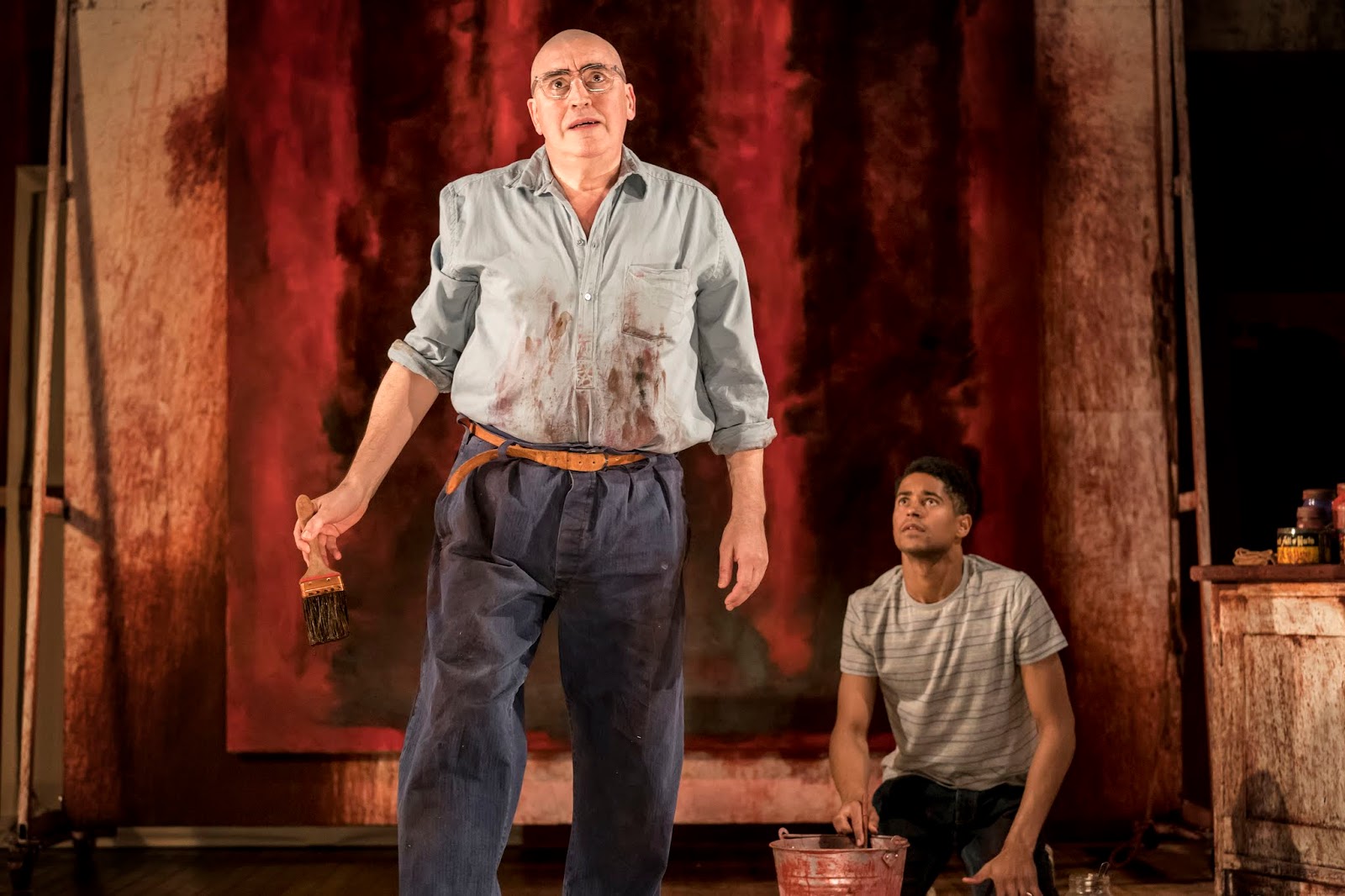

Alfred Molina and Alfred Enoch

There’s a chapel in a suburb of Houston, Texas, whose hexagonal walls each carry a black or nearly-black canvas by the abstract expressionist painter Mark Rothko. It’s a lonely, eerie space that can be meditative or depressing, depending upon your mood.

Rothko was an unknown abstract expressionist until 1959 when the architects of New York’s prestigious Four Seasons restaurant asked him to provide large scale paintings for decoration. The $35,000 that was paid to Rothko marked the highest value commission of an artist in America.

Having begun the paintings, Rothko dined at the restaurant one evening to “scope it out”. On finding the clientele pretentious, arrogant and at odds with everything in his Ukranian Jewish heritage, he tore up his contract, returned the money and eventually gifted eight of the pieces to the Tate Modern in London. They’re still there in room 3, and worth a look.

John Logan’s play focuses on Rothko in the throes of creating these masterworks.  In Michael Grandage’s tight, revived production (that first played at the Donmar Warehouse in 2009) all the technical elements serve to surround Alfred Molina, as Rothko, with excellence.

The replica canvases themselves, strung up in an enormous atelier as part of Christopher Oram‘s finely detailed scenic design, are variously dull and dark or glow mysteriously under Neil Austin’s bravura lighting design.  Music from Chet Baker to Gluck to opera attends the artist’s musings as Adam Cork’s sound design punctuates both the action and the scene changes with style.

Rothko is voiced with authority by Alfred Molina, a meticulously well-observed characterization as he shares his internal dialogue with Ken, a fictitious assistant played tautly - and possibly better than the original Eddie Redmayne - by Alfred Enoch whose own ‘story’ is neatly, if slightly melodramatically, linked to the dried blood colours of Rothko’s paintings.

Molina grows visibly both as a character and an actor during the performance: sarcasm, pain, pathos and anger all feel real, and the hints at future despair and suicide are as subtle as sighs.

There’s a stupendous scene in which the two work as a team to ‘size’ a canvas, filling the panel and spattering themselves with gore.  It’s physically thrilling: part ballet, part competition, part fight, played by the actors facing entirely away from the audience in one of the best wordless two-person scenes you could hope to encounter.

This is not Yasmin Reza’s Art, - a jejune 1990’s comedy vehicle for three luvvies off the telly to make cheap jibes about modern painting – rather, it’s an intense, well-written and tightly directed drama that in ninety minutes provides a rare insight into a man whose work seems baffling to the untutored eye.

Tutor yourselves, go and see it.  Then go to the Tate.


Booking until 28th July
Reviewed by Johnny Fox
Photo credit: Johan Persson

Friday, 20 April 2018

The Last Ship - Review

Playhouse Theatre, Liverpool


****


Music and lyrics by Sting
Original book by John Logan and Brian Yorkey
Direction and book by Lorne Campbell


Joe McGann and Charlie Hardwick
For the most part, Sting’s The Last Ship is a thing of beauty. The Geordie songwriter / pop megastar has penned a well-crafted salute to the shipbuilders of his native Newcastle Upon Tyne and their industry that has long vanished.

Sting’s roots shine proudly throughout the show. The language is frequently and gloriously in the north eastern vernacular while the melodies, be they balladry or the more rousing ensemble numbers,  are anchored firmly in English folk heritage. Think of The Hired Man, fused with Blood Brothers alongside a hint of Auf Weidersehn Pet and you start to get close to the show’s heartbeat. 

It’s hard (nigh, impossible) to write of the plot and remain spoiler-free. Suffice to say, not only is there a solid industrial foundation to the narrative, there is also a cleverly crafted human interest too. Themes of love, ambition along with both a respect for and a challenge to the importance of family and tradition, are well woven into the narrative.

Joe McGann and Charlie Hardwick lead the cast as Jackie and Peggy White, shipyard foreman and nurse respectively and both could not be more perfectly cast. Their singing voices may not be the finest, but McGann has a beautifully powerful presence that’s hewn from riveted granite. As he leads his workers in act one’s stirring Shipyard number, there is a believable wryness to his delivery that defines him, not only as a leader of men, but also as a shipbuilder with a deeply held a pride in his craft. Peggy is made of the same steel as her husband, but with the additional thread of a perceptively drawn woman’s compassion. We see her not only leading, but caring too. 

The story’s romantic theme derives from the school-love that blossomed between Gideon Fletcher and Med Dawson (Richard Fleeshman and Frances McNamee) and who we meet some 17 years later. Both actors are gifted with some of the show’s more heart-rending numbers, though McNamee leads the women in a gloriously tango-infused routine If You Ever See Me Talking To A Sailor.

The portrayal of the industry’s decline is as heartbreaking as it is recognisable. This review was written as the touring production played in Liverpool and there was a resonance to its message that was almost tangible sitting amongst the packed matinee audience in the Playhouse Theatre. Merseyside too has seen its docks and shipyards decimated.

But Sting and Lorne Campbell have pulled their punches with the villain of this piece. Mr Newlands (played by Sean Kearns) is the shipyard owner who, as his business crumbles, resorts to having to call in the police to clear the picketing workers, defiantly attempting to hold on to their livelihoods. He’s clearly the bad guy here, but the real "bad guy" was a far more complex machine of global and local politics and policies that crushed the shipyards along with many other of Britain’s heavy industries. Similarly, in a litany of current “issues” recited before the final bow, its hard to reconcile a reference to gun control in the USA, however fashionable that debate may currently be, with Newcastle shipbuilders stripped of their industrial pride and dignity. 

Creatively, the show is cutting-edge in its conception. 59 Productions’ set design makes for an ingenious use of simple girders and clever projections to create illusions that switch seamlessly from present day to backdrop to spiritualised suggestiveness. Lucy Hind has crafted clever and authentic dance work, while in the pit Richard John’s six-piece band makes Sting’s songs soar.

Whether the show will carry its charm into the metropolitan bubble of the M25 is hard to discern, with today's bloated Londoners being a world away from the harsh industrial axe that fell upon the North. Until then, the tour plays until July and it is well worth catching. 


The show tours until 7th July. Venues and dates can be found here.