Showing posts with label Eddie Redmayne. Show all posts

Monday, 13 December 2021

Cabaret - Review

Playhouse Theatre, London


*****


Music by John Kander
Lyrics by Fred Ebb
Book by Joe Masteroff
Directed by Rebecca Frecknall
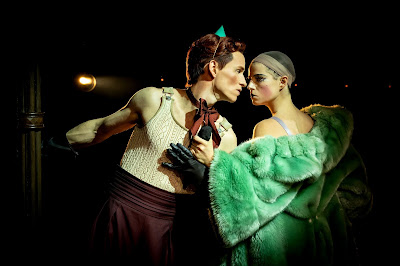

Eddie Redmayne and Jessie Buckley


In a remarkable transfiguration, London's Playhouse Theatre is ingeniously transformed by designer Tom Scutt to an in-the-round setting which after an equally imaginative pre-show mise en scene, goes a long way to transporting the audience to Berlin’s Kit Kat Club, the home of the show’s eponymous cabaret.

Rebecca Frecknall’s interpretation offers a bold take on the Kander & Ebb classic. The cabaret girls (“each and every one, a virgin”) are a chic metrosexual bunch, cleverly mixing 2021’s androgyny with Berlin’s famed inter-war decadence. The Kit Kat Club of course is a dive and rising from its deepest depths is the exquisitely ghastly Emcee, played in this iteration by Eddie Redmayne.

Cabaret’s Emcee is one of the most ingenious creations of late 20th century musical theatre. Almost like a Greek Chorus, or Lear’s Fool, he holds up a mirror to the Club’s audience (literally, in this staging, the theatre audience), parodying the hopes of the outside world (“Life is disappointing? Forget it”) while equally mocking the rise of Nazism and the persecution of the Jews. As Redmayne delivers If You Could See Her, the brutality of his satire chills to the bone. The actor is a tour de force throughout the piece such that when he is at times mute in the Finale, it only adds to the horrors that Germany as a nation will soon descend into.

Opposite the Kit Kat Club’s Emcee is of course the English cabaret artiste Sally Bowles. Jessie Buckley is sensational in her take on Bowles, bringing an understated haunting to the role. In her opening number Don’t Tell Mama, Buckley stuns with a polished insouciance that has the Kit Kat Club cheering for more. By the time the show is done however, and her Sally has both witnessed and experienced tragedy, Buckley’s take on the title number is breathtaking. Not for her the Broadway bravado of the song that one may perhaps associate with Liza Minnelli - rather, a delivery of Kander & Ebb’s signature tune that shows the singer to be broken and vulnerable. It is a stunning realisation of the song that shocks both in its despair and in quite how powerfully Buckley inverts the number’s traditional style into something far more poignant and haunting. I doubt that there will be a stronger performance to be found on London’s musical theatre scene for quite some time.

Redmayne and Buckley are surrounded by talent. Omari Douglas’ Clifford Bradshaw, a naïf to Berlin and the foil to the story’s piercing arc is assured and credible in his role. When late in the second act he is beaten up by Nazi thugs, there is a multi-faceted angle to the hate that he is subject to. Liza Sadovy as Fraulein Schneider, Berlin’s world-weary landlady, is gifted a number of musical opportunities, in which she shines, and her story too offers a sad wry glimpse into the country’s looming thunderstorm of fascism.

Fraulein Schneider’s two other tenants are the Jewish grocer Herr Schultz (Elliot Levey) and prostitute Fraulein Kost (Anna-Jane Casey).  Kander, Ebb and Joe Masteroff had a challenge in writing Schultz - as they sought to capture his pride in his German citizenship alongside his love for Schneider, while at all times keeping him wilfully blind to how the fate of German Jewry was to play out. It would have been easy to make Schultz a more soft and sentimental sop, but he is written (and here, played) perceptively, such that his future murder, that as a Jew he will likely face, plays out only in our minds, rather than on stage.

Casey is magnificent as Fraulein Kost, a small character who so skilfully depicts both Berlin’s depravity and its desperation. The gusto with which Kost joins in with Tomorrow is one of the most outstandingly simple depictions of the appeal of Hitler’s National Socialism to much of the German population.

Stewart Clarke’s Ernst Ludwig is the musical's face of Nazism, with Clarke cleverly capturing the ugliness of his role, at all times avoiding cliche and melodrama. As he leads the end of the first act with Tomorrow, it is a chastened and shocked audience that head out for their interval beers and ice-creams.

Jennifer Whyte’s musical direction of her 9-piece orchestra that boldly spans the auditorium is adroit, with Kander’s melodies being richly served. All her musicians are magnificent, but the guitar/banjo work from Sarah Freestone together with Matt French’s percussion are particularly distinctive and memorable.

With antisemitism again manifest on the streets of London, Cabaret has never been more relevant.


Booking until 1st October 2022
Photo credit: Marc Brenner

Friday, 18 May 2018

Red - Review

Wyndhams Theatre, London


*****


Written by John Logan
Directed by Michael Grandage


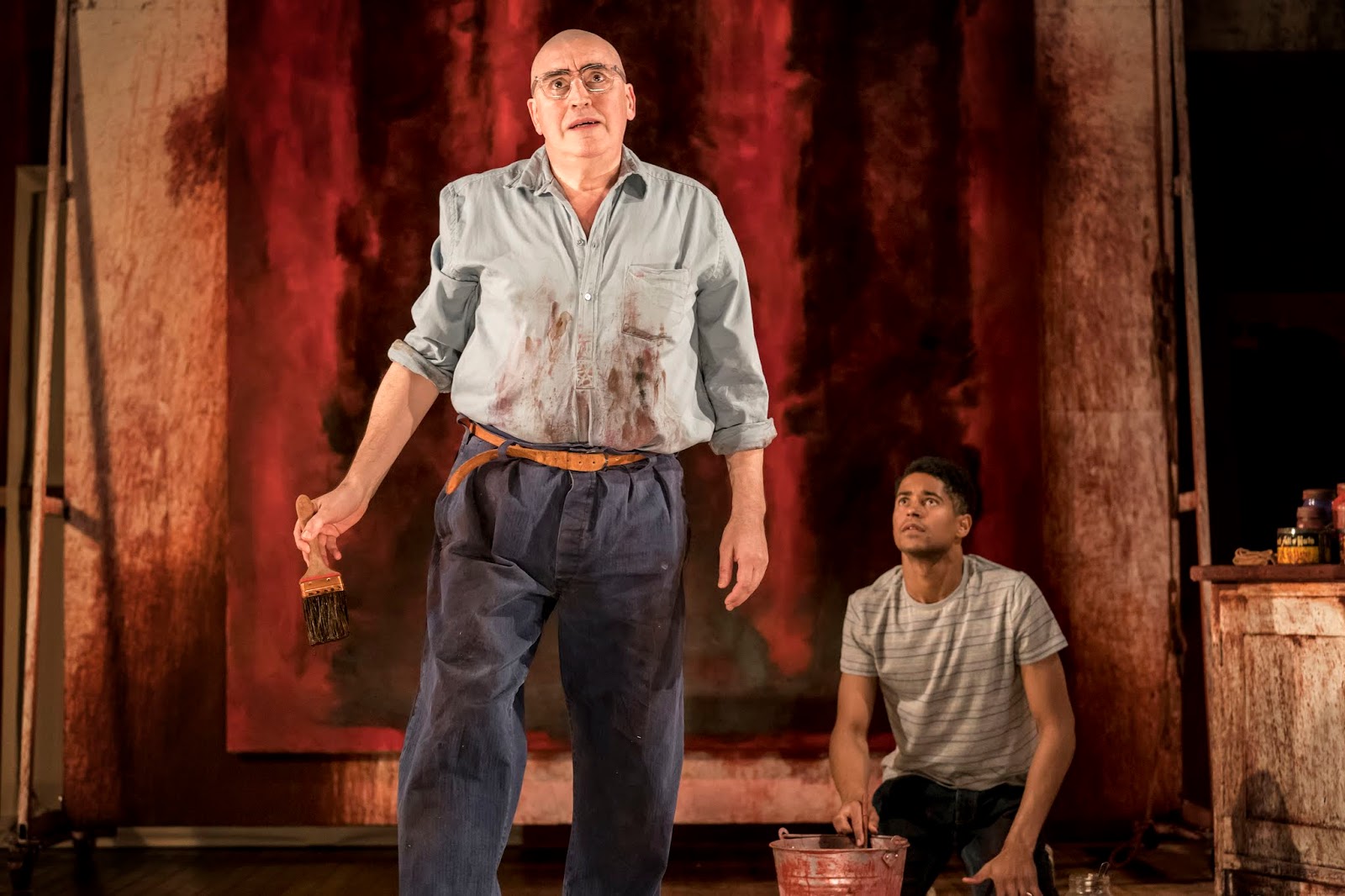
Alfred Molina and Alfred Enoch

There’s a chapel in a suburb of Houston, Texas, whose hexagonal walls each carry a black or nearly-black canvas by the abstract expressionist painter Mark Rothko. It’s a lonely, eerie space that can be meditative or depressing, depending upon your mood.

Rothko was an unknown abstract expressionist until 1959 when the architects of New York’s prestigious Four Seasons restaurant asked him to provide large scale paintings for decoration. The $35,000 that was paid to Rothko marked the highest value commission of an artist in America.

Having begun the paintings, Rothko dined at the restaurant one evening to “scope it out”. On finding the clientele pretentious, arrogant and at odds with everything in his Ukranian Jewish heritage, he tore up his contract, returned the money and eventually gifted eight of the pieces to the Tate Modern in London. They’re still there in room 3, and worth a look.

John Logan’s play focuses on Rothko in the throes of creating these masterworks.  In Michael Grandage’s tight, revived production (that first played at the Donmar Warehouse in 2009) all the technical elements serve to surround Alfred Molina, as Rothko, with excellence.

The replica canvases themselves, strung up in an enormous atelier as part of Christopher Oram‘s finely detailed scenic design, are variously dull and dark or glow mysteriously under Neil Austin’s bravura lighting design.  Music from Chet Baker to Gluck to opera attends the artist’s musings as Adam Cork’s sound design punctuates both the action and the scene changes with style.

Rothko is voiced with authority by Alfred Molina, a meticulously well-observed characterization as he shares his internal dialogue with Ken, a fictitious assistant played tautly - and possibly better than the original Eddie Redmayne - by Alfred Enoch whose own ‘story’ is neatly, if slightly melodramatically, linked to the dried blood colours of Rothko’s paintings.

Molina grows visibly both as a character and an actor during the performance: sarcasm, pain, pathos and anger all feel real, and the hints at future despair and suicide are as subtle as sighs.

There’s a stupendous scene in which the two work as a team to ‘size’ a canvas, filling the panel and spattering themselves with gore.  It’s physically thrilling: part ballet, part competition, part fight, played by the actors facing entirely away from the audience in one of the best wordless two-person scenes you could hope to encounter.

This is not Yasmin Reza’s Art, - a jejune 1990’s comedy vehicle for three luvvies off the telly to make cheap jibes about modern painting – rather, it’s an intense, well-written and tightly directed drama that in ninety minutes provides a rare insight into a man whose work seems baffling to the untutored eye.

Tutor yourselves, go and see it.  Then go to the Tate.


Booking until 28th July
Reviewed by Johnny Fox
Photo credit: Johan Persson

Sunday, 13 January 2013

Les Miserables - Movie

Certificate 12A - On general release

***
Screenplay by Alain Boublil, Claude-Michel Schönberg and William Nicholson
Lyrics by Herbert Kretzmer
Music by  Alain Boublil and Claude-Michel Schönberg
Directed by Tom Hooper

Samntha Barks as Eponine
Evolving from 27 years of spectacular live performance, Tom Hooper has taken Boublil, Schonberg and Kretzmer’s Les Miserables and  transplanted  their masterpiece from stage to screen.
As an exercise in pushing the technical boundaries of some aspects of musical performance in cinema, the film is an unqualified success, but as an adaptation of one of the most celebrated works in the musical theatre canon, it fails to satisfy.
In the Prologue, an impressive blend of performance and CGI, we first encounter Jean Valjean the convict amongst a team of prisoners hauling in a massive shipwreck. The scenery is breathtakingly vast, but the vocal work is intimate and up close and thereby hangs the movie's flaw. Boublil and Schonbergs' compositions are grand and beautiful and do not lend themselves well to the repeated scrutiny of solo close up that is Hooper's signature. His directorial style worked well in The King's Speech, and also in television's EastEnders, where individual intimacy is crucial to the flowing of the story. Few canvases however are as vast as that of Victor Hugo's french classic and an enormous tale demands a similarly proportioned sense of perspective from the director and not just in the rumbustious ensemble numbers.

Hugh Jackman as Valjean is not only an actor of global presence but also possesses a fine pedigree in musical theatre. His performance of Valjean, that has already garnered a Golden Globe, is a noble depiction of a heroic journey. But where cinema has permitted the “zooming out” of the visual experience of this story,  the decision to “zoom in” on the vocal work robs these songs of the impressive majesty that the writers conceived some thirty odd years ago. In One Day More, arguably one of the finest “Act One Closers” ever written, the fragmented camerawork, with Jackman making Valjean’s contribution whilst fleeing in a stagecoach, robs a fantastic number of its impact. This is a song written for the stage, not the screen and Hooper’s adaptation has stripped the number of both magic and also of its gut-wrenching power. On stage this song is pivotal but on screen it is reduced to not much more than an inventory of different character's perspectives, adding little value to the tale.  All too often in this film, wonderful songs are reduced to simply rhyming dialogue with a muslcal background.
Jackman’s fellow antipodean Russell Crowe is Javert, Valjean’s nemesis, and the face of authority that pursues him throughout the story. Thankfully, Crowe is a masterful actor because his singing disappoints. His big number Stars, a song that has a beautiful poetic lilt to its construction is terribly mauled in his rendition, sung as it is from a high rooftop parapet looking out across a Parisian backdrop in a setting that suggests the singing gargoyles from Disney’s Hunchback of Notre Dame.
Much has been made of the use of live singing to camera, rather than the miming to a previously recorded soundtrack, that this movie espouses. Technically, this is impressive, and it is generally pleasing to see voice so well linked to face.  Perfect musical theatre (or musical cinema) however is a trinity  of voice, physical movement and music and whilst in earlier filmed musicals the pre-recorded vocals may have been disconnected from the on-screen acting, in Les Miserables, the performers' acting has been severed from the orchestral accompaniment that plays through almost the entire length of the film. This was of course not the intention when these songs were first written and whilst the score has by its nature required adaptation from stage to screen, the adaptive process has diluted much of the brilliance of Boublil and Schonberg's composition. It is of no small significance that on the website of Working Title, who co-produced the movie, writing credits are displayed but no credit at all is shown for the composers of the music.
Where scenes and structure do permit, then the ensemble performances in the film are glorious. Sasha Baron-Cohen and Helena Bonham-Carter as the Thenardiers lead a wonderful Master Of The House, whilst the students'  Red & Black also stirs. Up close, Ann Hathaway’s I Dreamed a Dream and Come to Me reach out to touch the emotions alongside Eddie Redmayne’s Empty Chairs At Empty Tables that is equally a performance of powerful poignance. But when Samantha Barks performs On My Own and A Little Fall of Rain, the barrier of the screen between audience and actor descends and whilst her singing is exquisite, she fails to tug those same heartstrings that Boublil, Schonberg and Kretzmer so cunningly detected all those years ago in composing these tragic blockbusters.
It is impossible not to compare this film with the stage show. It is certainly as long as what one will find in the West End, albeit without the interval, although at least one advantage of the inevitable DVD release will be the ability to pause the movie after One Day More to take a comfort break. Stripped of its on-stage majesty, whilst the acting is magnificent throughout, the adaptation as a whole is a somewhat castrated version of the original work.   Some of the singing is wonderful and many of the visuals are magnificent. The credits list a vast team of talented and crafted folk who have laboured hard to deliver this film, which does deserve to be seen. Just don’t set your expectations too high.