Showing posts with label Michael Grandage. Show all posts

Wednesday, 30 April 2025

My Master Builder - Review

Wyndham's Theatre, London


***


Written by Laila Raicek
Directed by Michael Grandage


Elizabeth Debicki and Ewan McGregor


My Master Builder marks Lila Raicek’s impressive arrival on the West End. Ewan McGregor is Henry Solness the titular, eminent, architect, but just whose master builder he is, remains an enigma. It is clear from early on that his marriage to Elena (Kate Fleetwood) is in dire straits, while the arrival of Mathilde (Elizabeth Debicki) to the party that is marking the completion of Henry’s latest project, only adds a complex layer of shading to the narrative. 20 years his junior, Mathilde shared a romantic liaison with the architect a decade ago. The passions and grief that surround Raicek’s narrative are at times smouldering and at other times blistering. 

Debicki and Fleetwood are phenomenal - Fleetwood in particular with her lament in the second act as to the challenges facing women in life. McGregor convinces as a deeply flawed protagonist, but there are moments in his performance when his acting loses the required depth. This may no doubt be addressed as the play’s run settles in.

Similarly, and particularly in the first half, Raicek’s dialogue drifts into expositional cliche. For the most part however her writing thrills as it explores the agonies both of failed relationships and of bereavement. There is sound work too from David Ajala and Mirren Mack that serves to drive the story forward.

A play about an architect demands an appropriately ingenious staging, with designer Richard Kent duly delivering. That being said, Kent has created some massive set components that require hoisting up and down through the evening, with the Wyndham’s noisy winches proving an annoying distraction.

My Master Builder is clever and at times, deeply perceptive.


Runs until 12th July
Photo credit: Johan Persson

Friday, 18 May 2018

Red - Review

Wyndhams Theatre, London


*****


Written by John Logan
Directed by Michael Grandage


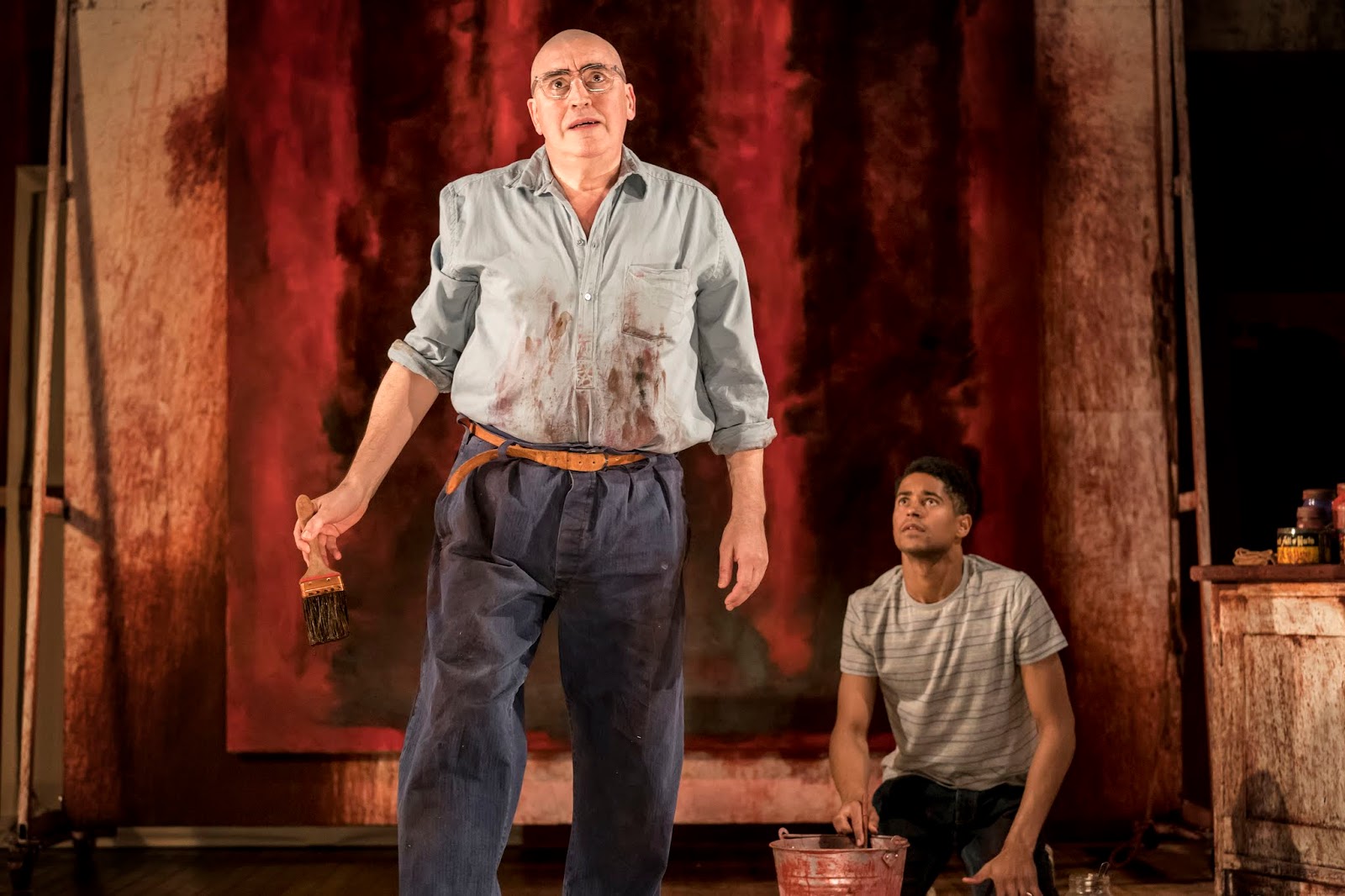
Alfred Molina and Alfred Enoch

There’s a chapel in a suburb of Houston, Texas, whose hexagonal walls each carry a black or nearly-black canvas by the abstract expressionist painter Mark Rothko. It’s a lonely, eerie space that can be meditative or depressing, depending upon your mood.

Rothko was an unknown abstract expressionist until 1959 when the architects of New York’s prestigious Four Seasons restaurant asked him to provide large scale paintings for decoration. The $35,000 that was paid to Rothko marked the highest value commission of an artist in America.

Having begun the paintings, Rothko dined at the restaurant one evening to “scope it out”. On finding the clientele pretentious, arrogant and at odds with everything in his Ukranian Jewish heritage, he tore up his contract, returned the money and eventually gifted eight of the pieces to the Tate Modern in London. They’re still there in room 3, and worth a look.

John Logan’s play focuses on Rothko in the throes of creating these masterworks.  In Michael Grandage’s tight, revived production (that first played at the Donmar Warehouse in 2009) all the technical elements serve to surround Alfred Molina, as Rothko, with excellence.

The replica canvases themselves, strung up in an enormous atelier as part of Christopher Oram‘s finely detailed scenic design, are variously dull and dark or glow mysteriously under Neil Austin’s bravura lighting design.  Music from Chet Baker to Gluck to opera attends the artist’s musings as Adam Cork’s sound design punctuates both the action and the scene changes with style.

Rothko is voiced with authority by Alfred Molina, a meticulously well-observed characterization as he shares his internal dialogue with Ken, a fictitious assistant played tautly - and possibly better than the original Eddie Redmayne - by Alfred Enoch whose own ‘story’ is neatly, if slightly melodramatically, linked to the dried blood colours of Rothko’s paintings.

Molina grows visibly both as a character and an actor during the performance: sarcasm, pain, pathos and anger all feel real, and the hints at future despair and suicide are as subtle as sighs.

There’s a stupendous scene in which the two work as a team to ‘size’ a canvas, filling the panel and spattering themselves with gore.  It’s physically thrilling: part ballet, part competition, part fight, played by the actors facing entirely away from the audience in one of the best wordless two-person scenes you could hope to encounter.

This is not Yasmin Reza’s Art, - a jejune 1990’s comedy vehicle for three luvvies off the telly to make cheap jibes about modern painting – rather, it’s an intense, well-written and tightly directed drama that in ninety minutes provides a rare insight into a man whose work seems baffling to the untutored eye.

Tutor yourselves, go and see it.  Then go to the Tate.


Booking until 28th July
Reviewed by Johnny Fox
Photo credit: Johan Persson

Sunday, 22 December 2013

Henry V

Noel Coward Theatre

***

Written by William Shakespeare
Directed by Michael Grandage


Jude Law

Jude Law is an inspirational Henry V. Michael Grandage knows the actor’s potential well and in this closing production of the director’s innovative West End season, Law represents a glimpse of what can be the finest of British stagecraft. 

Shakespeare’s Chorus (a youthfully rucksacked Ashley Zhangazha) famously asks in his prologue “can this cockpit hold the vasty fields of France?” and in truth, the answer is “No”. Christopher Oram’s design seeks to replicate a timbered arena, but whilst his endeavours are noble, to modern audiences accustomed to savouring their Shakespeare on the vast and visually accessible expanses of the subsidised Olivier and Royal Shakespeare stages, the confines of the Noel Coward and its antiquated Edwardian sightlines, present a hurdle from the outset. Law is unquestionably fabulous and his performance hints at greatness, but this Henry V is a Rolls Royce engine performing inside a far less glamorous arena. 

The play of course is a clever study in leadership, both political and on the battlefield. Henry is a brilliant reader of men and when in Act Two Cambridge, Masham and Northumberland's treachery is found out and they are challenged by the king, it is thrilling theatre. Law's monarch displays righteous menace through a combination of cool understatement and steely determination and we sense the traitors' terror. Law's St Crispin Day speech too is another humbling and inspiring treatment of some of the Bard’s most beautiful verse. When he speaks to his band of brothers, the sincerity is unquestionable. Ever the consummate actor, Law saves the best until last. The courtship scene with Jessie Buckley's Katherine is simply a masterclass in Shakespearean cool. An actor who not so long ago was the country’s alpha-male (and to many, still is), Law woos the M'lle with wit, charm and passion. It is rare for a Shakespearean role to lend itself to a swooning audience, but one senses that there will be swoons aplenty throughout this run.

The company work could be tighter. Seen some days after the first press night and whilst Norman Bowman and Ron Cook as Nym and Pistol respectively provide a wonderfully authentic grit to their more humble but critical characters, veteran kiwi James Laurenson should know better than to race through Exeter's text. Grandage would do well to keep a regular eye on maintaining the original tightness of his work. 

Law’s name alone will ensure that the production sells well and he justifies the face value ticket price (though no more). Amidst a production that occasionally falters, he shines and gives a very modern Henry to a classic history.


Runs until 15th February 2014

Tuesday, 16 July 2013

Mack-beth : A Profile of Norman Bowman


Bearded and relaxed in shorts and t-shirt, it’s a pleasure to grab an afternoon with Norman Bowman as he takes a breather from the demands of Kenneth Branagh’s acclaimed production of Macbeth at the Manchester International Festival. From a career that started out in musical theatre and has been most frequently filled by work in that genre, no-one was more surprised than Bowman himself to have been cast in this Shakespearean masterpiece, but as our conversation unfolds it is clear that all that this actor has achieved to date has been nothing less than hard won and above all, richly deserved.

Bowman’s biography is a tribute to his talents. He is wise to what makes a commercial West End production work, acknowledging that a “star name” is often needed to sell tickets and in a charmingly self-deprecating comment he acknowledges that today he may well not be that “star” person. Star billing or not, the body of work that this talented performer has achieved speaks of his abilities. From being cast as Marius in Les Miserables early on in his career, he has gone on to play Carousel’s Billy Bigelow in Chichester, Danny in a Grease national tour, Tony in West Side Story, and a two year stretch as Sam Carmichael in Mamma Mia. Whilst these parts have been his commercial leads, with many other supporting roles along the way, off West End his Mack in Thom Southerland’s 2012 production of Mack & Mabel at the Southwark Playhouse, was one of London’s outstanding male musical performances of the year. 

In Mack & Mabel with co-star Laura Pitt-Pulford
When Bowman reflects upon his journey to Macbeth, he does not hesitate in acknowledging the creative genius of Rob Ashford who, with Branagh, has co-directed the Scottish Play and who has creatively worked with the actor on three previous occasions. Bowman speaks warmly of being choreographed by Ashford in Michael Grandage’s 2005 Guys and Dolls, a show in which he played gambling gangster Harry the Horse, chuckling to learn in our conversation that the National Theatre’s 1982 version of that show opened with fellow gritty Scots countryman Bill Paterson, in the same role.

Ashford was to go on and cast Bowman as Tom Watson, the outspokenly racist publisher from the Deep South in Parade by Jason Robert Brown. Parade had had a difficult opening on Broadway and it was not until Ashford’s take on the work at London’s Donmar, that the show achieved the acclaim it deserved, an association with which Bowman is evidently proud. His next engagement under Ashford was to be directed by him in Finding Neverland at Leicester’s Curve. The production was controversial being movie mogul Harvey Weinstein’s first venture into staging an original piece of theatre and Bowman is nothing if not diplomatic in referring to the show’s journey. Notwithstanding the show’s challenges, Finding Neverland had provided a further opportunity for Bowman to work with the American, so when the opportunity for Macbeth arose and whilst there is no question that Bowman earned his place on merit, the established mutual respect between him and Ashford combined with his glorious Arbroath accent clearly stood him in good stead. Bowman is in fact one of only a handful of authentic Scots cast in this most Caledonian of texts. 

Bowman speaks as a man wise about his world and his profession. Even though he looks (enviably) damn good for his 43 years, he is all too aware that he is frequently auditioning for roles against fellow professionals some years his junior. His philosophy though is admirable, always respectful of competitor actors, yet focussing his energy on his own performance, rather than worrying over the potential strengths and weaknesses of others. He refers to the adage that once you mentally put yourself in a “race for a part”, the other actor is already in front of you and how he avoids that thought process.  It’s an attitude that speaks of immense personal strength, a pre-requisite in the glamorous but nonetheless harsh show-business world. He also speaks with a wry and realistic acknowledgment of the power of social media, the new lingua franca amongst performers and those who follow them, as an important component of an actor’s profile. He is savvy enough to recognise the increasing importance of media channels such as Twitter that can allow an audience to immediately express praise (or displeasure) for production or performer as they exit a theatre and like many around him, he conducts himself with measured professionalism in the online community. 

As sword wielding Ross in Macbeth
Bowman is that rare performer who is not only skilled enough to have amassed a respectable body of work to date, but is also open-minded enough to welcome development and improvement from acting legends. He speaks warmly of his time, again under Michael Grandage, in the director’s Twelfth Night that formed part of the Donmar at the Wyndhams season. Working with and occasionally opposite Sir Derek Jacobi was an experience that he acknowledges to have been rare and privileged and Bowman speaks with warmth and admiration of how he found Jacobi to be a source of inspiration. That some four years on he now finds himself selected to perform in a Branagh-led Shakespearean troupe is a further mark of the Scotsman’s talent.  As one might expect, he is at all times refreshingly respectful, but never fawning, to these giants of the English stage.

A father of two twins, Bowman speaks lovingly of his kids and it is clear that notwithstanding his recent separation from their mother and his long term partner, they remain vitally important to him and he remains focussed on being a significant part of their developing lives, living close by to them in London

Our conversation ends to allow Bowman time to return backstage, don his heavy garb as nobleman Ross and perform the daily pre-curtain up rehearsal that health & safety regulations demand of all fight scenes. For this production of Macbeth such compliance is an exhausting obligation as the stage combat of Ashford and Branagh’s vision is amongst the most ambitious ever presented in live Shakespeare. The physical effort that the actors put into their meticulously choreographed battle-work and swordplay is jaw dropping, as sparks literally fly from the clashes of heavy steel.

I bid farewell to this accomplished musical theatre performer and Shakespearean stalwart to boot and reflect that to describe Norman Bowman as “comfortable in his own skin” would actually be to understate. He is good at his job and, with all appropriate modesty, he knows that he is good at it too. Above all, the man is a committed actor who loves his work and it shows.


Norman Bowman can be seen in Macbeth via NTLIve on Saturday 20 July 

My review of Macbeth can be found here

My review of Mack & Mabel can be found here