Showing posts with label Shakespeares Globe. Show all posts

Wednesday, 28 August 2024

Antony & Cleopatra - Review

Shakespeare's Globe


**


Written by William Shakespeare
Directed by Blanche McIntyre


Nadia Nadarajah and John Hollingworth

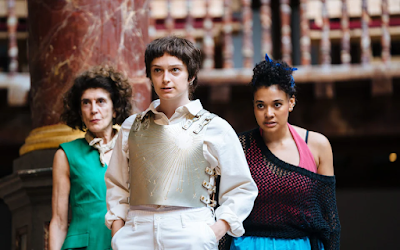
There are occasions in the theatre when a play is less than the sum of its parts. So it is with Blanche McIntyre’s take on Anthony &  Cleopatra that boldly translates Shakespeare’s prose into a hybrid of spoken verse and British Sign Language (BSL).

John Hollingworth and Nadia Nadarajah play the famed titular lovers. Hollingworth delivers an adequate Anthony as Nadarajah serves up an equally impassioned Egyptian Queen. However, with Nadarajah communicating her entire role through BSL, those audience members not fluent in that language are forced to follow her dialogue via the surtitle screens placed at gallery level around the Globe’s open space.

While the projected words enable the narrative to be followed, the scrolling text screens completely distract one from the strengths (or weaknesses) of Nadarajah’s performance. One is looking at the screen, not the actor and as a consequence much of the power of the verse is lost. The same frustration applies to those other characters in the story delivered through BSL, where again one’s eyes are taken away from the stage by the projections.

Daniel Millar shines as Enobarbus, notably in his famous description of Cleopatra’s barge, but such moments are rare.

An ambitious production that ultimately fails to deliver.


Runs until 15th September
Photo credit: Ellie Kurttz

Saturday, 10 February 2024

Othello - Review

Sam Wanamaker Playhouse, London


*


Written by William Shakespeare
Directed by Ola Ince


Ken Nwosu and Poppy Gilbert

With the action being set in 2023 London, this take on the Moor is more Moorgate than Venetian. And with most of the male characters being played as Metropolitan Police officers, Shakespeare’s dialogue has been liberally butchered too. Countless references to “Scotland Yard” and exclamations of “Guvnor!” make the evening feel like a badly written episode of The Sweeney that drags on for an excruciating 3 hours.

In trying to make this troubling tale of treachery, jealousy and racism accessible, director Ola Ince has cheapened the original. Mangling the Bard’s prose with contemporary slang not only disrespects the verse, it blunts its beauty. Shakespeare's early, subtle and nuanced and expressions of love are trampled by this treatment, leaving the plot hard to follow for those unfamiliar with the story. And while this may be the Wanamaker Playhouse with its famed candelabras, far too much of the play’s time is inexplicably wasted lighting, hoisting and snuffing out the flickering flames.

Struggling to break through the crackle of the police walkie-talkies punctuating the show, Ken Nwosu makes a decent attempt at the title role with a passionate performance. Equally Ralph Davis as Iago is appropriately villainous, and (what should be) the play’s final scene does prove surprisingly moving. Poppy Gilbert as Desdemona (or Desi as she’s frequently referred to in another act of textual carnage) saves her best for her swan song.

Ultimately this production is little more than a thinly-veiled attack on London's police force. While the Met may be a flawed institution for a variety of reasons, to clumsily denigrate it on the back of Shakespeare's verse is lazy politics and equally lazy theatre. Ince should try writing or directing an original piece to make his point about the cops. His corruption of Shakespeare's writing kills both the argument of the original, carefully crafted text as well as his more contemporary beef against the police. 

And of course, at the end, Othello gets tasered. Natch....


Runs until 13th April
Photo credit: Johan Persson

Thursday, 7 September 2023

Macbeth - Review

Shakespeare's Globe, London


**


Written by William Shakespeare
Directed by Abigail Graham


Max Bennett

There’s a moment just before the (long-awaited) interval in Macbeth when Banquo’s  ghost stalks the stage. To be honest it’s a miracle that Banquo’s spirit is not accompanied by that of the great Sam Wanamaker (whose legacy is this magnificent theatre) or even Shakespeare himself, such is the artistic travesty of much of Abigail Graham’s production.

Where to begin? The script has been tinkered with and for no apparent reason Duncan and the three witches have been gender-swapped, although quite why Duncan is referred to as the Queen, but the three hags, played here by beefy men, are still referred to in the script as the Weird Sisters is beyond me. And inexplicably, hospital gurneys are solemnly wheeled on and off the stage at times when there are no bodies to be borne.

By all means set the piece in modern dress. The witches’ cauldron being replaced by an electric blender was a nice touch. (Fenny-snake frappucino anyone?) But don’t play fast and loose with the basic constructs. With Macbeth a hardy perennial on school syllabuses across the land, the Globe was mobbed with pupils, all eyewitnesses to the slaughter of a classic.

Amidst the evening’s cultural carnage there were a handful of standout performances. Max Bennett’s Macbeth will not be remembered as one of the greats but credit to the man, he soldiered on like a trouper nursing a recently broken finger, with only the swordplay reduced (I guess) to dagger fighting. Fine work too from Matti Houghton as Lady Macbeth whose descent into madness was harrowing to see. Equally, the howls of grief from Aaron Anthony’s Macduff were heart rending and convincing. And to be fair the production's blood and gore was fun.

Sleep no more - The Globe hath done a far better job of murdering Macbeth than Macduff could ever dream of.


Runs to 28th October
Photo credit: Johan Persson


Thursday, 2 February 2023

Titus Andronicus - Review

Wanamaker Playhouse, London


*


Written by William Shakespeare
Directed by Jude Christian


Katy Stephens and Kibong Tanji


Mel Brooks’ The Producers opens with Max Bialystok, King of the Broadway flop, reading the dismal reviews of his latest show Funny Boy, a musical take on Shakespeare’s most famous tragedy, Hamlet.  As the lights went down for the opening of Titus Andronicus and the cast burst into song, for a moment one may have feared that the evening was likely to be a reprisal of Bialystok’s Funny Boy. Sadly, those fears were confirmed. All that was missing from the confected balladry was the all-female cast singing All The Nice Girls Love A Candle.


Titus Andronicus was Shakespeare’s first tragedy and his most viciously violent play. Done well, it can blend horror, humour and pathos into an evening of troubling yet moving entertainment. Jude Christian’s production however at the Wanamaker Playhouse (that theatre’s first Titus) is a pretentious attempt to sanitise the fabled gore, replacing blood and injuries with dumbed-down interpretation and chopped-up candles, playing for laughs at times when none are required and reducing the Bard’s brilliance to banality.


The now standard trigger-warning in the programme warns of the vast array of troubling themes in the play. The warning however fails to mention the extreme boredom and confusion that await the audience once the lights go down and the Wanamaker Playhouse’s famed candelabras descend...


Titus Andronicus is a play that demands the audience be shocked as a part of its structure. Typically this involves classy stagecraft, brilliant acting and, frequently, litres of stage blood, all combining to create the illusion of horrific human suffering. In Christian’s production the stagecraft is childish and trite, where rather than suspending our disbelief at the ghastliness we are supposed to be witnessing, Christian abuses it. The actors may be working hard on stage, but their direction has been lazy.


The classically trained Katy Stephens (reviewed as Tamora at Stratford on Avon in 2013) actually makes a decent fist of Titus and she’s matched by the similarly talented Kibong Tanji as Aaron the malevolent Moor. But that's it. 


There is virtually nothing to redeem this take on Titus Andronicus, and compared to Lucy Bailey’s magnificent version of the play that last graced the neighbouring Globe's stage in 2014, it is hard to believe these two productions emanated from the same company. The Globe fail to promote the author of the lyrics that bookend the show’s two halves, which is hardly a surprise - the lyricist should be ashamed of them.


Bloody awful!


Runs until 15th April

Photo credit: Camilla Greenwell

Friday, 2 September 2022

I, Joan - Review

Shakespeare's Globe, London


**


Written by Charlie Josephine
Directed by Ilinca Radulian

Reviewed by Isla Beckett


Isobel Thom and company

What would Shakespeare think? He wouldn’t, for that is the level of detail afforded by this play. Fancy that. Shakespeare stunned into silence in his very own theatre. O brave new world that has such mockery in it.

I, Joan is based on Joan of Arc’s life, one of the earliest documented feminists. Born in 1412 into poverty, she grew up possessed by a belief that she was channelling God. Convinced of her singularity, she requested a meeting with Charles VII of France, and the rest is history. Joan of Arc helped lead France to triumph against England, motivating a demoralised army and providing strategic input. She was later caught by the enemy and burned at the stake for heresy. Why? Joan reportedly had visions and experienced didactic voices in her head. The same as those that elevated her to the highest ranks of politics. In today’s world, she may have been classed as schizophrenic. In her era, she was deemed a witch. Adding fuel to the fire, she also wore men’s clothes in a defiant act of blasphemy. 

For all intents and purposes, Joan was unusual. Her history is rich and colourful, providing a wealth of material for an adaptation of her life. What a thrilling woman to explore. A walking contradiction. A fighter. A rebel. The skin of a lady with the heart of a man. Her vulnerabilities must’ve been fascinating. What a shame, then, that I, Joan deems it more appropriate to use this woman’s voice as a crass political megaphone. The fourth wall is frequently broken by Isobel Thom's Joan, with what follows being almost always a diatribe against pronouns and patriarchy. After a certain point this becomes tiresome, repetitive and pointless. In the unspoken background, Joan of Arc’s story is screaming to be told. We could learn more from her about gender equality than we ever could by being preached to here.

I, Joan crowbars the present into the past, forcing Joan’s narrative to be what it is not. Her tale is not one of complaint but of courage. Not one of bombastic opinion, but devotion to a cause. Joan did not proclaim herself a feminist, she lived the reality and died for it. So focused is the play on the narrator’s own personal beef with society that it falls flat in its depiction of a hero. For just under three hours, the play literally and metaphorically limps along. One has to admire the writer’s audacity for the constant gender-identity outbursts, couched in a plot that spends much of its time focused on a bunch of actors jiggling around the stage to simulate a 15th century war. A messy and uneven work, I, Joan suffers beneath the weight of two competing points of view. Ultimately, it is rendered characterless. Joan is a vessel for protest, but protest is not Joan. Protest does not stir the mind or the emotions. It does not have the capacity to haunt. As in life, in Charlie Josephine's play Joan does not get the justice she deserves.


Runs until 22nd October
Photo credit: Helen Murray

Sunday, 3 July 2022

King Lear - Review

Shakespeare's Globe


***


Written by William Shakespeare
Directed by Helena Kaut-Howson


Kathryn Hunter and Michelle Terry


Returning to the title role after 25 years (and back then in a production also directed by Helena Kaut-Howson), Kathryn Hunter leads in King Lear at Shakespeare’s Globe. That she is a woman in a man’s role, proves to be of little impediment to her delivery, and there is an authenticity to her take on the aged, dementia-raddled monarch that works well. The flaw in Hunter’s performance turns out to be not her sex, but rather her ability to master Shakespeare’s verse. Some of Lear’s words are amongst the most profound in the canon yet especially in the evening’s first half, Hunter races through her speeches offering two-dimensional deliveries too often rather than thoughtful interpretations of the prose. There is an Alf Garnett / Mel Brooks-like mania to her Lear that sees her play the role unnecessarily, inappropriately (and quite possibly, unintentionally) for laughs. And her howls at the death of Cordelia, surely one of the most gut-wrenching moments ever penned, lack pathos.  

Michelle Terry, the venue’s artistic director lands herself the curious casting combination of Cordelia and the Fool. To her credit, she makes a decent job of both, even if Kaut-Howson has decided the Fool’s departure from the story should be elevated to a moment of melodramatic death. Other than Lear’s penultimate lament that his “poor fool is hanged”, or reasons of economy, there is little to justify the fusion of these two roles into the same performer.

Some of the acting is fine and gripping. Ryan Donaldson as Edmund, Marianne Oldham’s Reagan and especially Diego Matamoros as Gloucester turn in fine performances. Matamoros in particular is deeply moving after his blinding. Elsewhere however there is under-performance and, too often, tedium. At 200 minutes including interval, weak performances make the narrative drag, and that's even without the addition of a great stage of fools as the entire cast rise from the dead to give an unnecessary post-finale display of country dancing.

Kaut-Howson was sadly caught up in a car accident that kept her away from the play’s final two weeks of rehearsals. Whether this absence contributed to the production’s lack of lustre one may never know, but this is not one of London's great King Lears.


Runs until 24th July
Photo credit: Johan Persson

Friday, 13 May 2022

Julius Caesar - Review

Shakespeare's Globe, London


**


Written by William Shakespeare
Directed by Diane Page


Anna Crichlow

The political rhetoric of Julius Caesar is timeless. Recklessly shoehorned into today’s politically correct constraints however and the beauty of Shakespeare's verse is squandered. Diane Page’s production of the classic tragedy seeks to place gender politics centre-stage, with Brutus and Cassius both played by women. To be fair, Anna Crichlow’s Brutus is a well-spoken performance and she makes a fine interpretation of the role’s moral quagmire. But given that this casting decision has led to a part of Mark Anthony’s most famous speech being butchered into: “And, sure, she is an honourable man”, then the production’s incongruities are clear. 

There is sound work from Dickson Tyrrell as a credible Caesar and equally from Samuel Oatley whose Mark Anthony does a good job of whipping up the Globe’s groundlings into Rome's plebeians. But too much of the rest of the company’s diction, especially in dialogue rather than otherwise well-projected monologue, is garbled and inaudible.

When Cicero’s death is announced in Act 4, one is almost reminded of Chicago’s Cell Block Tango – “he had it coming” - than be lost in Shakespeare’s perfectly constructed prose, such is the play’s inconsistency. The battle scenes of the story’s endgame are mangled and the stage-combat (developed by Rachel Bown-Williams and Ruth Cooper-Brown), a vital component of any high body-count Shakespeare, is very poor indeed.

There’s enough here, just, to satisfy a schools audience looking for dramatic context in support of the play’s countless classic quotes and speeches, the groundlings in particular again adding heft. But otherwise, this is a brutal assassination of the play.

Et tu Shakespeare's Globe? Then fall Caesar.


Runs until 17 September, playing at both Shakespeare's Globe and on tour across England
Photo credit: Helen Murray

Thursday, 10 February 2022

Hamlet - Review

Sam Wanamaker Playhouse at Shakespeare's Globe, London


*


Written by William Shakespeare
Directed by Sean Holmes


George Fouracres


"Fuck you Fortinbras!", as uttered by Claudius, is but one of the early revisions to Hamlet that Sean Holmes subjects us to in this, the first production of the play to be performed in the candlelit intimacy of the Sam Wanamaker Playhouse at Shakespeare's Globe. 

At least in 1994, when Disney offered up their take on Hamlet, they had the decency to re-name their version 'The Lion King'. The artistic team at the Globe lack such grace. Their interpretation of this finest of tragedies is sloppy in its revisions with text chopped and re-written, inappropriate songs and chants introduced and amidst a general demolition of the fourth wall, audience singalongs included too. Perhaps the Globe's team had taken Shakespeare's description of his audience to heart, the groundlings being "for the most part capable of nothing but inexplicable dumbshows and noise". Either way, it is notable that no name is posted in the credits to take responsibility for this ghastly adaptation.

This Hamlet comes across as no-more than a big budget student production, a play more likely to have graced the Edinburgh Fringe, rather than one of the country's leading Shakespearean venues. At least at Edinburgh the tickets would have been considerably cheaper and the show would have been likely to have lasted little more than 1 hour, rather than the interminable 3+ hours on offer here.

Ultimately it is hard to say what is more troubling. The butchery to which Shakespeare's prose has been subject or the rapturous applause, standing ovation even, that the whooping audience bestowed upon the production. This reviewer is privileged to be familiar with the text, having seen the play on many occasions over the decades. On the night that this production was attended, the Playhouse was packed with at least two parties of of school students. What a betrayal that these young people are being exposed to, seeing Hamlet perhaps for the first time in their lives, performed at times as little more than a pantomime with so much of Shakespeare’s verse savaged.

This is cultural vandalism of which the Globe’s trustees should be ashamed. The one star rating is for George Fouracres' decent work in the title role and by John Lightbody as Polonius. The rest is silence.


Runs until 9th April
Photo credit: Johan Persson

Thursday, 10 December 2015

Cymbeline - Review

Sam Wanamaker Playhouse at Shakespeare's Globe, London


****


Written by William Shakespeare
Directed by Sam Yates


Emily Barber and Eugene O'Hare

In that little wooden candlelit nest of magic and wonder that is the Sam Wanamaker Playhouse, Sam Yates directs a dreamy, fairytale-like Cymbeline.

Originally written to be performed across the river at the Blackfriars playhouse, (and now playing in that venue’s simulacrum) the play is a tragicomedy with heavy dark elements (jealousy, betrayal, poisoning, the list goes on) none of which appears to do much harm to this reassuring and family-friendly Globe production.

The clumsy villains all seem fatally destined to fail, the love between Emily Barber's Innogen and Jonjo O'Neill's Posthumus will clearly be blessed with a happy ending and the intricate Chinese box of the plot is solved in a jolly choral grand finale.

There is a beautiful simplicity to the Globe’s Playhouse, though one wonders if the surroundings, music and lighting could have dared to push the fantasy world further? They are faithful and faultless, if a touch plain and unmoving.

A better result is achieved with the costumes. Innogen’s trustworthy purity is manifest by her dress, simple and angelically light blue, contrasting with the Queen’s dark heart and her decorated dress.

The real strength of this Cymbeline is its cast’s ability to deliver Shakespeare’s language in a modern, contemporary way, that underlines the carefully crafted comedy in the text.

Barber’s performance is a high point, offering a lively representation of youth, love and beauty of heart. Pauline McLynn’s Queen succeeds as the fairytale evil stepmother (even her body language and hand gestures look mean and sly). And whilst Eugene O’Hare’s Iachimo looks more like a tombeur de femmes than a Machiavellian Iago, the audience seems to stay happily on his side!

Yates’ Cymbeline looks more like a blurred, funny reverie than a passionate, violent story, but given that it works and after all, “tis the season to be jolly”, it's well worth seeing.


Runs until 21st April 2016
Guest Reviewer: Simona Negretto
Photo credit: Marc Brenner

Sunday, 4 October 2015

Farinelli and the King - Review

Duke of York's Theatre, London


****


Written by Claire van Kampen
Directed by John Dove

Mark Rylance

At the age of 32, at the very height of a superstardom today reserved for the Hollywood A-list, the great 18th Century castrato Farinelli turned his back on the stage, never to return, to sing for only one man – Philippe V, the King of Spain. The King, suffering from a madness brought on by depression, could only find solace and sanity in Farinelli’s heavenly tones.

This apparently true historical titbit is the basis of Claire Van Kampen’s Farinelli and the King, recently transferred from the Globe’s Sam Wanamaker Playhouse to the Duke of York’s Theatre. At the play’s heart is an attempt to imagine the relationship between these two men, both ‘Kings’ in their own spheres and explain their friendship. And it is in exploring the dichotomy of these private, ordinary men and the public roles that they were forced to play that the piece is most interesting. After telling Farinelli how he became King, Philippe asks ‘When were you robbed of your normality?’

That dichotomy is given literal form in the case of Farinelli since the character is played by two men on any given night – Sam Crane taking a speaking role and counter-tenor Iestyn Davies joining him on stage to portray the singing superstar. This device, no doubt born out of necessity (countertenors of Davies’ quality are rare enough without expecting them to also be capable of acting the lead in a West End play), works well. Crane’s diffident ordinariness is a fine contrast to Davies’ strutting, golden-voiced megastar and it is Davies who provides many of the show’s highlights, aided by Robert Howarth's fine band. 

Of course, most of the audience had come not so see Farinelli but the King. Few actors are capable of playing bewildered, childlike madness as magnetically as Mark Rylance. At turns broadly comic, at others brooding and sinister, it is a predictably fine performance by one of the finest stage actors of his generation. And yet, there is perhaps a suspicion that a part so obviously written for him (van Kampen is his wife) has resulted in a one that he could do with his eyes closed without ever really needing to be at his glorious best – essentially a watered down version of his Richard II. 

Whilst the sometimes thin script provides fine moments of both humour and pathos, it at times straying dangerously close to Blackadder territory. Melody Grove in particular, has a rather thankless ‘one note’ task as Philippe’s long-suffering wife Isabella and neither she nor Crane convince in a predictable and possibly unnecessary love triangle.

Thank goodness, then, for the glorious music and the sublime voice of Davies, whose interjections bolster the piece. The scintillatingly beautiful “Lascia ch’io pianga” that closes the play is as memorable a moment as you will see on stage all year.


Runs until 5th December 2015

Thursday, 23 July 2015

Richard II - Review

Shakespeare's Globe, London


****


Written by William Shakespeare
Directed by Simon Godwin


Charles Edwards

Simon Godwin hones his focus in on the fallible nature of authority, in a smartly paced production with plenty of humour. His Richard II is an examination of the facets of hierarchy and begs the audience to consider the true origins of power. Is the right of Kings truly a gift from God? Or is it an innate and simplistic ability to rule justly and fairly, possessed of any man willing to seize the opportunity? Therein lies the central conflict between Charles Edwards' enigmatic Richard and David Sturzaker's earnest Bolingbroke. 

Designer Paul Wills has crafted a technically intelligent set, casing every wall and pillar in a slightly decayed gold leaf. The extravagant opulence of Richard's court is immediately captured in the garishly blanket plating of every surface, yet the hidden rot of his rule is also reflected in the decay. Just as the surface of the very walls is aged and scratched, so Richard's personal façade can only last so long. Richard himself, clad as he is in light creams and further gold, often disappears into his own throne, lost in the architecture of his surroundings and blind to the threats of the more darkly clad Bolingbroke, Northumberland and Willoughby. 

As Richard, Edwards' central performance captures the glib swagger of a man raised in a form of regal captivity. We see the young boy crowned in a coronation prologue and in so doing understand Richard's inability to see beyond the needs of his immediate entourage and desires. He is not inherently selfish, simply a man told since his pre-pubescent years that his actions are the will of God. Edwards is especially strong when physically handing over the crown to Bolingbroke. The former king is reduced to a linen clad waif, not mad, simply unable to fathom the recent turn of events. Edwards delicately portrays the sickened confusion of a man who has lost his spiritual foundation. 

Godwin keeps the play motoring along and whilst a couple of actors seem to slightly rush their lines, it gives the production a sense of welcome pace and comedy. Exchanges between Richard and his courtiers are fired off with precise timing and a catty wit. These scheming felines spit snide remarks behind closed doors and in one scene cackle over some odd catwalk-like entertainment. It all feels very 'high fashion mogul'. There are also some fantastically funny set pieces that lift what could've been a rather drab second act. Sarah Woodward and William Chubb, as the Duchess and Duke of York, do fine work on their knees in a farcical squabble over their sons’ misdeeds, whilst the biggest laugh of the night came from a sequence involving as many thrown gauges as you are likely to see in a single scene. 

If the production lacks anything, it is perhaps a degree of narrative investment. Sturzaker's Bolingbroke is likeable and well acted, but lacks that enigmatic zeal that would convince an audience of his ability to rally the disgruntled Lords to his cause. Also, both the Dukes of Richard's court and Bolingbroke's eventual sympathisers lack a sense of individual identity. They blur into a mass of camp malevolence and haughty aggression respectively, which robs the play of a sense of character depth. 

This aside, Richard II delivers in terms of a charismatic central performance from Edwards and a slick sense of pace throughout. Godwin's direction has clarity and his deft touch for the light-hearted encourages the audience to find humour in the pomp and reverence of sovereignty, as well as pity for a young boy King doomed by ideals thrust upon him.


Runs until 18th October
Guest reviewer: Will Clarkson
Photo credit: Johan Persson

Friday, 29 May 2015

Julian Glover's Beowulf - Review

Sam Wanamaker Playhouse at Shakespeare's Globe, London


*****

Adapted by Julian Glover from the translations by Michael Alexander and Edwin Morgan and from the Bristol Old Vic production directed by John David and John Elvery


Julian Glover


Beowulf is an Old English (possibly the oldest English) poem. Known to have been written in the tenth century, but with probable older origins, it's verses tell of a time of dragons, sea monsters, smoking swords and throughout it all wassail and riotous assembly in cavernous mead halls.

Julian Glover has been reciting the poem for nigh on thirty years, in a version that he has painstakingly laboured over. His editing of the verse has led to it being mainly recited in the contemporary idiom, with an occasional stanza of Old English and his helpful programme notes tell us of history having stressed that Beowulf "should not only be read to oneself, but spoken out loud". Thus it was, for two shows only last weekend, that Glover was to give his final performances of the poem in the Sam Wanamaker Playhouse at Shakespeare’s Globe. 

The venue was enchanting. Lit mainly by flickering candles (supplemented by a floodlit yellow wash) the Playhouse offers an elegant Elizabethan intimacy and that it was packed on a pleasant spring afternoon speaks much for Julian Glover's reputation.

Glover's delivery is the work of a master. Such is the actor's genius that even when speaking in the ancient tongue, typically unintelligible to a modern audience, his rhythm enhanced by a perfect emphasis on the text's alliterative strengths made even the most incomprehensible language seem crystal clear.

Using minimal props (a tankard, sword and throne, all used only occasionally) and dressed in simple, sober modern blacks, Glover's recital, through perfectly honed inflection and nuance, was a step back in time. For what must be nigh on millennia, folk have been entertained by talented raconteurs telling stories and this is precisely the ambience that Glover achieved. A man as at home performing in a Broadway musical as he is mastering Shakespeare, this wonderful actor held the crowd in the palm of his hand.

This review covered the matinee performance. Later that evening Glover's son Jamie, an accomplished actor himself, was to inherit his father's mantle by concluding the recital and carrying on its oral tradition. 

Today’s writers, directors and dramaturgs would do well to attend the future recitals of Glover Junior. Simply staged and beautifully performed, the purest of theatre does not get better than this.

Friday, 1 May 2015

The Merchant Of Venice - Review

Shakespeare's Globe, London

*****

Written by William Shakespeare
Directed by Jonathan Munby


Phoebe Pryce and Jonathan Pryce

Jonathan Munby's production of The Merchant Of Venice at Shakespeare's Globe is likely to prove a long remembered classic. The staging offers an interaction with the groundlings that defines the raison d'être of this remarkable venue and with some of the Bard's finest verse bestowed upon both Shylock and Portia, Jonathan Pryce and Rachel Pickup respectively provide a masterclass in English poetry. 

It can be all too easy to forget that The Merchant Of Venice is one of Shakespeare's comedies. Munby's production however makes much wonderfully timed merriment, with Stefan Adegbola’s Launcelot Gobbo putting on a class act that is as much Vaudeville stand up as it is classic Elizabethan drama. Elsewhere, David Sturzaker’s drunken Gratiano and Dorothea Myer-Bennett as Nerissa make for excellent comic foils.

The design of both costume and stage is gorgeous. The dress is of the period, with the Venetian masked Carnevale a prominent theme. Designer Mike Britton's Belmont is suggested magnificently by drapes of burnished gauze that billow in the Southwark breeze, cleverly catching the light and evoking a modest understatement to the wealth of Portia’s estate 

So much for the hilarity, there is heartbreak too - and in the most complex of parent-child dilemmas, Pryce wrestles with the demands of his Jewish faith as daughter Jessica spurns both father and tradition for her gentile lover, Ben Lamb's Lorenzo. That Jessica is played by Pryce's real life daughter Phoebe (who eschewing any whiff of nepotistic stunt-casting, more than earns her stripes) only adds to the moments of emotional devastation hurled at us. 

Much too is made of Bassanio's bisexuality as Daniel Lapaine and Dominic Mafham’s Antonio the eponymous Merchant, make frequent references to their past love. Away from the comedy again, Munby spotlights Portia's anguish as she comes to realise her new husband's sexual history, making for another neat and credible shot of pain.

Throughout, Munby's work is nothing short of visionary. His Princes of Morocco and Arragon (Scott Karim and Christopher Logan respectively) are stereotyped caricatures - indeed Karim’s Arabic creation could be straight out of Disney's Aladdin. But Munby knows just when to ease off too. Whilst his Princes may be buffoons, there is no hint of grotesque Jewish caricature to Shylock, with the director letting the evil of the play's prejudice speak for itself.

Whilst Shakespeare's original English text is respected, Munby takes brave linguistic licence elsewhere. Shylock and Jessica converse in Yiddish behind closed doors, whilst a devastating epilogue sees the now proselytised Jewess lament in Hebrew, whilst her father is subject to the full baptismal onslaught of a Catholic Latin liturgy.

But the heartbeat of this production lies in its devastating depiction of racist hatred. Shylock speaks of having been and is, spat upon. The courtroom scene is imbued with a lynch-mob menace that bays for the Jew’s blood. Whilst his desire for murderous vengeance can never be condoned, this production more than most, speaks clearly of the lifetime of abuse that the old money-lender has endured.

In what is likely to prove one of the capital’s stand out Shakespeare plays of the year, Pryce’s performance dominates and devastates. We share the pain of his yelp as his skullcap is brutally removed, realising more than anything else that the prejudices of 17th century Venice were barely different from those of Hitler's Berlin in the 1930s. And when we read today of the barbarity wreaked upon Iraq's Yazidis and upon many of Africa's Christian communities, we can only weep at Shakespeare's timeless wisdom.


Runs until 7th June

Image by Manuel Harlan

Saturday, 3 May 2014

Titus Andronicus

Shakespeare's Globe, London

****

Written by William Shakespeare
Directed by Lucy Bailey

Matthew Needham, William Houston and Indira Varma


Much like General Titus himself, Lucy Bailey’s production of this most bloodthirsty of Shakespeare’s works, makes a glorious and triumphant return to Shakespeare’s Globe. Under Bill Dudley’s black and oppressive velarium spread atop the yard space, the groundlings are spared blistering sunshine, but remain exposed to the pouring rain, which on press night only added to the ghoulish horrors of the ghastly tale. Guttural percussion and pungent incense assault one's senses on entering the Globe’s performing space and even before the players take to the stage, this production hints at being a festival of Shakespearean fun.

The classic story is driven by the vengeance that Tamora, the Goth Queen and Titus her conqueror, wreak upon each other's families for the various acts of murder, rape and mutilation that their children have suffered. Around these tribes and fuelling their appetites for revenge, Aaron, Tamora's Moorish lover, spins a web of lies and deceit that adds to the body count. Whilst the horrendous rape and disfigurement of Titus’ daughter Lavinia occurs offstage, nearly all the other carnage occurs in full view of the audience. For those who like their literature served bloody, this play truly is a rare treat.

Lavinia's rape is evil and Flora Spencer-Longhurst puts in a moving performance as the victim, pleading to Indira Varma’s Tamora woman to woman that she should call off sons Chiron and Demetrius from ravishing her. Elsewhere in the play however, and as can be so often the case with horror, there is much comedy. When Tamora gives birth to a mixed-race baby, conceived illegitimately with Aaron, the proud father boasts to her shocked legitimate sons. When they accuse him of having “undone” their mother, he retorts “I have done thy mother”. Obi Abili convinces as the malevolent Moor and deftly extracts a deserved guffaw from the crowd. Some of the play's comedy is occasionally overplayed and Matthew Needham’s Emperor Saturninus is at times just a little heavy on the Kenneth Williams style antics.

William Houston plays the wearied Titus well. Rome’s loyal servant, he comes close to losing his mind as he witnesses the terrors that befall his family, though in the play’s final scenes, adorned in chef’s hat as the Bard instructs, his serving up of the pie in which Chiron and Demetrius have been slaughtered and baked, is delivered with relish. One should also give a nod to Brian Martin and Samuel Edward-Cook's performances as the errant young Goths, destined to fill Titus' infernal pasty. Their final scene before Andronicus slits their throats is excruciating to watch. Suspended by their ankles for what is probably five minutes but seems an eternity, their ultimate despatch comes as a blessed relief to the audience.

Ian Gelder is a wise counsel as Titus’ brother Marcus, though it is also largely through this play's creative team that Bailey has also achieved her success. Django Bates’ music, haunting trumpets and relentless drums, suggest a world of violence and discord. Terry King, arguably one of the greatest fight directors, choreographs the mayhem with aplomb whilst Pam Humpage’s make-up effects go a long way to convincing us that the onstage horrors are for real.

If you can stomach violence (and 13 people were spotted being helped from the auditorium during act one alone) then Bailey's production truly is Shakespeare for the people. The yard space is used to the full as the groundlings become Rome’s plebeians and the bacchanalic splashing of wine over the squealing crowd only adds to the merriment. Shocking, upsetting and at times hilarious, this Titus Andronicus is bloody good Shakespeare.


Runs until 13th July 2014