Showing posts with label Wyndhams Theatre. Show all posts

Saturday, 22 November 2025

All My Sons - Review

Wyndham's Theatre, London


*****


Written by Arthur Miller
Directed by Ivo Van Hove


Tom Glynn-Carney and Bryan Cranston

Arthur Miller’s All My Sons is given an astonishing and devastating reworking at the Wyndham’s Theatre under Ivo Van Hove’s direction. Written in 1946, with the USA still under the shadow of the Second World War, the play is a forensic critique of greed and amorality in the American war machine. More than that however, it is an equally brilliant analysis of grief, denial, love and betrayal with Miller using but the slightest of phrases and descriptions to paint a richly detailed canvas of one tiny slice of the country’s Midwest.

In a story that was inspired by real events, Van Hove casts Bryan Cranston as Joe Keller whose engineering company supplied a batch of fatally flawed engines to the US Air Force that resulted in the deaths of 21 pilots. Cranston is colossal in his portrayal of a man prepared to sacrifice friendship and, unwittingly, family on the altar of the American Dream in his corrupt pursuit of personal fortune. His Keller is credible and deeply, darkly human, holding a mirror to us all.

Miller’s genius extends beyond his flawed protagonist. The story’s supporting characters offer a complex web of relationships and interactions, delivered in this production by a stunning company. Marianne Jean-Baptiste is Keller’s knowing yet grieving wife Kate, who breaks our hearts as she faces the challenges that Miller throws at her. Jean-Baptiste’s performance matches Cranston for its nuanced sensitivity and downright brilliance. Paapa Essiedu as Keller’s son Chris together with Tom Glynn-Carney and Hayley Squires as troubled siblings George and Ann pick up the lion’s share of the younger generation’s roles, with all three actors delivering excellence as the hellish tale unfolds.

Van Hove’s direction is precise. The play’s action unfolds in the Kellers’ yard where a tree has portentously fallen over in a storm the night before. As a chainsaw is taken to the fallen timber and the sawdust flies, the smell of the petrol engine’s exhaust filling the auditorium adds a curious and unexpected sensation of authenticity to the on-stage action.

Written in three acts, Van Hove chooses to dispense with any interval break at all, leading to a 2hr10 marathon of intense drama – that actually works incredibly well. The perfectly aligned combination of Miller’s prose delivered by a gifted company leads to an evening of tragically blistering perfection.


Runs until 7th March 2026
Photo credit: Jan Versweyveld

Wednesday, 30 April 2025

My Master Builder - Review

Wyndham's Theatre, London


***


Written by Laila Raicek
Directed by Michael Grandage


Elizabeth Debicki and Ewan McGregor


My Master Builder marks Lila Raicek’s impressive arrival on the West End. Ewan McGregor is Henry Solness the titular, eminent, architect, but just whose master builder he is, remains an enigma. It is clear from early on that his marriage to Elena (Kate Fleetwood) is in dire straits, while the arrival of Mathilde (Elizabeth Debicki) to the party that is marking the completion of Henry’s latest project, only adds a complex layer of shading to the narrative. 20 years his junior, Mathilde shared a romantic liaison with the architect a decade ago. The passions and grief that surround Raicek’s narrative are at times smouldering and at other times blistering. 

Debicki and Fleetwood are phenomenal - Fleetwood in particular with her lament in the second act as to the challenges facing women in life. McGregor convinces as a deeply flawed protagonist, but there are moments in his performance when his acting loses the required depth. This may no doubt be addressed as the play’s run settles in.

Similarly, and particularly in the first half, Raicek’s dialogue drifts into expositional cliche. For the most part however her writing thrills as it explores the agonies both of failed relationships and of bereavement. There is sound work too from David Ajala and Mirren Mack that serves to drive the story forward.

A play about an architect demands an appropriately ingenious staging, with designer Richard Kent duly delivering. That being said, Kent has created some massive set components that require hoisting up and down through the evening, with the Wyndham’s noisy winches proving an annoying distraction.

My Master Builder is clever and at times, deeply perceptive.


Runs until 12th July
Photo credit: Johan Persson

Wednesday, 26 June 2024

Next to Normal - Review

Wyndham's Theatre, London


*****


Music by Tom Kitt
Book & lyrics by Brian Yorkey
Directed by Michael Longhurst


Caissie Levy


There are moments when new writing touches the very essence of humanity. So it is with Next to Normal that has now opened in the West End following an acclaimed run at the Donmar Warehouse last year.

Caissie Levy is Diana, a woman who we learn early on in the show is grappling with significantly impaired mental health. Jamie Parker is her husband Dan, battling to support her, while there are perfectly nuanced performances from Eleanor Worthington-Cox as daughter Natalie and Jack Wolfe as son Gabe. To say much more about the plot would be to spoil the story’s reveals, as Levy and her three co-stars take Tom Kitt and Brian Yorkey’s inspired songs and narrative, delivering harrowing entertainment punctuated with moments of perfectly weighted ironic humor.

In support are Trevor Dion Nicholas as the story’s two doctors, and Jack Ofrecio as Natalie’s would-be suitor Henry.

The words and music are fast-flowing with credit to Nick Barstow’s six-piece ensemble perched atop Chloe Lamford’s ingeniously designed set.

Ultimately uplifting, the two-act show plumbs the depths of grief and suffering and it makes for an inspirational evening that is probably not suited to those who are emotionally fragile. That being said, Next to Normal is exquisitely crafted musical theatre.


Runs until 21st September
Photo credit: Marc Brenner

Wednesday, 3 April 2024

Long Day's Journey Into Night - Review

Wyndhams Theatre, London


*****


Written by Eugene O'Neill
Directed by Jeremy Herrin


Brian Cox

Brian Cox heads an impressive cast in Eugene O’Neill’s grim take on early twentieth-century America. Widely considered the finest of O’Neill’s works and drawn from the writer’s autobiographical experiences, Cox plays James Tyson, a miserly washed-up actor in his sixties and the patriarch of a family wracked with alcoholism, morphine addiction and consumption. 

Cox may take the starriest billing but his fellow performers are equally magnificent. Patricia Clarkson is his wife Mary, with Daryl McCormack playing elder son James Jnr. and Laurie Kynaston as Tyson’s youngest child Edmund.

In a 3hr 20min show, each of the 4 characters is given ample room by O’Neill to explore and display the depths of their own personal tragedies. All of the quartet are profoundly flawed, with the evening proving a stunning combination of outstanding prose delivered to perfection. Cox may be the unlikeable linchpin of his family, but even he garners a modicum of sympathy as the full extent of his and his family’s misfortunes are laid bare. Clarkson and her take on Mary’s surrender to opiates offers perhaps the evening’s most poignant interpretation.

Set over the course of one long day, in the confines of the Tyson house located in a remote coastal Hicksville, Jeremy Herrin’s direction is masterful, enhanced by Lizzie Clachan’s simply designed set and Jack Knowles’ ingeniously effective lighting.

It is rare for such a magnum opus of a play to be performed by such a gifted company. The evening may be uncomfortable and unhappy, but it is also unmissable.


Booking until 8th June
Photo credit: Johan Persson

Thursday, 2 November 2023

King Lear - Review

Wyndhams Theatre, London


****


Written by William Shakespeare
Directed by Kenneth Branagh


Kenneth Branagh and Jessica Revell


Kenneth Branagh’s take on King Lear is an intelligent interpretation of one of Shakespeare’s most powerful tragedies. Branagh’s treatment of the text is bold creating an amalgam of the play’s first published Folio and Quarto versions, then filleting out the narrative he considers superfluous. Not quite a King Lear Lite, but Branagh shaves a fair hour off the typical running time, bringing the show in at just under two hours with no interval.

For the most part the edits work. Amongst other clippings the courtroom scene in the hovel is chopped as is Lear’s comment on Cordelia’s quietly-spoken voice being “an excellent thing in woman”. But to be fair Branagh has trimmed wisely, maintaining the integrity of the narrative around Lear and his daughters, together with the sub-plot surrounding Gloucester and his sons. The play’s most famous quotes are (mostly) all there and in a time that has frequently seen the Bard’s prose butchered at Shakespeare’s Globe, Branagh treats the original with respect. 

On stage, Branagh is an excellent King Lear. There is weight and pathos to his words, with his curse of sterility on Goneril together with his grief in the final act, being fine examples of a well considered interpretation. His daughters are fun too. Melanie-Joyce Bermudez is a vicious Regan and Deborah Alli is an equally Ugly Sister as Goneril. There is a fine interpretation of Cordelia from Jessica Revell also doubling up as the Fool, who catches the complex sentiments of both her roles with a delightful accuracy. Doug Colling and Corey Mylchreest put in sound turns as Edgar and Edmund respectively, while Joseph Kloska’s Gloucester is deliciously done, vile jellies bouncing across the stage as his eyes are plucked out.

Jon Bausor’s designs together with Nina Dunn’s projections offer an original view of the Neolithic era in which the production is set, though the dancing and battling with staves is perhaps a little overplayed given the otherwise ruthless editing of the script.

Virtually sold out for the run, Branagh has delivered a King Lear for our times. 


Runs until 9th December
Photo credit: Johan Persson

Monday, 23 December 2019

Curtains - Review

Wyndham’s Theatre, London


****


Music by John Kander
Lyrics by Fred Ebb
Book by Rupert Holmes
Directed by Paul Foster 


The company of Curtains


American songwriters Kander and Ebb are probably best-known for creating the smash-hit musicals Chicago and Cabaret. But now another of the duo’s creations Curtains,  currently in the middle of a UK tour, steps into the limelight in London’s West End replacing The Man In The White Suit at the Wyndham’s Theatre until early January. 

With a book by Rupert Holmes (based on an original book and concept by Peter Stone), Curtains is a musical comedy whodunnit which initially opened on Broadway two years after the death of Fred Ebb. When musical actress Jessica Cranshaw, star of Robin Hood and the weakest link in a Boston theatre company, is murdered during the curtain call on opening night, her fellow cast mates and crew are all put under the spotlight as suspects. Enter stage left Lieutenant Frank Cioffi (Jason Manford), who puts the theatre on lockdown while he interviews those under suspicion. A keen musical theatre fan himself, Cioffi soon gets wrapped up in Robin Hood and sets about trying to save the show whilst catching a killer. 

Boasting a unique concept, Curtains is a classic murder mystery which at the same time provides the audience with an amusing look behind of the scenes of a critically-panned musical. With a show-within-a-show concept, plenty of clever twists and turns and humour throughout, Curtains is an enjoyable production sure to be a hit with fans of musical theatre. The soundtrack is pleasing, with toe-tapping numbers like Show People alongside more amusing tunes such as The Woman’s Dead and What Kind of Man? (the latter of which takes aim at critics, and went down particularly well on press night). Unlike Kander and Ebb’s more renowned productions, the songs here sadly aren’t particularly memorable but they’re all performed well by the brilliant cast. The ensemble numbers however highlight both the show and the company’s talent, providing a visual treat for the audience thanks to Alistair David’s spectacular choreography and Paul Foster’s clever direction. The beauty of Curtains is that it doesn’t take itself too seriously, packed full of clichés, puns and delightful digs at critics. 

Jason Manford proves likeable and funny as the overly enthusiastic yet charming detective. Carley Stenson shines as Georgia Hendricks, one of the songwriters behind Robin Hood, while Andy Coxon does an equally great job as her ex Aaron, his rendition of ‘I Miss the Music’ one of the more touching moments of the show. Rebecca Lock is fantastic as the tough-edged producer Carmen and it is she and Samuel Holmes who very nearly steal the show. Holmes gets most of the best lines in his role as British director Christopher, delivering his many one-liners with a delightful dose of witty acerbic sarcasm.

Curtains makes for a warm and entertaining musical sure to leave you with a smile on your face and a spring in your step. With dazzling choreography, slick humour and top-notch performances it is well worth seeing this Christmas. 


Runs until 11th January 2020 before continuing its UK Tour
Reviewed by Kirsty Herrington
Photo credit: Richard Davenport

Sunday, 16 June 2019

The Starry Messenger - Review

Wyndham's Theatre, London


***


Written by Kenneth Lonergan
Directed by Sam Yates


Matthew Broderick and Elizabeth McGovern

As a love letter to New York’s Hayden Planetarium, Kenneth Lonergan’s The Starry Messenger serves a purpose. Matthew Broderick is Mark, a professor of astronomy who teaches an evening class in the introductory basics of his subject, with an aspect of the play forming an  autobiographical nod to classes actually taken by Lonergan and Broderick in their youth at the Planetarium, before it was demolished in 1997.

Lonergan’s story however takes our disbelief and suspends it by the slenderest of threads. Amidst a string of weak constructs, we observe Mark being tested by a mid life crisis that stresses his long standing marriage to Ann (Elizabeth McGovern). Along the way Lonergan offers up a glimpse of many recognisable facets of modern living, his text enveloping love, lovelessness, deceit, jealousy, grief and ageing - together with a smattering of hope too. But ultimately there is little in this piece that grabs the audience to take them on much of a dramatic journey. For the price of a West End ticket Lonergan serves up a slice of life which, and for a fraction of the cost, many of the show’s audiences may well be experiencing day in, day out. The message of the piece may well be that sh*t happens but life goes on, but this is far too skimpy an argument to drive three hours of troubled text. There’s perception in the writing that offers up a sequence of meticulously observed mundanities, but too much of Lonergan's fiction is just implausible. 

Broderick does what he does best - this is Leo Bloom, thirty years on only without Mel Brooks writing the comedy. And as drama The Starry Messenger falls way short of Albee’s barbed acerbity that made George and Martha such a horrendously compelling mid-life, middle-aged, monstrous couple in Who’s Afraid Of Virginia Woolf. Overall, Lonergan’s Mark misses the mark. 

The acting is fine throughout. Alongside Broderick, McGovern captures an inner angst as Rosalind Eleazar's trainee nurse Angela puts in another well defined turn. Jim Norton's curmudgeonly Norman, an elderly cancer patient who drives one of the show's subplots is also spot-on in depicting the emotional onslaught of his disease and its impact on daughter Doris (great work from Sinead Matthews). 

There are momentary gasps and occasional laughs but ultimately this is a stretched out evening at the theatre, albeit one with a starry cast.


Runs until 10th August
Photo credit: Marc Brenner

Friday, 18 May 2018

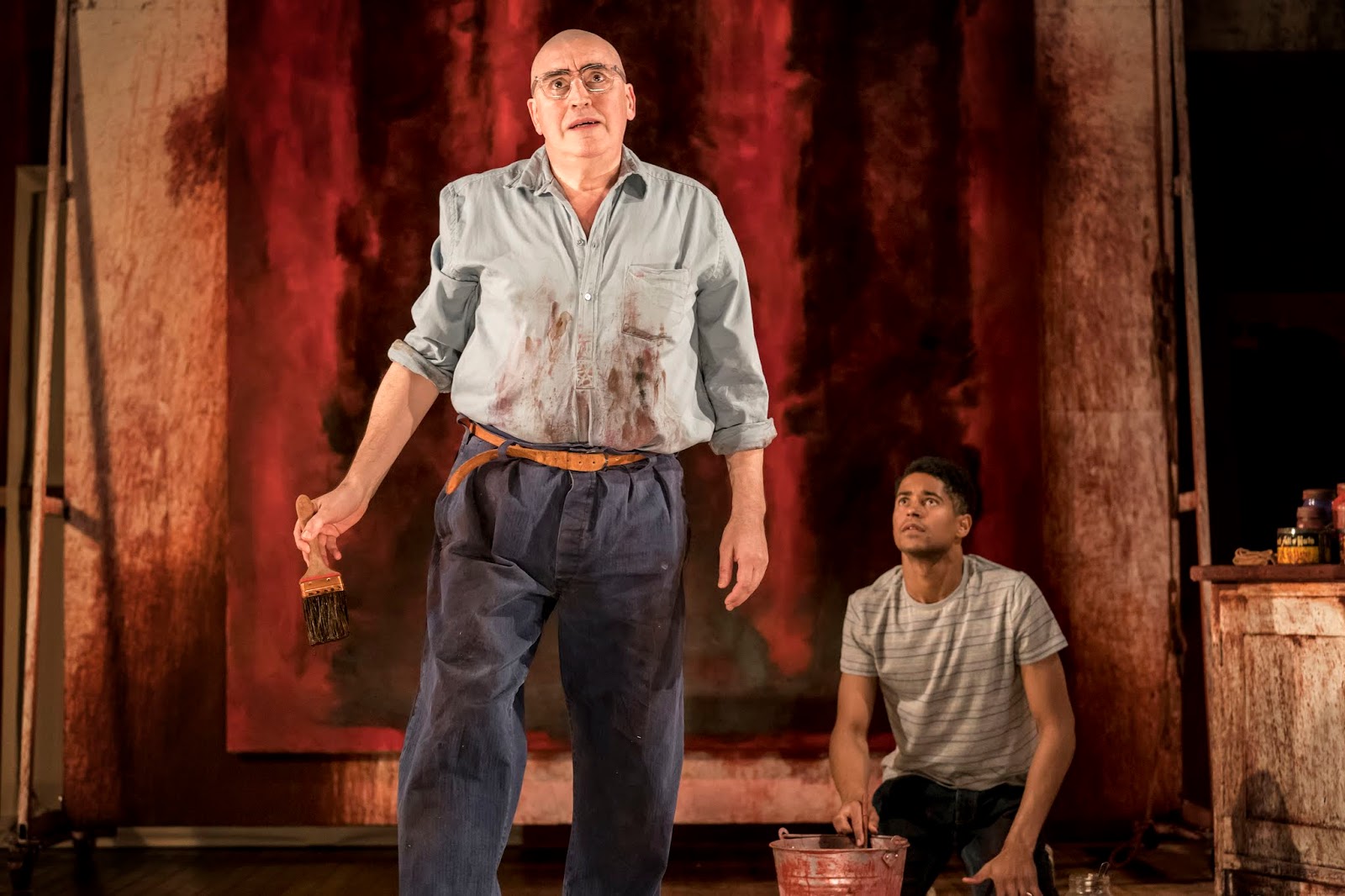
Red - Review

Wyndhams Theatre, London


*****


Written by John Logan
Directed by Michael Grandage


Alfred Molina and Alfred Enoch

There’s a chapel in a suburb of Houston, Texas, whose hexagonal walls each carry a black or nearly-black canvas by the abstract expressionist painter Mark Rothko. It’s a lonely, eerie space that can be meditative or depressing, depending upon your mood.

Rothko was an unknown abstract expressionist until 1959 when the architects of New York’s prestigious Four Seasons restaurant asked him to provide large scale paintings for decoration. The $35,000 that was paid to Rothko marked the highest value commission of an artist in America.

Having begun the paintings, Rothko dined at the restaurant one evening to “scope it out”. On finding the clientele pretentious, arrogant and at odds with everything in his Ukranian Jewish heritage, he tore up his contract, returned the money and eventually gifted eight of the pieces to the Tate Modern in London. They’re still there in room 3, and worth a look.

John Logan’s play focuses on Rothko in the throes of creating these masterworks.  In Michael Grandage’s tight, revived production (that first played at the Donmar Warehouse in 2009) all the technical elements serve to surround Alfred Molina, as Rothko, with excellence.

The replica canvases themselves, strung up in an enormous atelier as part of Christopher Oram‘s finely detailed scenic design, are variously dull and dark or glow mysteriously under Neil Austin’s bravura lighting design.  Music from Chet Baker to Gluck to opera attends the artist’s musings as Adam Cork’s sound design punctuates both the action and the scene changes with style.

Rothko is voiced with authority by Alfred Molina, a meticulously well-observed characterization as he shares his internal dialogue with Ken, a fictitious assistant played tautly - and possibly better than the original Eddie Redmayne - by Alfred Enoch whose own ‘story’ is neatly, if slightly melodramatically, linked to the dried blood colours of Rothko’s paintings.

Molina grows visibly both as a character and an actor during the performance: sarcasm, pain, pathos and anger all feel real, and the hints at future despair and suicide are as subtle as sighs.

There’s a stupendous scene in which the two work as a team to ‘size’ a canvas, filling the panel and spattering themselves with gore.  It’s physically thrilling: part ballet, part competition, part fight, played by the actors facing entirely away from the audience in one of the best wordless two-person scenes you could hope to encounter.

This is not Yasmin Reza’s Art, - a jejune 1990’s comedy vehicle for three luvvies off the telly to make cheap jibes about modern painting – rather, it’s an intense, well-written and tightly directed drama that in ninety minutes provides a rare insight into a man whose work seems baffling to the untutored eye.

Tutor yourselves, go and see it.  Then go to the Tate.


Booking until 28th July
Reviewed by Johnny Fox
Photo credit: Johan Persson

Wednesday, 11 January 2017

The Kite Runner - Review

Wyndhams Theatre, London


***


Written by Khaled Hosseini
Adapted for the stage by Matthew Spangler
Directed by Giles Croft

Andrei Costin

There's a broad canvas painted in Matthew Spangler's adaptation of Khaled Hosseini's novel in a story that traces the troubled recent, tribal history of Afghanistan from its pre-Soviet days to the Taliban nightmare of today. The deepest human drivers of honour, loyalty and guilt are played out through the interwoven family tales of two Afghan boys: Amir (played by Ben Turner) and Hassan (Andrei Costin) his closest friend, who is the son of Amir's family servant.

Kite flying was a national pastime in Afghanistan, with the kite runner chasing after the kites as they fall from the skies. The young Amir and Hassan are a skilled double act in the sport, but Kabul proves to be a dangerous and challenging city and when Amir (unseen) glimpses, in a backstreet, Hassan about to be raped by the local bully, rather than stepping up to defend his friend he shamefully flees.

To reveal any more of the narrative would spoil and the beauty of the production lies in the detail imbued in the characters. There is finely crafted supporting work too from Emilio Doorgasingh and Ezra Faroque Khan, as Amir and Hassan's fathers.

The staging is simple yet imaginative, with Barney George's designs suggesting not only Central Asia but also San Francisco as the plot crisscrosses the globe. Though it’s not all perfect - when an actor's fake beard ends up making his Taliban look more Tevye than terrorist, something's gone wrong. 

While the tale may be epic, its adaptation from the original best-seller is troublingly two-dimensional and at times melodramatic. A sharper wordsmith than Spangler would have told less - in fact much less as the play is nigh on 3 hours - but suggested more, through finer prose. 

Music is prevalent throughout - and one cannot help but wonder if a musical treatment, that might have reached out to both the harsh and beautiful aspects of the tale, might have offered a more artistic interpretation and unlocking of the tale's emotional depths. Tragedy and redemption lend themselves well to a grand score, with the play's second act offering more than a nod to hints of Miss Saigon.

Here for 12 weeks only - If you loved the novel, you'll probably love the play.


Runs until 11th March
Photo credit: Robert Workman

Friday, 23 September 2016

No Man's Land - Review

Wyndhams Theatre, London


*****

Written by Harold Pinter
Directed by Sean Mathias


Ian McKellen and Patrick Stewart

Every once in a while the theatrical planets align to create a pairing of such fine actors that it may well be unmatched for a generation. So it is with Harold Pinter's absurdist gem No Man's Land, a work that’s always best played by starry knights. Ralph Richardson and John Gielgud first created Pinter’s curious curmudgeons during the National Theatre's residency at the Old Vic in 1975. Today the honours fall to Ian McKellen and Patrick Stewart who again re-unite to lead an evening of theatre that remains as perplexing as it is entertaining.

In their twilight years Hirst (Stewart) and Spooner (McKellen) chance upon each other in a pub on Hampstead Heath before retiring to Hirst's nearby mansion. We learn that both men have literary achievements of varying pedigree, but while the wealthy and patrician Hirst still exudes an air of the virile masculinity that that made him an accomplished ladies’ man in years past, Spooner, the shabbier by far, is a down on his luck gay poet who spends his time earning a few bob collecting glasses in another local pub and spying on clandestine homosexual liaisons on the Heath. As the alcohol flows, the bleakness of their respective no man's lands of old age gradually emerges.

It wouldn’t be Pinter without a sinister undertone, injected here by two younger men, Foster and Briggs (Damien Molony and Owen Teale respectively) who also reside with Hirst. Quite what or who they are isn’t defined, though the suggestion that they are poised to prey upon the old man's wealth is never far away.

Amidst this cocktail of comedy and conspiracy, Pinter's prose is a delight. Hirst hates the "solitary shittery" of his decline, whilst Spooner is threateningly taunted as a "minge juice bottler". The bravura of the text is as timely as Stephen Brimson Lewis' exquisite costuming, with the 1970s so perfectly defined that the play could almost be a fusion of Derek and Clive mixed with The Sweeney.

Acclaimed on Broadway (though one wonders how American audiences have ever managed a text so steeped in London's geography and vernacular) Sean Mathias extracts power as much as pathos and frailty from his leading men. There's a hint of Shakespeare in the play's nosings too. Consider in act two how a vulnerable Lear or Gloucester could be being channelled - with the younger men's brutality (think here of Regan’s Cornwall) merely being hinted at. 

For lovers of theatre, drama does not get better than this, especially with both McKellen and Stewart having evolved into latter day screen giants. Freed from the close-up confines of film and TV work the pair are unmissable, with an electrifying chemistry in their interaction

No Man's Land may ultimately remain as unfathomable as Pinter intended, but no matter. Much like a generous measure of one of Hirst's malts (and a 40 year one at that), this production offers performance and dialog and oh, those glorious pauses that merit being swirled around in a heavy glass, savoured and carefully contemplated.


Runs until 17th December
Photo credit: Johan Persson

Sunday, 24 July 2016

The Truth - Review

Wyndhams Theatre, London


****


Written by Florian Zeller
Directed by Lindsay Posner


Alexander Hanson and Frances O'Connor

Florian Zeller is a precocious writing talent. The Truth is his third play to enthral London theatre goers in a year. Zeller's drama The Father reduced some viewers to tears with its' poignant and painful depiction of dementia. The Truth, a modern day farce about lies and adultery, brings tears of laughter.

Laurence (Tanya Franks) is married to Michel (Alexander Hanson) who is having an affair with Alice (Frances O'Connor) who is married to Michel's best friend Paul (Robert Portal). We watch in fascination as the reality of the characters' lives implode. Who is telling the truth? What are the lies? The audience is cleverly manipulated as the story unfolds. Zeller has certainly tapped into the male psyche concerning adultery but what makes this interesting is that the female characters are as complicit (or are they?) as the men. 

Alexander Hanson starts the proceedings, yanking up his underpants and meandering the stage like an impatient John Wayne. Never has the search for a sock been so amusing. Throughout, Hanson moves around the stage, a caged creature, whilst the other characters have a centred quality and often, a stillness. The simple, effective direction by Lindsay Posner keeps the action clean, letting the dialogue shine, lines ricocheting around the auditorium. 

Lizzie Clachan's stylish, minimalist set is highly effective in its simplicity. A pale, streamlined background of rooms that change ever so subtly; no doors are used as associated with our expectation of traditional farce. There is restrained embellishment, beautifully allowing the focus onto the actors.

Frances O'Connor has a regal quality in her sharp stilettos and brings a disarming coldness to Alice. For a play steeped in sex, O'Connor's Alice is calculating & practical, her sensual side kept under-wraps in her skin tight designer dresses. Tanya Franks' Laurence appears stoic, a perfect portrayal of middle class normality. She has a payoff in the final scene which she plays beautifully, the veneer that had been held together throughout, crumbling before our eyes. 

Robert Portal's Paul, has strength and conviction but an under lying sadness. Portal's body language and broad-chested stance belie his internal questioning. His confidence seems contrived and Portal keeps the audience questioning to the very end of Paul's motives. 

Throughout the 90 minutes duration (without an interval, which works perfectly) I found myself constantly drawn to Hanson's Michel. Even as a loathsome narcissist, he never fails to have immense charm and aplomb. His increasingly nervous, nuanced, suppressed manic philanderer is the glue that holds the whole piece together. It is a quite mesmeric performance which deserves as big an audience as possible.

The Truth packs the entertainment punch of a really good old fashioned farce, though Zeller has brought the genre into 2016 with barbed words, stating uncomfortable truths: with lies dressed in the hubris of modern day self belief. At one point, a character asks if they are in a comedy or a tragedy. And there is the truth - the play is both but manages to keep the tragedy of this predicament firmly within the comedy genre. This is darn good theatre, highly recommended. Go see it!


Booking until 3rd September
Reviewed by Andy Bee

Tuesday, 17 February 2015

A View From The Bridge - Review

Wyndham's Theatre, London

*****

Written by Arthur Miller
Directed by Ivo Van Hove

Mark Strong and Phoebe Fox

Ivo Van Hove's production of A View From The Bridge, first presented at the Young Vic last year, was one of the capital's 2014 highlights. Transferring across the Thames for a limited run at the Wyndham's, the searching intensity of this sensational piece of theatre has been stunningly maintained.

A View From The Bridge is a classic of 20th century American literature, yet this modern play's themes, drawn from classic lines of Greek tragedy are both universal and primeval. Treachery and revenge amongst immigrant American community, fuelled by an abusive and incestuous craving that burns inside longshoreman Eddie Carbone. Wife Beatrice is neglected as Eddie's infernal desire for orphaned niece and ward Catherine, a girl on the cusp of womanhood, stealthily consumes him.

Performed predominantly barefoot, against Jan Versweyveld's simple white rectangle of a stage that is barely fenced in by a shallow perimeter, the concept is stark. And yet with no scenery, the claustrophobic oppression of a Brooklyn tenement is cleverly suggested. There are moments when the actors appear in silhouette such is the brightness of the arena, the contrast between the dark and the good so cleverly, yet so simply suggested.

Mark Strong reprises his latin Carbone in a performance that is akin to a perfectly-tuned engine throbbing at the heart of a Ferrari. Strong's power of expression and his physical presence are immaculately presented. Muscular and forceful it is easy to see how he has so wrongfully channelled his passion towards the young girl. And yet in a moment of truly rare dramatic intensity, when illegal immigrant Marco challenges Eddie to a test of strength in lifting a chair one-handed, Strong's wannabe alpha-male is simply and virtually - and publicly -  emasculated in an abject and humiliating display of failure. 

Echoing a Greek Chorus, Michael Gould's Alfieri is Eddie's lawyer. Part counsellor to Carbone, part narrator to the audience, Alfieri's character, critical to the narrative is a moral compass that the Longshoreman is bound to ignore. Such is the level of craft, not only in Miller's writing but also in this company's performances that Carbone's destiny is subtly signalled and sensed.

Nicola Walker's Beatrice imbues the complex bitterness of a woman who sees and understands all around her yet is powerless to effect change. Walker's work is flawless. Catherine is played by the gamine Phoebe Fox. Initially unaware of the desire she stirs in the men around her, Fox masters the girl's interwoven naïveté and unintentional provocation. As she wraps her legs around her uncle during an embrace, we shudder.

Emun Elliott's Marco commands both fear and sympathy as he strives, albeit illegally, to earn money for his family back in Italy. Together with his brother Rodolpho (Luke Norris), both characters define the decent everyman of the play - though Miller relentlessly has us question Rodolpho's sexuality even as Catherine is falling in love with him.

Like an expert surgeon, Miller understands the human condition like no other modern dramatist, stripping it to the bones in a play that is as gripping as it is unbearable. As Van Hove’s bloody conclusion leaves you stunned, there is no finer play in London.


Runs until 11th April 2015

Wednesday, 18 September 2013

Barking In Essex

Wyndham's Theatre, London

***

Written by Clive Exton
Directed by Harry Burton


(l-r) Sheila Hancock, Lee Evans and Keeley Hawes


Barking In Essex is a new comedy to arrive in the West End. A classily cast show but nonetheless very much a tale of two halves. The play opens in a garishly tacky lounge somewhere in perma-tan Essex, where clearly no expense has been spared on a huge flat screen TV, a juke box and where chintzy posters of Brooklyn Bridge (complete with naff neon mini lights) and Pulp Fiction, adorn the walls. Rarely has a designer been so deliciously tasteless as Simon Higlett, in this perfectly contexted setting. The release of murderous villain Algie from jail is fearfully awaited by his family (don't worry, he never shows up and lest you think that is a spoiler, the programme and publicity, rather spoilingly, do not list Algie as a cast member.) The key to the plot is that whilst Algie's been locked up his family have spent all his swag and they know that his revenge will be ruthless.

Sheila Hancock is a marvellous ageing matriarch, whose withering put downs and occasional brilliantly timed dottiness are the mark of a true professional. This actress is long overdue a Dame-hood, but based on this show and its inconsistent material, she may yet have to wait a little longer. Lee Evans is her son and Keeley Hawes his wife. The play’s dialog is frequently foul mouthed and those who are easily offended should stay away. Littered with profanity indeed, but snobs beware, as for many years the language of the barrack room has gradually worked it's way into our common parlance, be it on the football terraces or in the reality TV shows that wallpaper our lives. People swear and as this blog has commented before, if mined responsibly both the f- and the c-word can yield rich seams of comedy. Well in Act One they do, with dialog that supports Evans' madcap antics in a tale that bears more than a nod to the genius of an Ealing Comedy complete with macguffin, laced with comeddia dell'arte and all brought bang up to date.

Act Two is more confused, with a strangely Latin-styled location and a story that whilst having been delightfully tenuous in the first half, crumbles away to a ridiculous ending. The only bit of humour post-interval is from Evans' physicality of performance though Karl Johnson puts in a craftily created performance as a doddering hitman and as a character who swears considerably less than his fellow performers, Exton has actually given this supporting role some of the show's funniest lines.

Lee Evans' fans will not be disappointed. His maladroit rubber faced presence is a gift to comedy writers, who when they sense their script may be tissue-paper thin, know that Evans' quirky gift will still salvage a laugh from the moment.

The first half of this show is an inspired work of funny fantasy, the second half is tedious. Exton's profanity dictates that this has to be a show for adults, so have a stiff drink before the show or even better, make it a large one in the interval. When you then find yourself watching Barking In Essex through beer goggles, you'll think its brilliant!


To book tickets for Barking In Essex, click here