Showing posts with label Lindsay Posner. Show all posts

Wednesday, 20 May 2026

Equus - Review

Menier Chocolate Factory, London


*****


Written by Peter Shaffer
Directed by Lindsay Posner


Toby Stephens and Noah Valentine

Lindsay Posner is back in the saddle at the Menier Chocolate Factory, jockeying his cast of thoroughbreds into a stunning interpretation of Peter Shaffer’s 1973 classic.

Teenager Alan Strang (Noah Valentine) has just been committed to a psychiatric hospital after having blinded six horses at the stables where he worked. Dr Martin Dysart (Toby Stephens) is the psychiatrist tasked with unlocking the young man’s deeply damaged mind, with Shaffer’s drama offering a brilliantly structured analysis of the challenges the doctor faces.

Onstage throughout, Stephens is sensational, gradually peeling away Strange’s defences to reveal his vulnerable core that led to such a horrific attack. Not only does Dysart unravel the teenagers traumatic life, such is Shaffer’s genius that he is also forced to face his own flaws too.

Stephens may be a sensation but he is well matched by the youthful Valentine a comparative newcomer to the London stage. In a story that revolves around flawed parenting, sexual frustrations and mixed attitudes to Christianity, it is no wonder that young Strang finds solace in the company of horses. Valentine is straining at the bit as he charts his most complex character’s arc with a graphic and brave brilliance. As a double act, Stephens and Valentine offer one of the best pairings in town.

The supporting cast are all given full rein to deploy their skill, notably Colin Mace and Emma Cunniffe as Alan’s bewildered parents who nurse troubled histories of their own. Bella Aubin - another relative newcomer - puts in fine work as Jill, the stable girl attracted to Alan.

It is however the ensemble of six performers, all trained in dance and who depict the horses, that offer some of the evening’s most powerful visuals. Moses Ward and Ed Mitchell do most of the heavy lifting in carrying their riders around the stage, but their stablemates of Luke Hodkinson, Aristide Lyons, Zack Parkin and Tommi Sutton have all been brilliantly cast for their sublime strength and movement. Credit too to Movement Director (or should that be Trainer?), choreographer James Cousins, who has groomed this talented sextet into mimes of equine beauty. Paul Farnsworth’s designs and Paul Pyant’s lighting only enhance Posner’s stylish direction.

After this Menier run, the production canters down the M4 for a brief stabling at its co-producers, the Theatre Royal Bath. Expect to see it galloping into the West End soon!


Runs until 4th July, then at Theatre Royal Bath from 14th - 25th July
Photo credit Manuel Harlan

Wednesday, 11 March 2026

The Holy Rosenbergs - Review

Menier Chocolate Factory, London


**


Written by Ryan Craig
Directed by Lindsay Posner


Tracy-Ann Oberman and Dorothea Myer-Bennett

Set in north west London’s Edgware, Ryan Craig’s The Holy Rosenbergs was a muddled collection of Anglo-Jewish stereotypes when it premiered at the National Theatre back in 2011. Fast forward 15 years, and it transpires that time has not treated Craig’s playtext kindly.

David and Lesley Rosenberg had three children. Ruth is a human-rights lawyer working for the United Nations, Jonny is struggling to find his way in life and Danny, who had emigrated to Israel, has recently been killed in action serving as a helicopter pilot with the Israel Defence Forces in Gaza. The play takes place on the eve of Danny’s memorial service at the local synagogue.

Against this backdrop of conflicting views and profound loss, Craig weaves a narrative that lurches from the sensational to the implausible in a two-act play that is at best, problematic. Ruth, and equally improbably, her boss Sir Stephen Crossley (played by Adrian Lukis) who appears half way through the second act, lays out the charges against Israel’s allegedly criminal military conduct, while offering scant criticism of Hamas’s corrupted governance of Gaza and minimal objective comment upon its terrorist activities. It has sadly taken the horrors of October 7th 2023 and that day's ensuing revelations, including the intimate connections that have been found to exist between agencies of the UN and Hamas, to realise the naïveté, or perhaps more accurately, the useful idiocy, of Craig’s argument.

Done well, Jewish self-deprecation can provide moments of masterful drama as demonstrated by the likes of 20th century greats such as Sheldon Harnick and Jack Rosenthal. Craig aspires to be an (Arthur) Miller Lite, offering us clumsily constructed nods to the American's Willy Loman and Joe Keller in the character of David Rosenberg. His writing however doesn’t come close to matching Miller's genius.

So the work may be profoundly flawed, but what of Lindsay Posner’s production values? Tracy-Ann Oberman as Lesley and Dorothea Myer-Bennett's Ruth are both magnificent. Oberman in particular, capturing the complex emotions of a mother struggling to maintain her equilibrium while simultaneously dealing with unimaginably traumatic grief. Her take on the role is credible and carefully crafted. Equally, Myer-Bennett in a part that is hard to be seen as believable, makes a first-class job of some mediocre writing.

As for the men, Adrian Lukis's human rights lawyer offers up the best work of the night. As David, Nicholas Woodeson struggles to suspend our disbelief, and though his final scenes in the play are delivered with a sincere poignancy, it is too little, too late.

Tim Shortall’s set may be authentic Edgware, but lest there be any doubt about this production’s bias, as the audience take their seats in the Menier an audio mise-en-scene plays clips of Gordon Brown’s and Barack Obama’s criticisms of Israel’s military.

Notwithstanding some outstanding work from the women, The Holy Rosenbergs does not stand up to the scrutiny of being revived and should have been allowed to rest in peace.


Runs until 2nd May
Photo credit: Manuel Harlan

Wednesday, 21 May 2025

The Deep Blue Sea - Review

Theatre Royal, Haymarket


*****


Written by Terence Rattigan
Directed by Lindsay Posner


Tamsin Greig

Terence Rattigan’s The Deep Blue Sea is a minutely observed take on one day in the life of Hester Collyer. Middle aged and having suffered a failed marriage and a failing affair, we encounter Hester, prone on the floor of her tawdry Ladbroke Grove flat following yet another failure, this time in her attempt to kill herself. Lindsay Posner’s take on 1950s England delivers a sepia-tinged snapshot of social mores that have long since been discarded. But while life’s customs may have evolved and changed, the play’s underlying themes of passion and despair are timeless.

As the day unfolds we meet Hester’s landlady, neighbours, her husband and her lover, as the jigsaw pieces of her life are slowly revealed. Rattigan has a powerful and perceptive understanding of the human condition, with each of his characters carefully crafted as they impact onto the fraught and fragile Hester.

But more than just the sublime writing, the acting at the Theatre Royal Haymarket defines this production (a transfer in from the Theatre Royal Bath) as one of the finest dramas currently to be found on a London stage. Tamsin Greig is Hester, on stage throughout, in a performance that captures the complexities of her depression, self-loathing and desperate desire in the finest of detail. Never melodramatic, Greig delivers a masterclass in perfectly nuanced acting.

As her High Court judge husband Sir William and some years her senior, Nicholas Farrell turns in an equally assured performance of a complex love that still burns for his estranged wife, while Hadley Fraser’s Freddie, Hester’s younger lover, offers up a snapshot of a man battling his own demons.

The key supporting roles of Miller, a lapsed German doctor and Mrs Elton, the landlady of the house are perfectly and sensitively fleshed out by Finbar Lynch and Selina Cadell respectively, each contributing valuable colour to Rattigan’s harrowing palette. Peter McKintosh’s set is an understated masterpiece of 50’s austerity, perfectly lit by Paul Pyant.

Rattigan’s eye for English misery is unmatched, and under Posner’s direction and with Greig’s breathtaking performance, The Deep Blue Sea is unmissable theatre.


Runs until 21 June
Photo credit: Manuel Harlan

Thursday, 26 September 2024

1984 - Review

Theatre Royal, Bath


****


Written by George Orwell
Adapted by Ryan Craig
Directed by Lindsay Posner


Keith Allen and Mark Quartley

In our world today with its visibly two-tiered criminal justice system, where citizens are imprisoned for the crime of having expressed their opinions while at the same time a notoriously shamed paedophile, convicted of viewing pornographic images of the most depraved child abuse can escape a custodial sentence, it feels like a re-visiting of George Orwell's 1984 is long overdue. 

Orwell's Oceania is a totalitarian state presided over by Big Brother. A society where the militia brutalise the citizens into surrendering their capacity to think. As the regime edits the languge of its day into the continually updated 'Newspeak', the modern-day resonances with the West are troubling. Orwell's classic has long been a harsh prediction on where our democracies are heading and in Lindsay Posner's production, staged against Justin Nardella's bleak but effective video projections, there are moments of deeply harrowing horror. 

Mark Quartley plays protagonist Winston Smith, a role that is physically demanding and consuming. On stage virtually throughout, it is his arc that we follow as his secrets are betrayed and he is violently subject to electric-shock torture, its objective to destroy any sense of right and wrong that we see him desperately try to cling on to.

Opposite Quartley is Eleanor Wyld playing his love interest Julia. The pair hold our suspense throughout and as we learn of their ultimate mutual betrayal of each other, the evening's endgame is a heartbreaker.

Astride the whole work and seated on stage throughout, in what should have been a stroke of perfect casting, is Keith Allen's O'Brien. Not at his best on press night, there is more that Allen can likely bring to the role. O'Brien is a man devoid of any shred of humanity and compassion and while that harshness was at times apparent in Allen's work, there were moments when his carapace appeared to be more of a soft underbelly.

This production can only improve on the road - an intelligent treatment of one of the 20th century's finest stories.


Runs until 28th September, then on tour to Malvern, Poole, Guildford, Cambridge, Brighton, Richmond and Liverpool
Photo credit: Simon Annand

Friday, 7 October 2022

Noises Off - Review

Richmond Theatre, London


*****


Written by Michael Frayn
Directed by Lindsay Posner


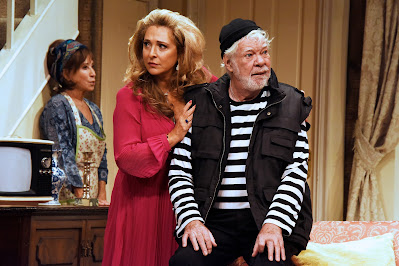
Felicity Kendal, Tracy-Ann Oberman and Matthew Kelly

Every now and then the planets align to create a production of sheer theatrical genius. So it is with Lindsay Posner’s touring take on Noises Off, currently playing at the Richmond Theatre.

Firstly, the script. Michael Frayn’s farce, penned 40 years ago, is a work of meticulous accuracy as it lays down gags, plots, sub-plots and nuance as we follow a touring theatre company rehearsing and performing the play-within-a-play Nothing On, around which the narrative plays out. Without ever resorting to corniness, Frayn mines the traditional farcical components of slamming doors, trousers around ankles and plot-lines of delicious sauciness. But its not just that Frayn’s text make us laugh, it is that he also offers a witty and at times poignant critique of the human condition – from the frailty of ageing through to alcohol addiction. No word of the script is wasted in the show’s three acts that treat the audience to whirlwind tours backstage and front of house as the plot’s calamitous events unfold.

Next up, the direction. Lindsay Posner has a visionary talent who understands the structure of each of the shows countless laughlines. Posner has form with the play, having directed the Old Vic production in 2011 and it shows. This production is slick, seamless and lifts the audience with its brilliance.

Finally, the cast, and Posner has been gifted a platinum-plated company to work with. The show’s seven key roles (the six characters of Nothing On together with that show’s director) include some of the nation’s finest comic pedigree - and in Noises Off there is no real star. The play only stands on the strengths of its company working as a team, and this team is strong. Felicity Kendal, Tracy-Ann Oberman, Matthew Kelly, Alexander Hanson, Joseph Millson, Jonathan Coy and Sasha Frost are all sublime in their roles that span a raft of characters aged from 70-something through to a glamourous starlet in her 20s. Their timing is honed to split-second accuracy and it is a credit to both actors and director that the show’s physical comedy, that in lesser hands could just be a ridiculous and clumsy distraction, is here delivered to side-splitting perfection. Pepter Lunkuse and Hubert Burton complete the cast list as the stage management team of Nothing On and though less accomplished than the show’s bigger beasts, are equally faultless in their work.

After Richmond, Noises Off heads off to Brighton and then Cambridge. Don’t miss it!


Runs until October 15th, then tours
Photo credit: Nobby Clark

Saturday, 10 June 2017

After Anatevka - Review

****

Written by Alexandra Silber


Alexandra Silber’s first novel After Anatevka is a carefully crafted study into love and life in Russia in the early twentieth century. Much like Marc Chagall was to paint enchanted images of that era, so too do Silber's words offer a painstaking picture of a world long since disappeared. 

Not just a writer, Silber is amongst the finest musical theatre performers of her generation and on both sides of the Atlantic too. The novel however marks her own remarkable and professional journey which in this instance, and unconventionally, has gone from “stage" to "page”. Read on... 

Every now and then an actress can come along who leaves an indelible impression upon a role. Think here perhaps of Imelda Staunton's Momma Rose or Glenn Close’s sensational take on Norma Desmond. Far more intriguing however, is when the role turns out to have left its own indelible handprint on the heart of its performer. 

So it was in 2006, when Lindsay Posner chose Silber to play Hodel in what was to be his acclaimed production of Fiddler On The Roof at Sheffield's Crucible Theatre. With Henry Goodman as Tevye the show was a sensation, becoming  swiftly earmarked for a West End transfer, playing at London’s Savoy for nearly two years.

Hodel of course is the second eldest of Tevye and Golde's daughters. When Perchik, the Jewish revolutionary firebrand blazes his way into the shtetl of Anatevka to steal her heart, what emerges is an onstage love story that is as sweet and inspirational as it is heartbreaking. It was 1894 when Sholom Aleichem breathed life into his fictional characters in his series of short shtetl-based yarns, collectively called Tevye The Dairyman. Some 70 years Joseph Stein was to draw on that creation in writing the book for Fiddler (a work that was only to be enhanced by Sheldon Harnick's Tony-winning lyrics). It has taken a further half-century for Silber to add a further thread into Aleichem, Stein and Harnick's golden literary tapestry.

One of the most poignant scenes in musical theatre's canon takes place on the platform of Anatevka's railway station. Some time earlier Perchik, branded as a political criminal by the tsarist regime, had been banished thousands of miles away to Siberia. His brief stay in the shtetl however had been long enough to win Hodel's committed and passionate love.  

Hodel realises that she must follow her heart to Siberia, and as the train approaches in the distance, she promises her father that she and Perchik will, one day, be married under a traditional Jewish canopy. Amidst the combined whirlwinds of political revolution, the impending destruction of Anatevka and the dispersal of its inhabitants across the globe, both father and daughter know that they are unlikely to meet again. When Hodel says to Tevye "God alone knows when we shall see each other again", the audience's hearts are broken. 

This scene is a manifestation of love at its most raw and pure. The exchange is carefully crafted prose which in the hands of skilled actors (and this scene has rarely come finer than with Silber and Goodman) can be a performance masterclass. Silber and Goodman did indeed break our hearts - but few (if any) in the audiences will have been aware of Silber's own tragedy that she brought to the role. Barely 23 years old at the time, she had borne the pain of losing her own and much loved father to cancer not long before taking on the role. The impassioned, blazing soul that fuelled Silber's performance was unforgettable.

And so, from the novel's background, to the tale of After Anatevka itself. It is a meticulously detailed story that paints a strangely recognisable picture of Russia’s imposing and corrupt hierarchy and the hardships wreaked upon those who offended the State. There are nosings of both Dostoevsky and Pasternak in Silber's work and she paints a picture of violence and violation as the backdrop to Hodel's remarkable quest to reach her betrothed and the life that they were to build amongst the salt mines of the East.

Silber's research has been thorough. Aside from studying archives of the vanished Jewish world of the Pale of Settlement she visited Siberia to understand for herself the detail and character of the region.

And yet, as well as the projecting the characters into their imagined futures, Silber also offers some charmingly imagined back-stories from the world of Anatevka that can only have come from a woman who has well and truly got under the skin of Tevye's daughters. For not only did Silber play Hodel in the UK, but two years ago in New York, when producers were searching for a Tzeitel for Bartlett Sher's (also acclaimed) revival of Fiddler, it was Sheldon Harnick himself who was to call Silber and ask her to re-visit his show, this time playing Tevye’s oldest daughter. Silber of course was again magnificent on stage and as an aside, the bond between Harnick and Silber is clear for the gifted lyricist has penned a sage and heartfelt foreword to the book.

Silber explores how the sisters grew up together. She offers Hodel's wistful perceptions on her older sister's strengths and capabilities, describing their shared childhood and how much their mother imbued in them the strengths and spiritual importance of 'tradition". The paragraphs in which Hodel recalls Golde instructing the girls in how to bake challah (the Jewish plaited loaf eaten on Sabbath) are but one example of the delightful detail with which Silber fleshes out her world.

There's also a fascinating back story to Perchik. Who would have guessed that this inspirationally handsome communist had started life as an accountant? Though while Perchik is surely no Leo Bloom, Silber breathes a fascinating life into his own troubled past  

After Anatevka is an impressive published debut. Alexandra Silber offers a profoundly perceptive yet quintessentially female take on a world in which tradition was both revered and challenged. Silber also gives us a stunning study into the power of love.


After Anatevka is published on 4th July 2017 and will be available from all good online book distributors

Sunday, 24 July 2016

The Truth - Review

Wyndhams Theatre, London


****


Written by Florian Zeller
Directed by Lindsay Posner


Alexander Hanson and Frances O'Connor

Florian Zeller is a precocious writing talent. The Truth is his third play to enthral London theatre goers in a year. Zeller's drama The Father reduced some viewers to tears with its' poignant and painful depiction of dementia. The Truth, a modern day farce about lies and adultery, brings tears of laughter.

Laurence (Tanya Franks) is married to Michel (Alexander Hanson) who is having an affair with Alice (Frances O'Connor) who is married to Michel's best friend Paul (Robert Portal). We watch in fascination as the reality of the characters' lives implode. Who is telling the truth? What are the lies? The audience is cleverly manipulated as the story unfolds. Zeller has certainly tapped into the male psyche concerning adultery but what makes this interesting is that the female characters are as complicit (or are they?) as the men. 

Alexander Hanson starts the proceedings, yanking up his underpants and meandering the stage like an impatient John Wayne. Never has the search for a sock been so amusing. Throughout, Hanson moves around the stage, a caged creature, whilst the other characters have a centred quality and often, a stillness. The simple, effective direction by Lindsay Posner keeps the action clean, letting the dialogue shine, lines ricocheting around the auditorium. 

Lizzie Clachan's stylish, minimalist set is highly effective in its simplicity. A pale, streamlined background of rooms that change ever so subtly; no doors are used as associated with our expectation of traditional farce. There is restrained embellishment, beautifully allowing the focus onto the actors.

Frances O'Connor has a regal quality in her sharp stilettos and brings a disarming coldness to Alice. For a play steeped in sex, O'Connor's Alice is calculating & practical, her sensual side kept under-wraps in her skin tight designer dresses. Tanya Franks' Laurence appears stoic, a perfect portrayal of middle class normality. She has a payoff in the final scene which she plays beautifully, the veneer that had been held together throughout, crumbling before our eyes. 

Robert Portal's Paul, has strength and conviction but an under lying sadness. Portal's body language and broad-chested stance belie his internal questioning. His confidence seems contrived and Portal keeps the audience questioning to the very end of Paul's motives. 

Throughout the 90 minutes duration (without an interval, which works perfectly) I found myself constantly drawn to Hanson's Michel. Even as a loathsome narcissist, he never fails to have immense charm and aplomb. His increasingly nervous, nuanced, suppressed manic philanderer is the glue that holds the whole piece together. It is a quite mesmeric performance which deserves as big an audience as possible.

The Truth packs the entertainment punch of a really good old fashioned farce, though Zeller has brought the genre into 2016 with barbed words, stating uncomfortable truths: with lies dressed in the hubris of modern day self belief. At one point, a character asks if they are in a comedy or a tragedy. And there is the truth - the play is both but manages to keep the tragedy of this predicament firmly within the comedy genre. This is darn good theatre, highly recommended. Go see it!


Booking until 3rd September
Reviewed by Andy Bee

Tuesday, 24 March 2015

Harvey - Review

Theatre Royal Haymarket, London

****

Written by Mary Chase
Directed by Lindsay Posner


Maureen Lipman and James Dreyfus

There are few shows in town more charming than Lindsay Posner's re-working of this 1940's all-American fable. Widowed Veta Simmons lodges with her daughter in the home of her wealthy brother Elwood P Dowd. Yet much is amiss, for as Simmons strives to keep up a genteel facade of normality, Dowd's closest confidante is Harvey, an invisible giant rabbit and much of the play hinges upon the anguish that his behaviour causes to his loved ones. 

This parable of the savant, who in today's jargon would be classified as somewhere on the autistic spectrum and yet who sees his world with a clarity denied his fellows, has already been explored in Rain Man and Forrest Gump. Yet Chase’s Pulitzer Prize-winner preceded those modern classics by some decades and as her Harvey lifts the curtain on a petty-minded small town, so we see Dowd's noble and chivalrous pursuit of all that is good in life, shine out as a beacon amongst his morally flawed peers, all signed up to the rat-race.

James Dreyfus is Dowd bringing a comic pathos to a beautifully created character. We laugh at the witty excellence of his performance though with a compassionate chuckle rather than the poking of cruel fun at a Bedlam lunatic. Dreyfus convinces us of his belief in Harvey and at the same time plays the straightest of bats as his (and the company's) pinpoint timing sees the plot's farcical elements unfold delightfully.

Opposite Dreyfus is Maureen Lipman's Veta. Amongst the best actors of her generation, Lipman commands our sympathy as she strives to find a suitor for Myrtle Mae her grown daughter, whilst supporting her brother's mental frailty. We feel her frustration at the difficulties she has to manage, yet at the finale we almost weep at the loving compassion she shows her sibling. Powerful stuff indeed, although glossing over the physical abuse Veta inadvertently suffers in the local sanitarium, as comedy rather than the ghastly brutality that it truly represents, is perhaps the script's only flaw. It was to be another thirty years before Jack Nicholson's Randle P. McMurphy in One Flew Over The Cuckoo's Nest was to define how the cruelty of mental institutions should truly be portrayed.

Dreyfus and Lipman lead a marvellous troupe. Ingrid Oliver's Myrtle Mae nails the awkward self-centredness of a girl on the cusp of womanhood, whilst Sally Scott's psychiatric Nurse Kelly is a clever portrayal of cutely cognisant compassion. David Bamber is psychiatrist Dr Chumley, a medic who undergoes a Damascene conversion of his own with Bamber giving the complex role the comic mania it deserves. The play's endgame sees Linal Haft, in a tiny role, play a cab driver whose revelatory monologue moves both hearts and minds. (And those eagle-eyed and over 40 may recall Haft’s Melvyn, the much put-upon son to Lipman's Beattie in the BT 1980s ad campaign.) 

Peter McKintosh's set displays an ingenious elegance as interlocking revolves shift the action between home and clinic, whilst meticulous design in both costume and wigs set the time and tone perfectly.

Old fashioned for sure and with American accents that occasionally grate, the show is a curiosity of a production, but nonetheless bravo to the Birmingham Rep and its co-producers for having taken it on the road. When late into the second act, as Dowd reveals that during his lifetime he has known what it is to be “smart” as well as what it is to be profoundly pleasant, it is with a moving wisdom that he reports (and we feel chastened), that "being pleasant" is nicer. An allegory with the feel-good warmth of an adult fairy tale, Harvey makes for excellent theatre performed by a fabulous cast.


Runs until 2nd May 2015