Showing posts with label Anna-Jane Casey. Show all posts

Wednesday, 15 May 2024

Fawlty Towers - The Play - Review

Apollo Theatre, London


*****


Written by John Cleese
Based on the TV series Fawlty Towers written by John Cleese & Connie Booth
Directed by Caroline Jay Ranger


The cast of Fawlty Towers - The Play

Written for television some 50 years ago and almost immediately entering the pantheon of comedy, Fawlty Towers was a work of scriptwriting genius by John Cleese and his (then) wife Connie Booth. 

Cleese himself has now adapted three of the (only 12) original TV episodes into a tightly paced show that runs for two hours including interval. The adaptation itself is a work of art, Cleese fusing those famous plotlines and gags into an ingenious confection designed to appeal to both fans and newcomers alike.

Of course the writing credentials of Fawlty Towers The Play were never in doubt. The challenge was always going to lie in the effectiveness of the on-stage resurrections of the beleaguered hotel’s iconically comic characters.

Anna-Jane Casey and Adam Jackson-Smith

Simply put, director Caroline Jay Ranger’s cast are sensational. Adam Jackson-Smith is the lugubrious hotelier Basil Fawlty, a role that many may have considered unplayable. In an immaculate combination of voice, nuance and sublime physical comedy, Jackson-Smith nails the performance with far greater skill than he manages to fix a moose’s head to a hotel wall. 

Alongside him, Anna-Jane Casey takes on the mantle of Sybil Fawlty, the other half of one of comedy’s most celebrated loveless marriages. Casey’s tone is magnificent and as the evening plays out, her portrayal of a woman who is as equally monstrous as her husband, only becomes more acid. Hemi Yeroham takes up the role of the much put-upon Manuel, the hotel’s Spanish waiter with Victoria Fox playing the maid Polly. Both recreate their characters to a tee.

But aside from those big four rocks of the Fawlty Towers series, what pushes this stage show into the stratosphere of excellence is the inspired casting of the supporting roles. It’s a breath of fresh air in these politically-correct times that Paul Nicholas’s interpretation of The Major, clearly suffering with the onset of dementia, is given such a beautifully weighted and perfectly pitched performance. Equally, Rachel Izen’s hard of hearing and cantankerous Mrs Richards (“What?”) is another comedy gem.

Paul Nicholas

Creative credits are due to Liz Ascroft’s set that cleverly captures the essence of the Torquay original, along with Kate Waters’ fight direction that has the physical slapstick honed to perfection. And Campbell Young Associates’ wig design for Sybil deserves its own Olivier Award just for looking so bloody brilliant!

This critic sat down with scepticism and left the theatre with eyes and cheeks wet from laughter. Quality comedy demands a holy trinity of first-class writing, acting genius and pinpoint timing. Fawlty Towers has all three - it’s the funniest show in town.


Runs until September 28th
Photo credit: Hugo Glendinning

Monday, 12 December 2022

Mother Goose - Review

Theatre Royal, Brighton and Duke of York’s Theatre, London


*****


Written by Jonathan Harvey
Directed by Cal McCrystal


Ian McKellen as Mother Goose

Ponder a while and reflect on the image above. It is a picture of Sir Ian McKellen, one of this country’s finest actors and in this photograph by Manuel Harlan is captured the humour, genius and lifetime of experience that defines him. Now read on…

Mother Goose that has played a week at Brighton’s Theatre Royal before transferring to London’s Duke of York's Theatre and then touring into spring next year, is pantomime at its finest.

In one of those rare theatrical events that sees a Knight become a Dame, Ian McKellen leads the company in a spectacular take on the title role. It’s seventeen years since McKellen last did panto and it’s as if he’s never been away. He holds the role flawlessly in a production that has been built for a long haul on the road and thus denies him both Christmas references and moments of localised fast-moving audience interaction. Nonetheless, his majestic dame captures Goose’s stunning faux-glamour alongside some fabulous moments of self-deprecation and immaculately timed repartee. Heck, McKellen even sings, and for just a brief moment, as he lapses into Tomorrow from Annie that’s prefaced by an autobiographical reference to his 8-year old self seeing panto in Bolton, there is just a hint of poignant pathos as we recognise the man’s remarkable longevity and his place in the pantheon of Britain’s greats. But written by Jonathan Harvey this is panto not pathos - and McKellen’s ability to roll through a script that references Mother Goose’s beaver as well as her (his?) haemorrhoids, hallmarks Harvey's carefully crafted text that will tickle all ages. References to Lord Of The Rings abound, and there’s even a splash of Shakespeare on the closing moments, as McKellen’s Dame treats us to Portia’s “Quality of mercy” speech from The Merchant Of Venice.

McKellen’s supporting cast are outstanding. Sharing the celebrity-billing alongside the venerable Dame is standup comedian John Bishop (mocked throughout by McKellen as not being a ‘real’ actor) as Mother Goose’s husband Vic, making a wonderful foil to McKellen’s high-octane campery. Oscar Conlon-Morrey steps up to the comedy role of the Gooses’ son Jack. Conlon-Morrey is a dab hand at panto, heroically handling Jack’s buffoonery and slapstick.


Oscar Conlon-Morrey, Ian McKellen and John Bishop

The production’s musical references are a delight, with frequent references to classic musical theatre shows - none finer than the Act Two opener of One from A Chorus Line (I can’t explain its relevance to the plot either) with a delivery that is as brilliant as it is hilarious, with Dame Ian providing the number’s visual (if not vocal) climax. It is left to Anna-Jane Casey however, playing the goose of the show Cilla Quack to deliver not only the odd wry menopause gag, but to take the roof off the Theatre Royal, firstly with a brief take on All By Myself, before a simply stunning version of Don’t Rain On My Parade. It is often said that pantomime is, for many children, their first experience of live theatre. In this production they’re also being given a taste of some of Broadway’s finest songs. A nod here to musical director James Keay whose arrangements, delivered by his economically sized three-piece band, are spot on. Lizzi Gee’s choreography is a treat, delivering dance routines (just wait until you see Sir Ian tap!) that has been lavishly designed and immaculately rehearsed.


Anna Jane Casey, John Bishop and Ian McKellen

The show heads into the West End next week and it is a far more traditional pantomime than London’s other highly-priced festive offering. McKellen’s Mother Goose is not about million-dollar costumes shoehorned into a formulaic variety show. Far from it. This is a pantomime created in the mould of hundreds of shows that are playing across the country right now. It just happens to have one of our finest actors ever giving one of his finest performances. What’s more, when the show departs London in February to tour England, Wales and Ireland , all its tickets are affordably priced too.

It is not often that one can say that a pantomime is “coming to a town near you soon”, but this one is. And when it does, don’t miss it.


Photo credit: Manuel Harlan

Monday, 13 December 2021

Cabaret - Review

Playhouse Theatre, London


*****


Music by John Kander
Lyrics by Fred Ebb
Book by Joe Masteroff
Directed by Rebecca Frecknall


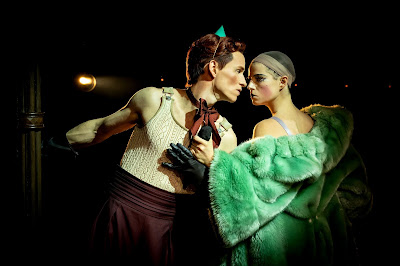
Eddie Redmayne and Jessie Buckley


In a remarkable transfiguration, London's Playhouse Theatre is ingeniously transformed by designer Tom Scutt to an in-the-round setting which after an equally imaginative pre-show mise en scene, goes a long way to transporting the audience to Berlin’s Kit Kat Club, the home of the show’s eponymous cabaret.

Rebecca Frecknall’s interpretation offers a bold take on the Kander & Ebb classic. The cabaret girls (“each and every one, a virgin”) are a chic metrosexual bunch, cleverly mixing 2021’s androgyny with Berlin’s famed inter-war decadence. The Kit Kat Club of course is a dive and rising from its deepest depths is the exquisitely ghastly Emcee, played in this iteration by Eddie Redmayne.

Cabaret’s Emcee is one of the most ingenious creations of late 20th century musical theatre. Almost like a Greek Chorus, or Lear’s Fool, he holds up a mirror to the Club’s audience (literally, in this staging, the theatre audience), parodying the hopes of the outside world (“Life is disappointing? Forget it”) while equally mocking the rise of Nazism and the persecution of the Jews. As Redmayne delivers If You Could See Her, the brutality of his satire chills to the bone. The actor is a tour de force throughout the piece such that when he is at times mute in the Finale, it only adds to the horrors that Germany as a nation will soon descend into.

Opposite the Kit Kat Club’s Emcee is of course the English cabaret artiste Sally Bowles. Jessie Buckley is sensational in her take on Bowles, bringing an understated haunting to the role. In her opening number Don’t Tell Mama, Buckley stuns with a polished insouciance that has the Kit Kat Club cheering for more. By the time the show is done however, and her Sally has both witnessed and experienced tragedy, Buckley’s take on the title number is breathtaking. Not for her the Broadway bravado of the song that one may perhaps associate with Liza Minnelli - rather, a delivery of Kander & Ebb’s signature tune that shows the singer to be broken and vulnerable. It is a stunning realisation of the song that shocks both in its despair and in quite how powerfully Buckley inverts the number’s traditional style into something far more poignant and haunting. I doubt that there will be a stronger performance to be found on London’s musical theatre scene for quite some time.

Redmayne and Buckley are surrounded by talent. Omari Douglas’ Clifford Bradshaw, a naïf to Berlin and the foil to the story’s piercing arc is assured and credible in his role. When late in the second act he is beaten up by Nazi thugs, there is a multi-faceted angle to the hate that he is subject to. Liza Sadovy as Fraulein Schneider, Berlin’s world-weary landlady, is gifted a number of musical opportunities, in which she shines, and her story too offers a sad wry glimpse into the country’s looming thunderstorm of fascism.

Fraulein Schneider’s two other tenants are the Jewish grocer Herr Schultz (Elliot Levey) and prostitute Fraulein Kost (Anna-Jane Casey).  Kander, Ebb and Joe Masteroff had a challenge in writing Schultz - as they sought to capture his pride in his German citizenship alongside his love for Schneider, while at all times keeping him wilfully blind to how the fate of German Jewry was to play out. It would have been easy to make Schultz a more soft and sentimental sop, but he is written (and here, played) perceptively, such that his future murder, that as a Jew he will likely face, plays out only in our minds, rather than on stage.

Casey is magnificent as Fraulein Kost, a small character who so skilfully depicts both Berlin’s depravity and its desperation. The gusto with which Kost joins in with Tomorrow is one of the most outstandingly simple depictions of the appeal of Hitler’s National Socialism to much of the German population.

Stewart Clarke’s Ernst Ludwig is the musical's face of Nazism, with Clarke cleverly capturing the ugliness of his role, at all times avoiding cliche and melodrama. As he leads the end of the first act with Tomorrow, it is a chastened and shocked audience that head out for their interval beers and ice-creams.

Jennifer Whyte’s musical direction of her 9-piece orchestra that boldly spans the auditorium is adroit, with Kander’s melodies being richly served. All her musicians are magnificent, but the guitar/banjo work from Sarah Freestone together with Matt French’s percussion are particularly distinctive and memorable.

With antisemitism again manifest on the streets of London, Cabaret has never been more relevant.


Booking until 1st October 2022
Photo credit: Marc Brenner

Friday, 27 May 2016

Flowers For Mrs Harris - Review

Crucible Theatre, Sheffield


****

Based on the novel by Paul Gallico
Music and lyrics by Richard Taylor
Book by Rachel Wagstaff
Directed by Daniel Evans


Clare Burt


Flowers For Mrs Harris marks Daniel Evans’ farewell production at Sheffield’s Crucible and he bows out premiering a musical that is elegant, charming and beautifully crafted.

Paul Gallico’s novel, set just after the Second World War tells of Ada Harris, a charlady widowed during the Great War and who, upon setting eyes on a Christian Dior dress in a client’s house, falls in love with the frock and sets about earning enough cash to buy one of her own. The strength of Gallico’s tale hangs upon Harris’ steely humble resolve in a world that has shown her few favours. Radiating an enchanted kindness to all those she encounters and inspired at first by the spirit of her dead husband with whom she shares private conversations, act one is about Ada raising the near-fortune of £500 to purchase the dress, with the second half centred around her antics upon reaching Dior’s salon in Paris.

And at risk of spoiling, that's it for the plot - save to say that this hardened critic, who was expecting to be entertained if not necessarily moved by a show about a woman and a dress, was in tears at the denouement.

Gallico’s work is a minute examination of post-war England. A time of rationed austerity, where class was prevalent and everyone knew their place. His world also demonstrates the timeless virtues of grace and kindness, demonstrating that whilst some people of power and wealth can behave like pigs, so too and on both sides of the Channel, can privileged folk act with love and compassion.

At the centre of this journey is Clare Burt’s astonishing performance as Ada Harris. A glorious everywoman, Burt makes us believe in the utmost modesty of her lifestyle and its contrast with her dazzling Dior dream. We root for her endeavours and we (literally and audibly) gasp in anguish at her setbacks and stoicism. Imagine a female Jean Valjean, only this time from Battersea, and you start to get close to the genius that lies at the heart of Burt’s creation. 

Like Valjean’s encounters in Les Miserables, it is the individuals who Mrs Harris meets on her journey that make this tale. In assembling his cast Evans has plundered the A-List of Britain's musical theatre performers, with a neat conceit seeing all the cast (Burt excluded) double up from playing one role in Battersea to another in Paris – a touch that only makes the show’s charm sparkle more.

There is much for Anna-Jane Casey to do in London as Ada’s fellow widowed charlady, Violet Butterfield. Casey nails not only nails the female camaraderie of south London working class, but after the break returning as a fag hag of a Parisian femme de ménage, she is a hilarious delight. Rebecca Caine’s opera trained voice thrills, first as a wealthy Londoner and then as the manageress of the Dior salon who learns to overcome her own prejudiced snobbery.

Laura Pitt-Pulford plays a well observed, petulant, wannabe movie actress in London, who cares little for her cleaner, Mrs Harris. But act two sees this gifted actress metamorphose into Natasha, Dior’s star model and in sporting the scarlet Rose ballgown, the highlight of the season’s collection on the Paris runway, Pitt-Pulford takes our breath away.

There's a measured dignity to Mark Meadows’ supporting work, firstly as the ghost of Mr Harris and later on as a kindly French patrician, while Louis Maskell offers some beautifully sung romance as the young André, out to woo Natasha.

Lez Brotherston’s set design suggests a bombed out Battersea, all power station and gasworks. But as the interval strikes his grim London is flown away to reveal a skyline of Paris highlights – only enhancing the magic of Mrs Harris’ arrival in the French capital. Brotherston's imagery is embellished with the imaginative use of a revolve - a further nod to Les Mis?

The costumes are magnificent with act two’s fashion show proving a jaw-dropper. But badged as a musical – and to be fair Tom Brady’s 10piece band make fine work of the score – the tunes are hard to recall and frustratingly the show’s programme does not include a list of musical numbers. One’s memory can almost almost hint at having attended a play with songs.

Either way, the show is pure class and let's hope that London producers will have travelled to Sheffield for make no mistake, the underlying production values of Flowers For Mrs Harris are exquisite. If the right West End venue were to be found then this new musical, Clare Burt, and her stellar company would surely deserve Olivier-nomination.


Runs until 4th June
Photo credit: Johan Persson

Wednesday, 22 July 2015

Mack and Mabel - Review

Festival Theatre, Chichester

****

Music and lyrics by Jerry Herman
Book by Michael Stewart
Directed by Jonathan Church


Anna-Jane Casey leads the company in a spectacular Tap Your Troubles Away

There is much about Jonathan Church’s Mack and Mabel at Chichester that displays the very best of modern British musical theatre talent. Amidst a tale of humour and tragedy, the production frames a collection of performances and creative work, much of which is flawless.

Michael Stewart’s book, revised by his sister Francine Pascal, famously tackles a complex history. Telling the true story of the love between movie director Mack Sennett and Mabel Normand, the star he discovered, is a challenge. The show charts Normand’s rise from deli delivery girl, to the heights of Hollywood fame, before an early death hastened by addiction and scandal – and all played out against a collection of numbers that blend melancholy with the madcap farce of Hollywood’s silent slapstick golden years. It is a combination of tableaux that has longed proved a challenge to its (stage) directors.  

Michael Ball plays Sennett in a performance that imbues the Hollywood director’s vision and ruthless singleness of purpose with a magnificent stage presence and masterful vocals. Ball is arguably unmatched in his abilities – and his range: imperious in Movies Were Movies and perceptively tender in the beautifully crafted I Won’t Send Roses defines his place in the musical theatre pantheon.

Broadway import Rebecca La Chance makes her UK debut as Mabel – and it’s a tough ask. If her performance lacks the impish defiance that her opening number Look What Happened To Mabel demands, she makes up for it with a powerfully scornful Wherever He Ain’t. La Chance’s work in act 2 impresses as she captures Normand’s capricious management of fame alongside a drug-fuelled decline. Her final solo Time Heals Everything (set in the 1920’s and with La Chance clad as a gorgeously shimmering flapper – great design work from Robert Jones) offering a scorching torch-song in its interpretation.

Stephen Mear’s choreography is as inspired as it is ingenious. The little touches that include a trio routine that kicks off Wherever He Ain’t are a treat – whilst the big ensemble numbers all impress. Hundreds Of Girls wittily combines projections with dance (as well as some eye-watering work with beach balls) whilst Hit ‘Em On The Head weaves a Keystone Cops yarn into a routine whose technical excellence suggests David Toguri’s ground-breaking work at the National Theatre more than thirty years ago.

Act two’s penultimate number Tap Your Troubles Away has long been the show’s big dance routine and in a revelatory move, Mear intricately links Normand’s addictions with the flamboyant splendour of his  tap-dancing company. It’s all black waistcoats / basques and red shoes, led by the jaw-dropping Anna-Jane Casey’s Lottie whose feet become a blur of brilliance. Mark Inscoe’s William Desmond Taylor is an elegantly competitive cad to Sennett, whilst Jack Edwards’ Fatty (Arbuckle) similarly adds a convincing layer.

Robert Scott conducts his 15 piece ensemble (heavy on brass and reeds) gorgeously – setting the scene with one of the finest overtures in the canon.

The show runs until September before embarking on a nationwide tour. With Jerry Herman’s classic melodies, Michael Ball’s peerless performance and Stephen Mear’s dance work it’s well worth catching. 


Runs until 5th September and then tours.

To read my review of Mabel's Wilful Way, a Mack Sennett two-reeler and watch the film itself on YouTube, click here

Thursday, 21 May 2015

How to Succeed in Business Without Really Trying - Review

Royal Festival Hall, London


****

Music and lyrics by Frank Loesser
Book by Abe Burrows, Jack Weinstock and Willie Gilbert
Directed by Jonathan Butterell


Clarke Peters (l) and Jonathan Groff in rehearsal

There must be something in the Thames as it flows around the bend of Waterloo Bridge that enchants the work of Frank Loesser. Back in the 1980s the National Theatre gave the capital a groundbreaking Guys and Dolls and yesterday, for one night only, Jonathan Butterell directed a sensational production of Loesser’s How to Succeed in Business without Really Trying (almost) next door at the Royal Festival Hall.

It’s been fifty years since How to Succeed in Business without Really Trying last popped up in the West End and Butterell was blessed with a star-studded cast to perform this concert staging. In a story that is occasionally heavy on a complex narrative, the show set in the offices of the World Wide Wicket company takes us on a whirlwind tour of ladder-climbing both literal and metaphorical, as we watch “the rise” of window cleaner J. Pierrepont Finch and his studious devotion to a self-help book on business success. In today’s parlance the show would represent a mash-up of The Office with The Apprentice and all set to show-tunes of a deliciously cheesy improbability. 

Crossing the Atlantic to play Finch, Jonathan Groff is probably best known here for his time on the US TV series Glee. Make no mistake though, Groff has serious stage credentials, with spurs earned both on and off-Broadway and stellar vocals that make Finch the true hero of the piece. It should also be noted that given the very  limited rehearsal time available, his performance oozed a charming confidence that forgave his occasional glances at the script.

Cynthia Erivo and Hannah Waddingham made for Finch’s vibrantly intriguing colleagues. As love interest Rosemary, Erivo brought a warmth and sincerity to her vocals that truly allowed us to understand her desires beyond the office walls whilst Waddingham’s Hedy La Rue brought another aspect of sexual desire to the tale in a role as perfect to listen to as to gaze upon. 

Making a rare and welcome return to a London stage, Clarke Peters’company President J.B Biggley provided a strong backbone to the office set up. Elsewhere Clive Rowe as Trimble was as ever delightful in his fleeting appearances, with Rowe’s soaring vocals lending a massive contribution, not least to the glorious ensemble numbers Company Way and Brotherhood Of Man. In another neat touch, London's Loesser cognoscenti will have noted that both Peters and Rowe include the National’s Guys and Dolls in their biographies

A nod too to Amy Ellen Richardson as Smitty and Anna-Jane Casey’s Miss Jones, who both brought quirk and charm to the office table on top of their stunning stage presence. 

Loesser’s luscious and vibrant score, boasting many forgotten and understated classics, was expertly executed under Mike Dixon conducting the Royal Philharmonic Concert Orchestra. It is a treat to hear a classic score so excitingly pitched and performed at that by a full size orchestra too.

The company’s excellence left one longing for a fully staged return of this charming old show and with such a remarkable array of talent and so finely polished too, Butterell certainly showed how to succeed in musical theatre!


Picture credit: Poppy Carter Portraits at www.poppycarterportraits.com

Wednesday, 6 May 2015

Jerry's Girls - Review

St James Studio, London

****

Created by Jerry Herman and Larry Alford
Directed by Kate Golledge


Sarah-Louise Young, Anna-Jane Casey and Ria Jones

After the relative failure of Mack & Mabel on Broadway, Jerry Herman took a break from composition and embraced interior design. It might seem an unusual departure for the writer of mega-hits such as Mame and Hello Dolly! but Herman was pragmatic about the highs and lows of the industry. In 1981 however, he teamed up with Larry Alford to create a small cabaret of his greatest hits called Jerry's Girls. The production was a modest success and when La Cage Aux Folles opened two years later, Herman was hot again and with a little tweaking Jerry's Girls was given a full-blown production, first in Florida and then on Broadway.

Perhaps embracing the original concept, Aria Productions puts the emphasis on the songs rather than spectacle and feature three diversely talented performers - Ria Jones, Anna-Jane Casey and Sarah-Louise Young -  each of whom bring something very special to the table. Director Kate Golledge recognises the lightness of touch required for this style of cabaret and allows this triple-threat trio a relatively free hand to engage properly with their audience.

Musically, the highlights come thick and fast, from the clinking glasses that herald Tap Your Troubles Away to the edifying anthem I Am What I Am, delivered with steely determination by an exceptional Jones. Casey proves once again a truly versatile performer, clambering across the grand piano trilling the hilarious Nelson and yet bringing such poignancy to If He Walked Into My Life. Young's comic timing is very much in evidence throughout, no doubt honed through years on the cabaret circuit and lending an easy familiarity to the nature of La Cage Aux Folles.

In the intimacy of the St James Studio Matthew Cole's choreography only really comes to the fore with the Tap Your Troubles Away routine. What this number actually highlights is the versatility of Edward Court on piano and Sophie Byrne on woodwind, who gamely join in the routine and establish themselves irrefutably as part of the ensemble.

Jerry's Girls is however something of a misnomer. The book lists a few token references to the great performers Herman wrote for including Carol Channing, Angela Lansbury and Bernadette Peters and of course, there are his creations such as Dolly Levi, Mame Dennis, Mabel Normand, Countess Aurelia from Dear World and -  somewhat ambiguously - Zaza from La Cage. Thankfully Jerry's Boys make a few appearances and it wouldn't really be a Herman retrospective without the lyrical signature tune from Mack and Mabel, I Won't Send Roses.

Whichever way you look at it, one thing Jerry's Girls will remind you of is Herman's mastery of the musical theatre idiom. A genius of lyric as well as music, you will leave Jerry's Girls anxious for a revival of Mame or at least a desire to check out Hello Dolly! on Netflix. Of course, dedicated Herman fans will have already caught the wonderful recent production of The Grand Tour at the Finborough and have probably already booked for Mack and Mabel at Chichester.


Runs until March 15th 2015

Guest Reviewer : Paul Vale

Monday, 4 May 2015

Scott Alan :Everything Worth Holding Onto - Review

St James Theatre, London

*****


There was a deliciously different diversity that Scott Alan brought to his one-off gig at the St James Theatre. Entertaining a packed house for an eye-watering (almost) four hours, his guest list ranged from West End stars and TV Reality Show finalists through to audience wannabes.

The New York based singer/songwriter has strong friendships with many of musical theatre’s leading ladies and recent years has seen Cynthia Erivo evolve into a performer who truly gets under the skin of Alan’s writing. With a 3 night Alan & Erivo residency (sold out) about to start at the venue’s smaller Studio room, her inclusion on the bill was an unexpected treat. Erivo set the tone for the evening with her signature Rolls-Royce vocal performance – immense power couched in a silky, elegant style.

An Alan gig is never less than a ballad-fest and Oliver Tompsett, guesting with Darlin’ (Without You), sealed the atmosphere of soulful reflection. It was however to be Madalena Alberto’s take on Blessing, with its verses documenting the pain of Alan coming out to his mother, that brought many to tears. 

In another moment of exquisite soprano serenity, The Phantom Of The Opera's Christine and her cover, Harriet Jones and Emmi Christensson respectively, gave an enchanting interpretation of Always On Your Side. They proved a breathtakingly beautiful pairing, with later on in the evening and also from Phantom, Oliver Savile impressing too.

Anna-Jane Casey offered an accomplished excellence to And There It Is, in yet another performance that spoiled the audience with the riches of talent that Alan is able to invite and it was a precious moment that then saw Sophie Evans, previously one of Lloyd Webber’s Dorothys and a finalist from the BBC’s Over The Rainbow, give a fresh nuance to Look, A Rainbow.  

Newcomer David Albury performed one of the writer’s most popular numbers Never Neverland with an invigorating up-tempo beat – though in a delightful twist Alan was later to invite any audience member who wanted to sing the number, to join him on stage. Reminiscent of kids called up to a pantomime stage, this impromptu people’s chorus made for a moment that was free of all pretension, with some stunning yet to be discovered voices in the routine!

Elsewhere and away from established star names, Alan had unearthed via YouTube Nicola Henderson and Dublin’s Niall O’Halloran, two performers who shone in their brief moment of West End limelight. The Irishman’s Kiss The Air proving particularly powerful.

And there was just so much more to the gig – It speaks volumes for the professional devotion of Eva Noblezada, currently performing Miss Saigon’s Kim 8 times a week, that she could find the honed energy to sing Alan’s Home with a perfectly poised passion. Lucie Jones was shown somewhat less respect in a cheekily foof-fuelled intro from Alan, but her sensational Watch Me Soar more than answered her host’s irreverence.

Teamed with Craig Colton, Zoe Birkett’s The Journey was immense. Carley Stenson wowed with her usual aplomb and in a revelatory performance Danny-Boy Hatchard, aka EastEnders’ Lee Carter took Alan’s Now, a song written amidst the still bleeding wounds of a ripped-apart relationship and stunned the room again.

Alan famously wears his heart on his sleeve, speaking to the audience of his battle with depression and doing much to trample on the stigma associated with mental health. Above all his overarching message and one that many are likely to have found inspirational, is that life is worth holding on to. (Though the frequent references to his evening’s diet comprising white wine and Xanax could have been toned down.) 

Supported on the night by a six-piece band that was all strings and percussion, Musical Director and drummer Ryan Martin delivered a perfectly rehearsed and weighted accompaniment.

As the gig came to a close Erivo returned. Broadway-bound this year as she takes her sensational Celie in The Color Purple to star in New York, when news broke of her casting Alan wrote her a song. At All captured Erivo’s excitement at the achievement of having landed the show’s transfer, yet crossed that emotion with her pain at having to leave her loved ones behind in the UK. Honest lyrics that reduced the singer to tears.

It was left to Sam Bailey to wrap a fine and moving evening with Alan’s cri de coeur, Anything Worth Holding Onto.