Showing posts with label Elliot Levey. Show all posts

Friday, 2 May 2025

Giant - Review

Harold Pinter Theatre, London


***


Written by Mark Rosenblatt
Directed by Nicholas Hytner


John Lithgow
.

Back in October 2024, when Giant premiered at the Royal Court, this website declared John Lithgow a likely Olivier contender for his world-class interpretation of Roald Dahl, in Mark Rosenblatt’s new play. And so it was that the Olivier award came to pass, together with numerous other gongs that have been bestowed upon this production. And while Giant's cast were impressive at the Court, they are equally impressive in the West End with all the key players remaining  other than Romola Garai who is stunningly replaced by Aya Cash in the role of Dahl’s American publisher, Jessie Stone.

While the production values remain exquisite and the acting world class and Rosenblatt’s words still pack a tightly constructed 2+ hours, the quality of the drama that he has created remains highly-debatable. As this website set out last year, Giant lacks a base objectivity. 

Rosenblatt (and Hytner?) rightly highlight Dahl’s vicious antisemitism and the evil of his appalling conflation of Israel’s actions as being the ultimate responsibility of the entire Jewish people. But for all that signalled virtue, there remains a failure to effectively posit or argue any explanation whatsoever (save for a brief passing nod by Stone in act one) for Israel’s military actions, with the play remaining an unbalanced soapbox for anti-Israel tropes. And from there it becomes all too easy for audiences to take the writer's evident Israel-sceptic stance and translate his comments, drawn from a 1982 conflict between Israel and Lebanon, onto a critique of today's current military action in Gaza.

Giant offers quite possibly the finest acting in town, matched only by a premise that is as deeply flawed.


Runs until 2nd August
Photo credit: Johan Persson

Tuesday, 1 October 2024

Giant - Review

Royal Court Theatre, London


***


Written by Mark Rosenblatt
Directed by Nicholas Hytner

John Lithgow

Set in a bucolic summer’s afternoon in Buckinghamshire in 1983, amidst the drilling and banging of a country residence that’s being lovingly restored, Giant is a drama loosely based on facts, about the antisemitic views and writings of that hero of children’s literature, Roald Dahl.

Bearing a striking resemblance to how we recall Dahl from his appearances in the media, with perhaps a nod to JR Hartley too, John Lithgow makes his Royal Court debut as the author. His foils across the lunch table are real life publisher Tom Maschler (played by Elliot Levey) and the fictional Jessie Stone (Romola Garai), an agent from Dahl’s US publishing company. Dahl has recently published a book review, widely seen as antisemitic, and the two publishing professionals are there, over glasses of Chablis, to coax him into drafting an apology.

Mark Rosenblatt’s drama is tightly written. In what feels like a slightly overlong 2hrs 20mins, the pace never falters, with Rosenblatt’s dialogue proving well-structured and his characters, credible. Garai and Rachael Stirling, as Dahl’s Mitford-like fiancĂ©e Felicity Crosland are both outstanding. Levey plays a recognisably luke-warm diaspora Jew, not too bothered by Dahl’s pronouncements and more concerned with trying to smooth things over at all costs. Of the three supporting characters, his is perhaps the least compelling.

Lithgow’s work however is tremendous - and under the direction of Nicholas Hytner, turns in an Olivier-worthy performance.

But other than some smug references to Ian McEwan and the literary world of that time, ultimately what is the point of this play other than to provide a platform for Dahl’s rabid ravings? Giant drips with Dahl’s criticism of Israel (the 1982 Lebanon War was raging), with clear echoes of criticisms that have been levelled at the Jewish state in more recent times during the Gaza conflict. Unsurprisingly for the Royal Court there is little offered by way of challenge to Israel’s actions, although it ultimately has to prove some comfort that Dahl’s rants against Israel are coming from the same mind and mouth that throughout the play utter the vilest antisemitic slurs. There remains of course the sad but realistic possibility that much of that irony may have soared over the heads of many of the Royal Court’s audience.

That this is brilliantly crafted theatre is unquestionable. That it also provides a soapbox for countless tropes makes for an evening that is ultimately deeply unsatisfying.


Runs until 16th November
Photo credit: Manuel Harlan

Friday, 14 October 2022

Good - Review

Harold Pinter Theatre, London


***


Written by C.P.Taylor
Directed by Dominic Cooke


David Tennant


The moral narrative that underlies Good is as sound as its title. David Tennant drives the piece as Halder, CP Taylor’s German gentile protagonist, an academic, who we see from 1933 through to 1941 being slowly seduced by and drawn into the Nazi machine.

Tennant’s performance is outstanding and the glimpses of ordinary mundanity that he offers, as at first he disbelieves and then ultimately succumbs to Hitler’s horrific ideology are fine acting. Taylor’s writing however vacillates between the discombobulating psychodrama of the first act, and a second half that sensationalises horror over dramatic structure  As Halder implausibly shins the greasy pole of the Nazi machine, over the course of an hour or so Taylor takes us on a whistle-stop tour of the Holocaust that starts with book-burning, moves on to Kristallnacht and ends with a grim finality at Auschwitz. Taylor even includes some conversations between Halder and Adolf Eichmann, just in case the audience hadn’t got the message.

The noble strength of the play is its argument that all it took in Germany was for “good” people to essentially enable Hitler’s horrors and allow the fomenting of antisemitism along with a euthanising contempt for the elderly and infirm.

The flaws of the play – or possibly this specific production – are the bewildering multi-roles foisted upon Tennant’s two fellow actors Elliot Levey and Sharon Small. Levey (himself only recently out of the excellent Cabaret that charts subtly yet brilliantly the Nazis’ rise to power) plays Maurice, Halder’s Jewish doctor friend. There is sound work from Levey, but there was little on-stage credible chemistry of friendship between the pair. And whenever a strand of consistency was developed, it was instantly shattered as the penny-pinching producers swapped Levey into yet another role.

Equally Small, who has to tackle the triumvirate of Halder’s mother, wife and lover as well as a senior male official in the SS fails to suspend our disbelief with so many confusing facets to her onstage work. When late in the second half, and in the role of Halder’s lover, she complements Halder on looking so handsome in his SS uniform, the line is as expected as it is cliched.

Fans of David Tennant will not be disappointed. 

Runs until 24th December
Photo credit: Johan Persson

Monday, 13 December 2021

Cabaret - Review

Playhouse Theatre, London


*****


Music by John Kander
Lyrics by Fred Ebb
Book by Joe Masteroff
Directed by Rebecca Frecknall


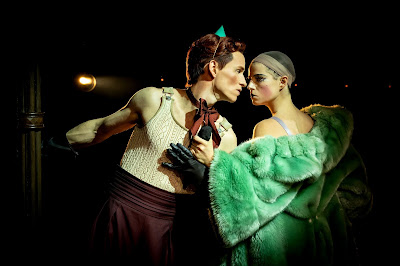
Eddie Redmayne and Jessie Buckley


In a remarkable transfiguration, London's Playhouse Theatre is ingeniously transformed by designer Tom Scutt to an in-the-round setting which after an equally imaginative pre-show mise en scene, goes a long way to transporting the audience to Berlin’s Kit Kat Club, the home of the show’s eponymous cabaret.

Rebecca Frecknall’s interpretation offers a bold take on the Kander & Ebb classic. The cabaret girls (“each and every one, a virgin”) are a chic metrosexual bunch, cleverly mixing 2021’s androgyny with Berlin’s famed inter-war decadence. The Kit Kat Club of course is a dive and rising from its deepest depths is the exquisitely ghastly Emcee, played in this iteration by Eddie Redmayne.

Cabaret’s Emcee is one of the most ingenious creations of late 20th century musical theatre. Almost like a Greek Chorus, or Lear’s Fool, he holds up a mirror to the Club’s audience (literally, in this staging, the theatre audience), parodying the hopes of the outside world (“Life is disappointing? Forget it”) while equally mocking the rise of Nazism and the persecution of the Jews. As Redmayne delivers If You Could See Her, the brutality of his satire chills to the bone. The actor is a tour de force throughout the piece such that when he is at times mute in the Finale, it only adds to the horrors that Germany as a nation will soon descend into.

Opposite the Kit Kat Club’s Emcee is of course the English cabaret artiste Sally Bowles. Jessie Buckley is sensational in her take on Bowles, bringing an understated haunting to the role. In her opening number Don’t Tell Mama, Buckley stuns with a polished insouciance that has the Kit Kat Club cheering for more. By the time the show is done however, and her Sally has both witnessed and experienced tragedy, Buckley’s take on the title number is breathtaking. Not for her the Broadway bravado of the song that one may perhaps associate with Liza Minnelli - rather, a delivery of Kander & Ebb’s signature tune that shows the singer to be broken and vulnerable. It is a stunning realisation of the song that shocks both in its despair and in quite how powerfully Buckley inverts the number’s traditional style into something far more poignant and haunting. I doubt that there will be a stronger performance to be found on London’s musical theatre scene for quite some time.

Redmayne and Buckley are surrounded by talent. Omari Douglas’ Clifford Bradshaw, a naĂŻf to Berlin and the foil to the story’s piercing arc is assured and credible in his role. When late in the second act he is beaten up by Nazi thugs, there is a multi-faceted angle to the hate that he is subject to. Liza Sadovy as Fraulein Schneider, Berlin’s world-weary landlady, is gifted a number of musical opportunities, in which she shines, and her story too offers a sad wry glimpse into the country’s looming thunderstorm of fascism.

Fraulein Schneider’s two other tenants are the Jewish grocer Herr Schultz (Elliot Levey) and prostitute Fraulein Kost (Anna-Jane Casey).  Kander, Ebb and Joe Masteroff had a challenge in writing Schultz - as they sought to capture his pride in his German citizenship alongside his love for Schneider, while at all times keeping him wilfully blind to how the fate of German Jewry was to play out. It would have been easy to make Schultz a more soft and sentimental sop, but he is written (and here, played) perceptively, such that his future murder, that as a Jew he will likely face, plays out only in our minds, rather than on stage.

Casey is magnificent as Fraulein Kost, a small character who so skilfully depicts both Berlin’s depravity and its desperation. The gusto with which Kost joins in with Tomorrow is one of the most outstandingly simple depictions of the appeal of Hitler’s National Socialism to much of the German population.

Stewart Clarke’s Ernst Ludwig is the musical's face of Nazism, with Clarke cleverly capturing the ugliness of his role, at all times avoiding cliche and melodrama. As he leads the end of the first act with Tomorrow, it is a chastened and shocked audience that head out for their interval beers and ice-creams.

Jennifer Whyte’s musical direction of her 9-piece orchestra that boldly spans the auditorium is adroit, with Kander’s melodies being richly served. All her musicians are magnificent, but the guitar/banjo work from Sarah Freestone together with Matt French’s percussion are particularly distinctive and memorable.

With antisemitism again manifest on the streets of London, Cabaret has never been more relevant.


Booking until 1st October 2022
Photo credit: Marc Brenner