Tuesday, 18 October 2022

Local Hero - Review

Minerva Theatre, Chichester


****


Music & Lyrics by Mark Knopfler
Book by David Greig
Based on the Bill Forsyth film


Hilton McRae

The twentieth century gave us few finer rock musicians than Mark Knopfler, whose talent both as a writer and guitarist place him as one of the UK's greats. In 1983 Knopfler wrote the score for Bill Forsyth’s BAFTA-winning film Local Hero and he has now now taken those themes penned some fourty years ago, weaving them into a musical based upon the movie.

Local Hero is a whimsical tale of humanity and the cosmos set amidst the Scottish Highlands. Offshore oil was big business for Scotland in the 70s and 80s and Forsyth’s story focussed on a Houston based oil corporation sending out Mac, a high-powered executive, to acquire the coastal village of Ferness together with its beach for the purposes of constructing a refinery. Mac arrives amongst the canny villagers who are quick to sense the fortune that may be coming their way, and in an era that long pre-dated the internet or even mobile phones, one of the story’s most cosily comforting images is the village's old red telephone box on the beach that proves Mac’s only way of privately communicating with his USA Head Office. Of course the plans do not proceed as anticipated – love, charm and a respect for nature and the stars combine to chart a course that leads to an unexpected but decisively happy and inspiring ending.

Broadway's Tony-winner Gabriel Ebert makes his UK debut in the role of Mac. His is a performance of charm and assured voice, completely believable as the Texan city-slicker who falls for the beauty of Ferness' remote idyll. Opposite Mac is Paul Higgins as Gordon, the village’s pub-landlord cum accountant cum lawyer, who is appointed to negotiate with the oilman and strike the best deal possible. The musical’s triangular love interest comes from Lillie Flynn’s Stella who forges an emotional connection with both men. Arguably stealing the show however is Hilton McRae’s beachcomber Ben, whose encyclopaedic knowledge of the stars in the Scottish skies serves to bring together the narrative’s various strands.

Daniel Evans directs a sensitive ensemble piece from his company which is only enhanced by Frankie Bradshaw’s set design that ingeniously transforms into a sandy, pebble-strewn beach. Ash J Woodward offers up video projections that strive to create the aurora borealis in deepest West Sussex – an effect that relies heavily upon the audience’s ability to imagine the Northern Lights.  

The production's star of course is unquestionably Mark Knopfler’s rich score. His original movie soundtrack offered up a raft of melodies, most of which have been fused into the stage show and it is a mark of the man’s talent that he has been able to create so many songs from these gaelic and celtic themes. The music is powerful, stirring and fresh, containing a heady mix of beautiful balladry and rousing numbers written for guitars and violin. That musical director Richard John’s seven piece band contains no less than three guitarists speaks to Knopfler’s love affair with strings.

This is a show built around Knopfler’s love for Local Hero, itself one of the finest British movies. It makes for an evening of charming, gorgeous theatre.


Runs until 19th November
Photo credit: Manuel Harlan

Friday, 14 October 2022

Good - Review

Harold Pinter Theatre, London


***


Written by C.P.Taylor
Directed by Dominic Cooke


David Tennant


The moral narrative that underlies Good is as sound as its title. David Tennant drives the piece as Halder, CP Taylor’s German gentile protagonist, an academic, who we see from 1933 through to 1941 being slowly seduced by and drawn into the Nazi machine.

Tennant’s performance is outstanding and the glimpses of ordinary mundanity that he offers, as at first he disbelieves and then ultimately succumbs to Hitler’s horrific ideology are fine acting. Taylor’s writing however vacillates between the discombobulating psychodrama of the first act, and a second half that sensationalises horror over dramatic structure  As Halder implausibly shins the greasy pole of the Nazi machine, over the course of an hour or so Taylor takes us on a whistle-stop tour of the Holocaust that starts with book-burning, moves on to Kristallnacht and ends with a grim finality at Auschwitz. Taylor even includes some conversations between Halder and Adolf Eichmann, just in case the audience hadn’t got the message.

The noble strength of the play is its argument that all it took in Germany was for “good” people to essentially enable Hitler’s horrors and allow the fomenting of antisemitism along with a euthanising contempt for the elderly and infirm.

The flaws of the play – or possibly this specific production – are the bewildering multi-roles foisted upon Tennant’s two fellow actors Elliot Levey and Sharon Small. Levey (himself only recently out of the excellent Cabaret that charts subtly yet brilliantly the Nazis’ rise to power) plays Maurice, Halder’s Jewish doctor friend. There is sound work from Levey, but there was little on-stage credible chemistry of friendship between the pair. And whenever a strand of consistency was developed, it was instantly shattered as the penny-pinching producers swapped Levey into yet another role.

Equally Small, who has to tackle the triumvirate of Halder’s mother, wife and lover as well as a senior male official in the SS fails to suspend our disbelief with so many confusing facets to her onstage work. When late in the second half, and in the role of Halder’s lover, she complements Halder on looking so handsome in his SS uniform, the line is as expected as it is cliched.

Fans of David Tennant will not be disappointed. 

Runs until 24th December
Photo credit: Johan Persson

Tuesday, 11 October 2022

The Crucible - Review

National Theatre, London


*****


Written by Arthur Miller
Directed by Lyndsey Turner


Erin Doherty and cast of The Crucible

Arthur Miller's The Crucible was penned in 1953 as an allegory to Senator Joe McCarthy’s House Un-American Activities Committee. Miller’s work is horrifically exquisite as his drama meticulously dissects the history of the Salem witch-hunts of the late seventeenth century. This stain on the history of the pre-United States saw a toxic confluence of church and government in which the word of children, accusing their elders of witchcraft, grew into an almost unstoppable untruth in the communities of the Massachusetts Bay Colony. Based on these allegations of sorcery, 19 adults were hanged, countless others imprisoned and it was not until some 20 years later that government compensation was awarded to the families of those executed or convicted. 

Miller proves himself to be not just a historian, but as this website has long recognised, a dramatist whose understanding of the human condition is virtually unmatched. Much like Shakespeare, he can offer an analysis of events that may well be hundreds of years old and give them a context that is not just timeless, but timely and chillingly relevant.

Lyndsey Turner directs a show that presents the subsidised National Theatre at its very best, with lavish production values. This is what Arts Council money should be spent on: brilliant (albeit vintage) writing; imaginative stagecraft and a luxuriously massive cast list.  Entering the auditorium Es Devlin’s stark, striking staging sets the scene with the Olivier’s magnificent thrust boxed in on three sides by a curtain of cascading water and for the thousand or so souls in the audience, there will be at least a thousand different interpretations as to what this deluge of a mise-en-scene suggests. My take on this shower-curtain is to see it as the most transient of barriers between us and history. It appears tangible but is in an instant, permeable – a powerful suggestion that there is in fact no difference between a terrible history and the world of today.

Brendan Cowell leads as John Proctor, a noble yet flawed citizen who resists the accusations of the children, calling it out for what it is. Proctor is a striking character, saintly in his principles and courage yet profoundly and fallibly human too. The detailed, complex crafting of his relationship with wife Elizabeth (Eileen Walsh) defines Miller’s writing genius.

Another gem of characterization is in Karl Johnson’s take on the curmudgeonly, upright, elderly Giles Corey, with Johnson winning our love for the defiance he displays in the face of the madness enveloping his community. Erin Doherty plays the young Abigail Williams, her excellent performance reminding us that evil actually lies not in the Devil, but in mankind. 

There isn’t a weak link in the entire cast. Rachelle Diedericks as Mary Warren has us rooting for her as she strives to swim against the tide of her peers. Nick Fletcher’s Reverend Parris defines the odious hypocrisy so often found in the clergy while Matthew Marsh as Deputy Governor Danforth, effectively the supreme head of the local judiciary is equally, marvellously, malignant in his role. Credit too to the remarkable Nathan Amzi who, in an understudy step-up so last minute that the National Theatre (disgracefully) failed to inform the audience of the cast change, played Reverend Hale so well that it was not until studying the programme later that one realised that there had been a cast change. Hale is a complex character, starting off as a “bad-guy” inquisitor who goes on to find redemption in the second act and Amzi commands our sympathies throughout.

Paul Arditti’s sound design and Tim Lutkin’s ingenious lighting plots combine to make the sensory experience of the evening nothing less than immaculate.

Many of today’s writers would do well to study Miller’s work. There is not a sloppy sentence to be found in the text and amidst much modern mediocrity, it is a breath of cold, sobering air to be presented with such genius. McCarthyism and its accompanying mob-terror may have inspired Miller, but it is a tragedy of our times that his words are so relevant in today's era of polarising culture wars and internet-fuelled cancel culture. Much as it took immense moral courage for John Proctor to face his own destiny, so too can we see modern-day heroes bravely weathering the slings and arrows of outraged, vile opposition. 

The Crucible is unmissable theatre for everyone. 


Runs until 5th November and screening live via NT Live on Thursday 26 January2023
Photo credit: Johan Persson

Friday, 7 October 2022

Noises Off - Review

Richmond Theatre, London


*****


Written by Michael Frayn
Directed by Lindsay Posner


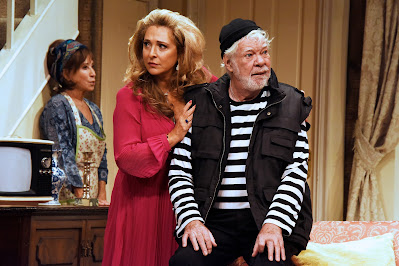
Felicity Kendal, Tracy-Ann Oberman and Matthew Kelly

Every now and then the planets align to create a production of sheer theatrical genius. So it is with Lindsay Posner’s touring take on Noises Off, currently playing at the Richmond Theatre.

Firstly, the script. Michael Frayn’s farce, penned 40 years ago, is a work of meticulous accuracy as it lays down gags, plots, sub-plots and nuance as we follow a touring theatre company rehearsing and performing the play-within-a-play Nothing On, around which the narrative plays out. Without ever resorting to corniness, Frayn mines the traditional farcical components of slamming doors, trousers around ankles and plot-lines of delicious sauciness. But its not just that Frayn’s text make us laugh, it is that he also offers a witty and at times poignant critique of the human condition – from the frailty of ageing through to alcohol addiction. No word of the script is wasted in the show’s three acts that treat the audience to whirlwind tours backstage and front of house as the plot’s calamitous events unfold.

Next up, the direction. Lindsay Posner has a visionary talent who understands the structure of each of the shows countless laughlines. Posner has form with the play, having directed the Old Vic production in 2011 and it shows. This production is slick, seamless and lifts the audience with its brilliance.

Finally, the cast, and Posner has been gifted a platinum-plated company to work with. The show’s seven key roles (the six characters of Nothing On together with that show’s director) include some of the nation’s finest comic pedigree - and in Noises Off there is no real star. The play only stands on the strengths of its company working as a team, and this team is strong. Felicity Kendal, Tracy-Ann Oberman, Matthew Kelly, Alexander Hanson, Joseph Millson, Jonathan Coy and Sasha Frost are all sublime in their roles that span a raft of characters aged from 70-something through to a glamourous starlet in her 20s. Their timing is honed to split-second accuracy and it is a credit to both actors and director that the show’s physical comedy, that in lesser hands could just be a ridiculous and clumsy distraction, is here delivered to side-splitting perfection. Pepter Lunkuse and Hubert Burton complete the cast list as the stage management team of Nothing On and though less accomplished than the show’s bigger beasts, are equally faultless in their work.

After Richmond, Noises Off heads off to Brighton and then Cambridge. Don’t miss it!


Runs until October 15th, then tours
Photo credit: Nobby Clark

Friday, 30 September 2022

Jews. In Their Own Words - Review

Royal Court Theatre, London


**


Written by Jonathan Freedland
From an idea by Tracy-Ann Oberman
Co-created by Vicky Featherstone, Tracy-Ann Oberman & Audrey Sheffield
Co-directed by Vicky Featherstone & Audrey Sheffield


The company of Jews.In Their Own Words

Jonathan Freedland’s verbatim play Jews. In Their Own Words sees a company of seven actors perform a hundred minute one-act verbatim drama that has been drawn from the words of twelve British Jews interviewed by Freedland earlier this year. It is their true stories that form the framework for much of this play that seeks to examine the history and present state of antisemitism.

The play is born from the Royal Court’s own troubled relationship with Jews. Smarting from being caught out over the stereotypical naming of a villainous billionaire in the Court’s 2021 production of Rare Earth Mettle (a non-Jewish character curiously named Hershel Fink, an admitted lapse that the Court blamed on “unconscious bias” before renaming the character as Henry Finn) Freedland was swiftly hired by the theatre to expiate their sins, taking Tracy Ann-Oberman’s original idea and setting it to paper.

The dozen interviewees who include politicians Dame Margaret Hodge (played by Debbie Chazen) and Luciana Berger (Louisa Clein) all brought sound testimony, some of it terrifyingly mundane in the racism they spoke of and much of it harrowing. What these individuals have suffered and endured is not to be criticised at all. It is however Freedland’s stitching together of their stories that has created a flawed play.

The flaws lie in the structure of the piece that at times relies too heavily on exposition, lacking dramatic initiative. The historical depictions of the tragedies of York and Lincoln are treated with a patronizing simplicity that diminishes their horror and equally, a musical number that pops up half-way through the work is both incongruous and childish. If one is going to satirise Jews on stage and in song then recognise that both Monty Python and Mel Brooks have done it before, to perfection. Freedland’s verse pales in comparison.

And then there are the glaring omissions and bias of Freedland’s work in a play that may have been better titled Some Jews. In Their Own Words. Those of his original twelve whose political stance was known, were all from the Left. It may well be the Labour Party that has had to challenge its own problems with antisemitism, but in excluding Jews from the other shades of our political spectrum, where was the balance? The clumsy and dangerous impression that has been created here is that political antisemitism only exists on the Left.

Where was the reference to the ghastly, commonplace antisemitism that so many Jewish students face on campus today? And where was any reference at all to the vile antisemitism that sees frequent calls for the destruction of the State Of Israel and which was so clearly thrown into relief last year, with calls in London for the murder of Jews and the rape of Jewish women? 

Notwithstanding Hodge’s remarkable and tragic personal history, where was there any argument to counter her harsh criticism of modern Israel? By all means let Dame Margaret have her opinion, but for Freedland to have omitted any balanced debate on current Israeli policies simply letting Hodge’s criticisms stand as an unquestioned truth, could be charitably described as his own unconscious bias. Others may call it a useful idiocy.

There has to be a good play waiting to emerge from Oberman’s original idea. This isn’t it.


Runs until 22nd October
Photo credit: Manuel Harlan

Thursday, 8 September 2022

Rehab The Musical - Review

Playground Theatre, London


*****


Music & lyrics by Grant Black and Murray Lachlan Young
Book by Elliot Davis
Directed & choreographed by Gary Lloyd


Keith Allen


Rehab is one of those rare finds in the world of new musical theatre writing. A strong story, supporting stunning songs, brilliantly performed and all expertly directed.

In a story that’s drawn from writers Grant Black and Murray Lachlan Young’s personal mental health journeys, Jonny Labey plays Kid Pop, a rock star at the height of fame who gets papped doing a line of coke and is promptly sentenced to 60 days rehab at The Glade. Pop’s journey from denial to recovery is subtly yet brilliantly defined, alongside 3 other patients, with songs defining their respective addictions and flaws that capture a wryness of wit, honesty and humour and which show sensitive perception from both writers and performers.

The Glade of course is a supposedly safe and therapeutic place. Outside the clinic’s confines blows the cruel winds of the paparazzi and the media, with the villain of the piece, PR guru Malcolm Stone wonderfully defined by Keith Allen, delivering what has to be the greatest tribute act to Max Clifford ever. Pop is Stone’s client, with the PR man concocting vile and corrupt manipulations (no spoilers here) to keep his client in the headlines. As part of Stone’s deviousness he recruits Lucy Blake, a young mum who’s down on her luck (played wonderfully by Gloria Onitiri), as a honey-trap, paying her to check herself into The Glade. Onitiri has a magnificent presence and she takes the roof of the Playground with her second act number Museum of Loss

There are moments of musical theatre magic - and literal cheesiness - in the story that evolves, but such is the talent on display that the pathos evoked by the story is both credible and at times, deeply moving.

Supporting the story’s three principals are a cast that seamlessly segue in and out of various roles. John Barr as patient Barry Bronze, a man addicted to tanning is, as always, outstanding.  Phil Sealey as obsessive eater Phil Newman is equally compelling, while slightly more thinly-sketched is Annabel Giles’ Jane Killy. All of these three deliver top-notch musical theatre work, not least in their introductory number At The Glade. There is also a fine turn from Dawn Buckland in two modest cameos, firstly as Phil’s wife, singing the haunting Still Here and later with a comic masterpiece as an oligarch’s wife.

Jodie Steele is another of the evening’s treats as Stone’s assistant Beth. With her number Die At Twenty Seven And You’ll Live Forever, Steele steals the show (almost) with her breathtaking power and passion.

Above all, Rehab displays a bold, brave verve and vigour. With songs that range from first-class duetted balladry in Two Broken People through to the stadium-powered Everyone’s Taking Cocaine, slick lyrics are melded with Gary Lloyd’s pinpoint choreography and precise direction. This is a show that has invested as much in its production values as in its libretto (take a bow designers for set, light and sound Andrew Exeter and Chris Whybrow respectively) with Simon Lee’s 4-piece band, hidden atop the stage, making gorgeous work of the exciting score.

Rehab is destined for a larger future. With its brave narrative, exciting score and a company that define musical theatre excellence, catch it in The Playground for an outstanding night out.


Runs until 17th September
Photo credit: Mark Senior

Friday, 2 September 2022

I, Joan - Review

Shakespeare's Globe, London


**


Written by Charlie Josephine
Directed by Ilinca Radulian

Reviewed by Isla Beckett


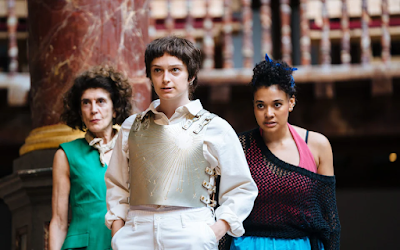
Isobel Thom and company

What would Shakespeare think? He wouldn’t, for that is the level of detail afforded by this play. Fancy that. Shakespeare stunned into silence in his very own theatre. O brave new world that has such mockery in it.

I, Joan is based on Joan of Arc’s life, one of the earliest documented feminists. Born in 1412 into poverty, she grew up possessed by a belief that she was channelling God. Convinced of her singularity, she requested a meeting with Charles VII of France, and the rest is history. Joan of Arc helped lead France to triumph against England, motivating a demoralised army and providing strategic input. She was later caught by the enemy and burned at the stake for heresy. Why? Joan reportedly had visions and experienced didactic voices in her head. The same as those that elevated her to the highest ranks of politics. In today’s world, she may have been classed as schizophrenic. In her era, she was deemed a witch. Adding fuel to the fire, she also wore men’s clothes in a defiant act of blasphemy. 

For all intents and purposes, Joan was unusual. Her history is rich and colourful, providing a wealth of material for an adaptation of her life. What a thrilling woman to explore. A walking contradiction. A fighter. A rebel. The skin of a lady with the heart of a man. Her vulnerabilities must’ve been fascinating. What a shame, then, that I, Joan deems it more appropriate to use this woman’s voice as a crass political megaphone. The fourth wall is frequently broken by Isobel Thom's Joan, with what follows being almost always a diatribe against pronouns and patriarchy. After a certain point this becomes tiresome, repetitive and pointless. In the unspoken background, Joan of Arc’s story is screaming to be told. We could learn more from her about gender equality than we ever could by being preached to here.

I, Joan crowbars the present into the past, forcing Joan’s narrative to be what it is not. Her tale is not one of complaint but of courage. Not one of bombastic opinion, but devotion to a cause. Joan did not proclaim herself a feminist, she lived the reality and died for it. So focused is the play on the narrator’s own personal beef with society that it falls flat in its depiction of a hero. For just under three hours, the play literally and metaphorically limps along. One has to admire the writer’s audacity for the constant gender-identity outbursts, couched in a plot that spends much of its time focused on a bunch of actors jiggling around the stage to simulate a 15th century war. A messy and uneven work, I, Joan suffers beneath the weight of two competing points of view. Ultimately, it is rendered characterless. Joan is a vessel for protest, but protest is not Joan. Protest does not stir the mind or the emotions. It does not have the capacity to haunt. As in life, in Charlie Josephine's play Joan does not get the justice she deserves.


Runs until 22nd October
Photo credit: Helen Murray